The rise in online shopping, cashless payments, and busy lifestyles has led to an increase in online purchases of medicine. People nowadays prefer to scan for medicines on a pharmacy website and buy them from the comfort of their homes. In fact, the global e-pharmacy market is forecasted to reach USD 324.67 billion by 2033. (Source- IMARC Group)
As this market expands, more and more businesses are launching their own online medical platforms, increasing competition and making it difficult to build a brand presence and achieve the desired results. To avoid this struggle, businesses can leverage paid media advertising and run medicine ads.
These ads, if thoughtfully designed and precisely targeted, can help healthcare brands achieve the results they crave through other marketing channels. Medicine ads can promote your health and wellness products, build brand awareness, gain trust, and even boost customer loyalty.
In this post, we will explore everything about medicine ads, including proven ad formats and strategies to maximize your ROI and grow your online medication business.
Create Your Pharma Brand Presence At The Right Time With 7SearchPPC!
Why do Users Prefer to Buy Medicines Online?
The surge in online medicine platforms over the past few years is due to the convenience, subscription refills, offers, and medication-tracking functionality they offer to users.
More users visit pharmacy websites and apps because they offer amazing benefits such as:
1. Convenience and Efficiency
Users don’t have to visit a physical store to buy medicines when they’re in pain or need urgent medical care. Online medicine apps are the perfect solution for busy professionals, elderly patients, and caregivers, as they can order medicines 24/7 from anywhere and have them delivered to their doorsteps. It saves their time and provides convenience.
2. Better Pricing and Discount Comparison
Due to the digital shift, it’s now possible to compare prices, discounts, promo codes, and cashback across multiple online pharmacies to get the best deals and reduce monthly medication expenses. It strengthens customer relationships and increases retention rates, as discounts directly support patients with chronic diseases.
Many online medical platforms offer substantial discounts on bulk purchases because customers feel happier and more satisfied, as they can save on medical bills.
3. Subscription Refills
Several pharmacy websites and apps provide automatic refill programs, also known as subscription refill plans, to help patients prevent running out of their essential medicines.
If patients choose a subscription refill plan, the e-pharmacy prepares their chronic medications in advance as the due dates approach and delivers them to their doorstep, without requiring them to place a new order each time.
Some even provide one-click reorder functionality to simplify checkout, boost conversions, and reduce customer retention costs.
4. Safe Digital Payments & Tracking
Digital nomads prefer cashless payments and a smooth checkout process when buying medicines online. Online pharmacies provide UPI and Wallet transactions, along with other digital payment methods, and real-time tracking to help patients monitor their medicines and ease delivery concerns.
5. Wider Availability of OTC and Wellness Items
Access to OTC and wellness products such as pain relievers, cough syrup, cold medicines, vitamins, and immunity boosters that aren’t available in physical stores.
[Over-the-counter (OTC) medicines are antidotes that can be purchased without a doctor’s prescription for self-treating common ailments.]
6. Privacy for Sensitive Product Categories
Patients often feel discomfort while buying sensitive medications, such as sexual wellness, mental health, and skin concerns, and prefer to have them without face-to-face interaction. Digital pharmacies ensure private and secure packing and delivery of such products.
7. Platforms Offer Quick Teleconsultation
Online medical platforms offer in-app doctor’s appointments and consultations, letting users consult doctors online for acute to chronic health concerns without waiting in long queues. It helps users get digital prescriptions instantly and speeds up the diagnosis-to-purchase process.
Buyers trust online pharmacies because they highlight genuine sourcing, batch numbers, reviews, cold-chain handling, and fast delivery. These factors have encouraged digital consumers to install pharmacy apps or sign up on medical websites.
Diagnosing Healthcare Advertising Challenges: The Prescription for Success with 7SearchPPC
Why Do Medicine Ads Deliver Stronger Conversions in 2026?
Users are already interested in buying medicine online. You only need to make your brand more visible and easier to recall through your e-pharmacy ads. Below, we’ll show you why online medicine advertising is the #1 customer acquisition method and how it drives more conversions than traditional advertising and other digital strategies.
1.Users Already Know What They Need
When users search for queries like:
- Is cough syrup available today?
- Where to buy cold & flu medicine right now.
- Blood pressure tablets are in stock now.
- Asthma inhaler in stock today.
- Pharmacy with same-day delivery in stock.
- Painkillers are available near me.
- Urgent medicine availability near [Mall/Hospital]
- Medicine is now available near the airport/station.
They already know what they want to buy. They’re either in need of immediate medication, need it for a friend or family member, or already have a prescription. They search online to find where the medication is available for purchase.
All these search queries have high intent, which shortens the customer journey and turns it into a search -> click -> purchase path. The rise of search-to-purchase journeys makes it easier to convert users through online pharmacy ads.
Here, users aren’t interested in educational ad content. They just want to compare prices, reviews, discounts, stock availability, and delivery rates.
Pharma advertisers who promote medicine online using the pay-per-click advertising model with keywords like “In Stock & Fast Delivery”, “Talk to a Pharmacist”, and “Same-day Delivery with Reasonable Discounts” easily convert qualified patients for their healthcare business.
Tip: Learn more about PPC strategies for healthcare and web pharmacy to effectively boost your visibility among high-intent medicine buyers and lower your CPC and CPA.
2. Easier to Retarget Users Based on Their Actions
Retargeting medicine ads boosts repeat purchases and customer lifetime value. You can easily segment users by their actions on your website or app to create medication ads that are relevant to their intent.
You can create retargeting pharmacy ads, such as:
- Post Order Pharma Ads: Medical businesses can create reminder ads for chronic medication refills or general health and wellness products that users have previously purchased.
- Cart Abandonment Ads: Pharma advertisers can retarget cart abandoners with simple offers like “price drop-off,” “apply coupon MED125,” or “free shipping,” and create urgency with messages like “limited stock” or “sale ends at midnight.”
- Upsell and Cross-sell Drug Ads: You can suggest relevant add-ons such as “Cold tablets → Nasal spray/saline drops,” “Constipation meds → Fiber supplements,” “Diabetes tablets → Test strips & lancets,” or “Allergy eye drops → Protective eyewear” to increase the average order value of remaining products and inform users about beneficial medical items.
You can make your medicine ads more personalized by addressing your users directly, such as “Hey, Helly. A reminder about your Diabetes Meds Refill. Re-order in one click so you don’t miss your dose!” Add personalization to retargeting ads not only to drive conversions but also to foster a relationship with users that’s not possible with generic promotions.
3. Easier to Highlight the Perks
Patients prefer home delivery, remote consultations, one-click refills, and digital prescriptions instead of waiting in long clinic lines.
Pharma advertisers can easily showcase the benefits they offer on their platform, such as 24/7 doorstep delivery, consultations with experienced doctors, and weekly healthcare educational content, through digital ads to meet user demand.
All these reasons make paid medicine advertising the best digital strategy for customer acquisition.
How to Create High-ROI Medicine Ads for Your Online Pharmacy Brand
Outline your health and wellness brand goals, target audience, branding elements, top-performing SEO keywords, and ad formats to start advertising your healthcare products and capture your audience attention towards your brand.
1. Define Your Pharmacy Business Objectives
To make your online pharmacy advertising effective and conversion-oriented, first, outline the primary goals you want to achieve. Do you want to increase awareness to build local and online presence, establish trust with your ad message, boost repeat purchases through discounts or refill subscriptions, increase app installs via mobile optimization, or enhance brand recall by offering 24/7 medicine delivery?
Advice: Don’t rush when outlining your objectives; the clearer you define your goals, the better results you’ll get from your online pharmacy campaigns.
2. Understand and Segment Your Buyer Intent
The consumer base for e-pharmacy is diverse—identify who you really want to target, understand their intent, and segment them by behavior and interests to craft relevant ads for medicines.
The primary audience for healthcare and medicine brands includes the following:
- Patients who need immediate medications.
- Caregivers and healthcare professionals who want to provide better care, facilities, and promote their medical services.
- The elderly and local residents who seek to save time and add convenience.
- Health-conscious users who look for everyday health and wellness products.
- Before moving forward, identify your ideal audience whom you really want to target with your medicine ads.
Advice: Create user personas to better understand your target audience’s demographics, geographic location, search intent, pain points, interests, and behaviors. Once you’ve gathered all the basic details, start mapping buyer intent across each customer funnel to deliver ad messages that have the highest likelihood to convert at the right moment.
| Customer Funnel Stage | Buyer Intent | Search Queries | Goal |
| Awareness Stage | Users are exploring the root cause of their experience or general health tips. |
| Build trust and credibility with your information pack content and make your audience rely on your brand for their health concerns. |
| Consideration Stage | Users are comparing prices, discounts, flexibility, reviews, and ratings of different pharma brands. |
| Position your online medicine brands as the most reliable, safest, and cost-effective brands compared to your competitors. |
| Decision Stage | Users have decided on the medical solution they want to consume. |
| Perform precise targeting to maximize conversions. |
| Retention Stage | Customers want to refill their medications or need mandatory precautions to avoid allergies and infections after medical treatment. |
| Retarget existing customers with personalized medicine ads to turn them into brand promoters. |
This will also help you select the right ad format to promote medicines online. Different audiences have different needs; choosing ad formats based on their demographic information helps you close more profitable deals.
3. Create Compliant-Friendly Medicine Ad Copy
Pharma advertising platforms have strict laws and regulations that must be followed to access the platform’s features and benefits. This is all done to create a safe, secure digital healthcare environment that protects users’ personal information and prevents fake claims and the promotion of restricted medicines.
In addition to the standard ad platform policies, pharma advertisers must adhere to local and regional advertising policies and regulatory guidelines.
Practice the following rules to create compliant-friendly ad copy for your digital medicine advertisements.
- Never offer a diagnosis or medical advice without a legitimate medical certificate.
- Avoid terms like “magical cure,” “guaranteed recovery,” “instant cure,” “100% success rate,” “best treatment,” “superior doctors,” or any absolute claims such as “have these medicines, and you’ll have hair like Tom Cruise.”
- Never recommend restricted product categories or advertise in prohibited geographical areas.
- Always review local and regional laws and regulations.
As a pharma advertiser, you must review local and regional laws to ensure your medication advertisements comply, as the promotion of certain medicines and treatments is prohibited and cannot be advertised at all.
If the healthcare ad platform finds out you’re violating general or platform-specific medicine advertising guidelines, they can permanently freeze your pharma advertiser account, and you won’t be able to reactivate it until you successfully appeal.
Follow all ethical guidelines when promoting medical products online to ensure transparency, build trust, and present yourself as a verified medical brand that users worldwide can trust.
Advice: Create compliant-friendly ad headlines such as “Safe & Approved Medicines Online,” “Doctor-Prescribed Medicines Delivered,” “Trusted Pharmacy for Everyday Health Needs,” and “Order Prescription Medicines Securely.”
4. Research and Analyze High-Intent Keywords
Identify the customer funnel you want to target, then choose keywords that are more relevant to your audience and help achieve your goal—traffic, leads, or sales.
List all relevant seed keywords (keywords that are directly related to your product or health topic you want to promote) for your medicine advertisements, such as “buy medicine online,” “pain relief tablets,” “diabetes medicines,” and “cough syrup.”
Use popular keyword research tools like Ubersuggest and KeywordTool.io to identify search volume, CPC, competition, keyword difficulty, and search trends to select high-converting keywords for your medicine campaigns.
Don’t limit your paid ad keyword research to these tools; expand your search with Google Autocomplete, People Also Ask, and Related Searches.

Target and bid on informative, high-intent, branded, and location-based keywords with moderate search volume and competition to lower your CPC.
Create a keyword spreadsheet to filter out unnecessary keywords and set priorities based on your healthcare advertising strategy. Group similar keywords to avoid keyword cannibalization, and use them in your landing pages to stay aligned with the intent and relevance of your ad messages and webpages.
5. Use Storytelling and Emotional Connection
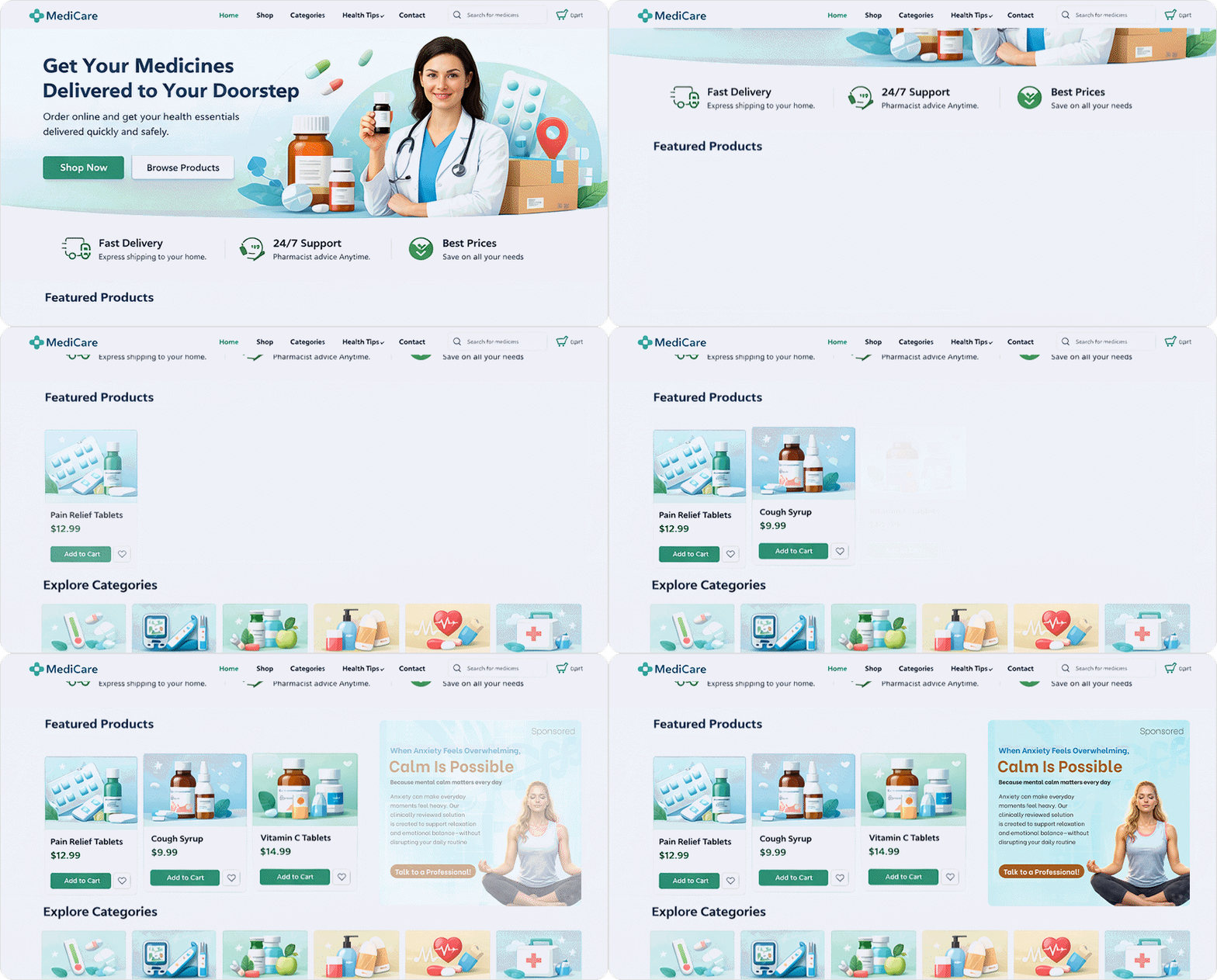
This ad message normalizes anxiety, reduces stigma, and builds emotional trust. Here, we aren’t selling anxiety pills directly; we’re trying to connect with human emotion.
Medicine ads that connect with patients’ emotions and use storytelling convert far better than generic or sales-oriented pharma advertisements.
Smart storytelling shows how life feels like before and after medication, without promoting fear; instead, it focuses on wellness, personal health, and the hope of a better lifestyle and health.
To create powerful storytelling in online medicine ads:
- Use narratives and create the ad around your patients, not your medical products or brand. Pivot the attention to the real-life challenges patients face and how life feels after treatment, rather than medicine promotion, such as daily struggles before diagnosis, anxiety during treatment, and relief and confidence patients experience after recovery.
- Make medicine ads more relatable by using this structure in your storytelling—problem, solution, life changes.
- Authenticate and make it more relatable by showing real users’ experiences.
- Visually represent before-and-after moments, family interactions, and happy faces to drive strong brand recall.
Tip: Use storytelling to raise users’ awareness about general health problems like breast cancer and attract their attention to wellness and fitness programs.
6. Personalize Ads to Engage Visitors
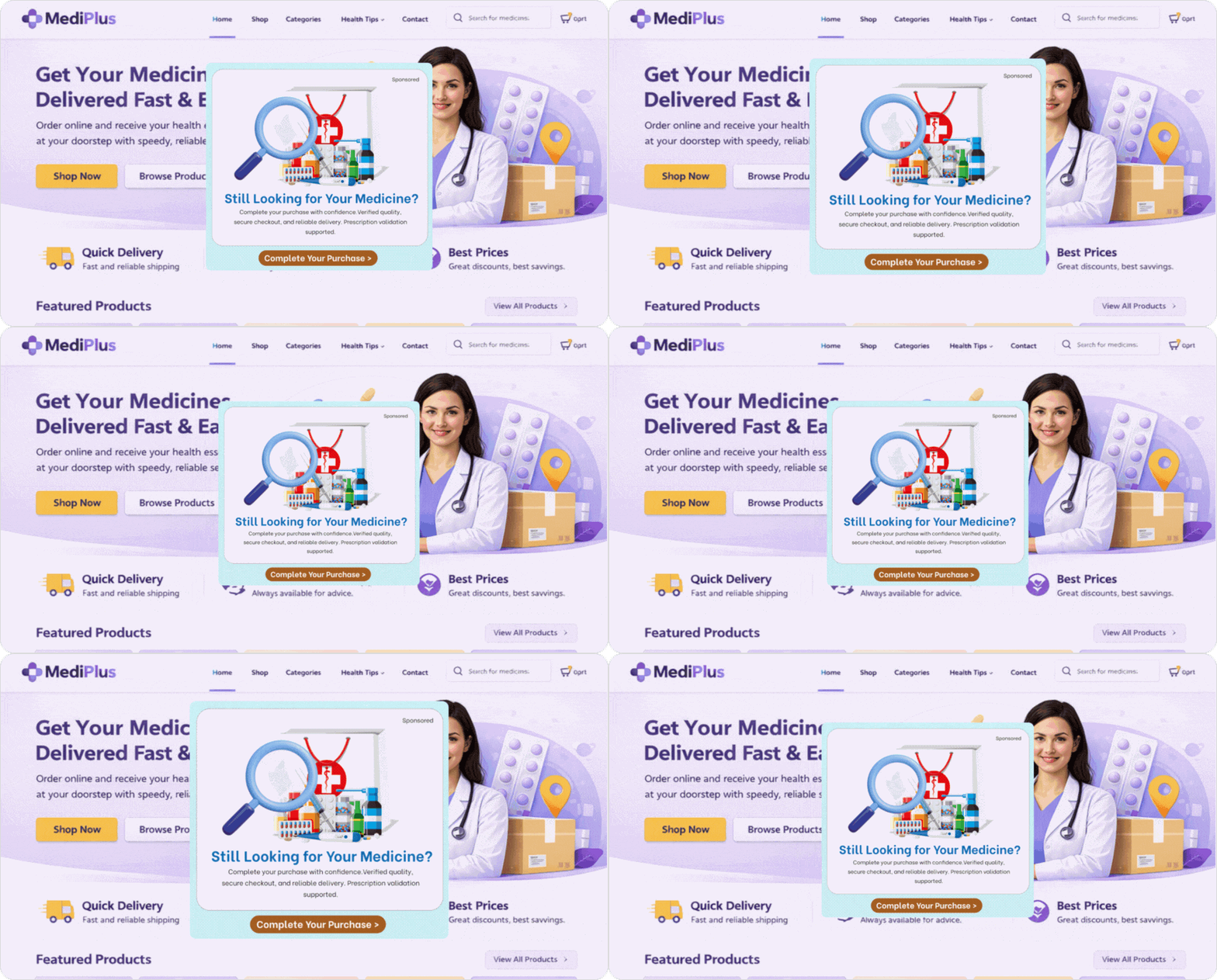
Add personalization by directly informing your existing customers about upcoming refill reminders, reminding them of their doctor’s appointment, or sharing high-quality health and wellness best practices to foster long-term relationships.
Personalized medicine ads work because of several reasons:
- Remind users about the medical products they have forgotten.
- Users were already searching for the same medical solution, so these medication ads have a higher CTR.
- Better ad spend because you’re showing ads to users who are already interested in the product.
To retarget users effectively, check the pages and medicines that users have visited or searched for. Personalize your retargeting ads by categories, customer funnel, and condition.
7. Use Smart Tools to Monitor and Optimize Medicine Ad Performance
Tools simplify tracking medicine ads that grab audience attention, generate clicks, and ultimately increase medicine sales. Some of the most used digital advertising tools for tracking and monitoring are Google Analytics, Unbounce, and RedTrack. Using these tools, it’s easier to analyze underperforming ads and stop their promotion in real time, so you can focus on campaigns that are delivering results.
You can increase bids on high-performing pharma campaigns to reach users at the right time and boost sales of medicines.
Identify your primary KPIs to measure the performance of your medicine ads effectively.
Main KPIs for Medicine Ads
Use these metrics to measure the performance of your pharma advertisements and optimize your ads based on the results obtained.
- Cost Per Click (CPC): The total amount paid for each click on your ad.
- Cost Per Mille (CPM): The total amount paid for every 1000 impressions.
- Click Through Rate (CTR): The percentage of users who clicked the pharma ad after viewing it.
- Cost Per Acquisition (CPA): The total cost paid to achieve the desired outcome (sale, sign-up, call, app install, or appointment scheduled).
- Customer Lifetime Value (CLTV): The total revenue generated from a customer over their lifetime.
- Cost Per Order (CPO): The total cost incurred to generate one complete order.
- Conversion Rate (CVR): The percentage of users who completed the desired action after clicking on medicine ads.
- Cost Per Install (CPI): The total cost spent to generate a successful app install.
- Repeat Purchase Rate: The percentage of customers who made repeat purchases over a given period of time.
These are the common metrics used to analyze the performance of medicine ads.
What are the Best Ad Formats to Craft Medicine Ads
Maximize your pharma advertising conversions with banner ads, search ads, in-page push ads, and feed ads.
Banner Ads
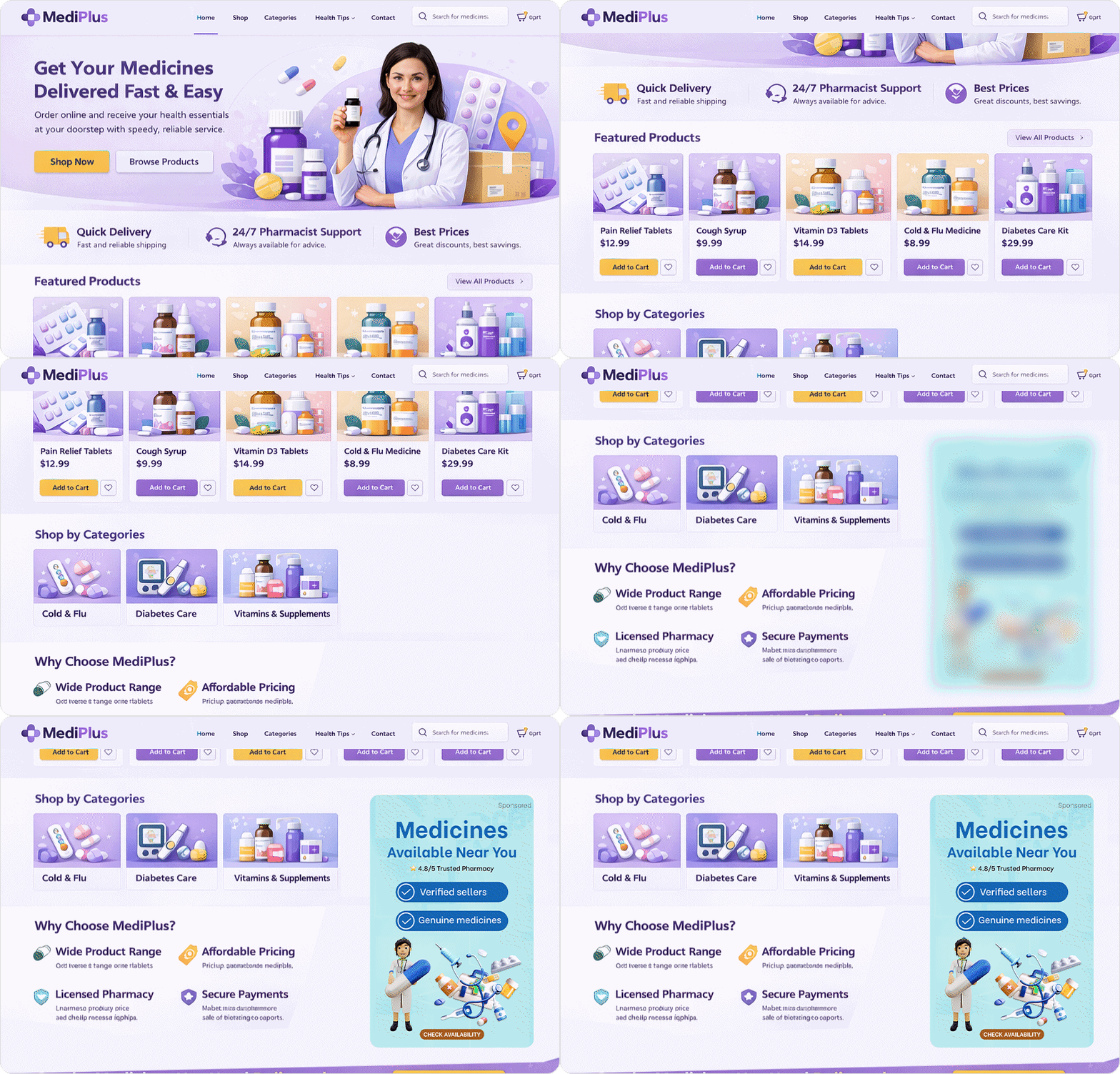
Banner ads have been the most consumed digital advertising format for decades. Banner ads feature intuitive ad creatives with a clear, concise message, often static or animated. These ads can be placed on websites or apps to capture users’ attention toward pharma products and supplements, raise health and wellness awareness, and guide users on how to protect against certain diseases.
Most Common Banner Ad Formats for Pharma Advertising
| Banner Size | Banner Type |
| 300×250 | Medium Rectangle |
| 728×90 | Leaderboard |
| 320×50 / 320×100 | Mobile Banner |
| 300×600 | Half Page |
| 250×250 | Square |
| 468×60 | Main Banner |
| 160×600 | Wide Skyscraper |
Banner ad sizes that complement pharma ad creatives and ad copies.
- Why banner ads work: Banner ads are easy to promote on health portals, pharmacy apps, and medical blogs. Pharma banner ads are ideal for creating awareness and promoting OTC, wellness, and chronic care medications.
- How to create the best pharma banner ads: Promote only one message—a key benefit—and emphasize it with creative and trust-building elements, such as a rating, logo, and a clear CTA like “check availability” or “order medicines online.”
Tip: Don’t confuse users with multiple messages in a single ad creative, as it creates confusion and makes it difficult for users to understand the real message.
In-page push ads
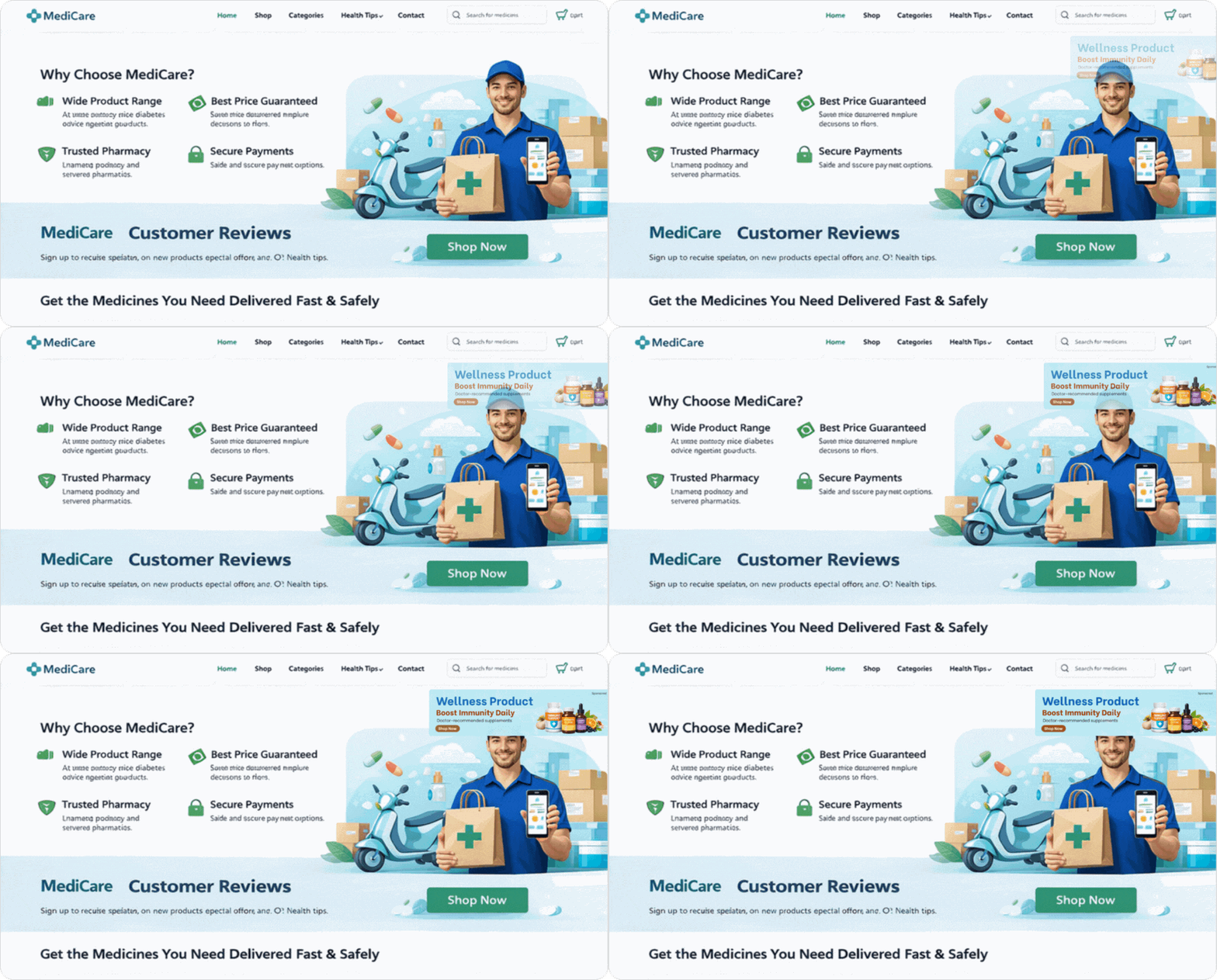
In-page push ads are similar to push notifications – the only difference is that in-page push ads appear within websites and apps, not on users’ device notification bars, and they don’t require permission to appear, helping pharma brands to capture more users’ attention.
- Why in-page push ads work: In-page push ads look less intrusive and don’t irritate users as most pop-up ads do. Ideal for mobile users who want to buy medicines online conveniently on their handheld devices.
- How to create the best pharma in-page push ads: Keep your ad copy short and clear so users can easily understand the message. Keep your ad title within 40 characters, your description within 60 characters, use a clear image, and include a CTA such as “Buy Online | Delivery Today.”
Tip: Integrate copywriting best practices and avoid creating lengthy ad messages.
Search Ads
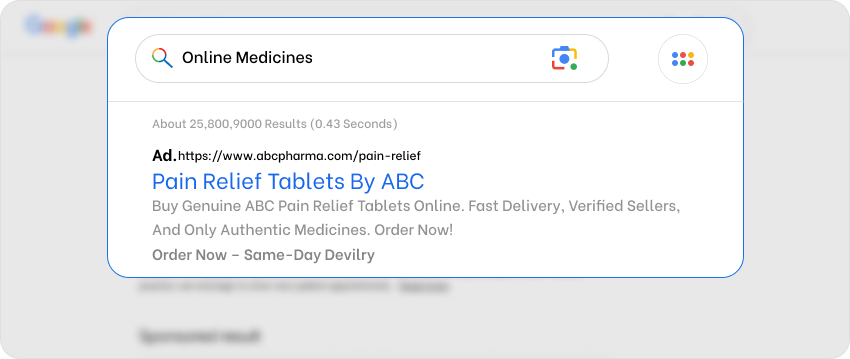
Search ads are a top-performing digital ad format that competes effectively with traditional advertising methods, including TV, radio, print, and direct mail.
Users search with the intent to learn about medications, compare brands and prices, and make purchases from a specific brand, such as “insulin injection near me”, “best cough syrup for adults [brand_name]”. These users have high intent to convert for a pharmaceutical company, making them the perfect audience.
Search ads are text-based ads without visuals. They include a headline, description, and destination URL, and appear in SERPs when users’ queries match the ad’s intent and relevance.
- Why search ads work: Your ads appear above the organic searches, making your pharmaceutical brand more noticeable and helping you achieve a higher CTR.
- How to create the best pharma search ads: Bid on high-intent keywords, incorporate related keywords into your headline and description, and try to make it action-oriented.
Tip: Identify branded keywords and conduct a keyword gap analysis to find the keywords your competitors are ranking, but you aren’t.
Feed Ads
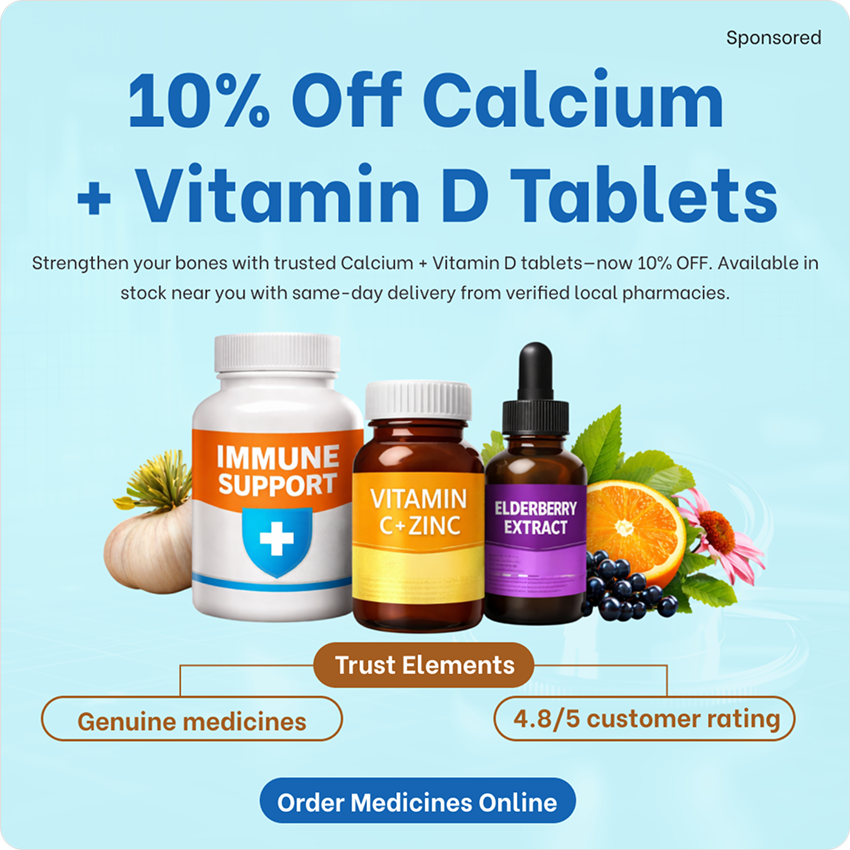
Feed ads blend seamlessly within the social ecosystem, allowing you to connect and increase brand awareness on the platforms where users spend most of their time.
- Why feed ads work: Feed ads appear non-disruptively inside users’ feeds on social media and news apps. They appear when users are scrolling through their feeds, capturing their attention, boosting user engagement, and improving CTR. Through feed ads, it is easier to lead users to product pages, pharma apps, or useful content.
- How to create the best pharma feed ads: Create feed ads considering the platform’s specifications and audience requirements.
Tip: Use visually appealing elements and colors to grab users’ attention instantly.
These are the most dependable and scalable ad formats for promoting medicine online. Use a mix of ad formats to increase reach and improve the performance of your healthcare and pharma ads.
How to Target High-Intent Buyers with Online Medicine Ads
Use smart audience-targeting strategies, including geographic location, device preferences, and search intent, to reach the right audience at the right time and drive conversions.
1. Create Geo-Targeted Pharmacy Ads for Faster Conversions
Users perform searches such as “nearest pharmacy” by distance, address, contact details, and operating hours. You can target users based on their current locations (search area), city, country, and region, to drive better ROI from your medicine advertisements.
How to create Geo-targeted pharmacy advertisements
- Create hyper-local medicine advertisements to target users within a small radius.
- Use CTAs such as click-to-call, directions, or instant-order options.
- Personalize your ad message for specific regions: Calcium + Vitamin D Tablets at 10% off in [city_name] for same-day delivery.
- Add local presence and familiarity to personalize medicine ads.
- Highlight “In stock near you” or “pharmacy address” to reduce users’ decision time.
Ensure you have sufficient stock to stay true to what you’ve mentioned in your ad messages. Disclaimer: Avoid promoting medicine ads when out of stock to maintain users’ trust and prevent wasted clicks on unavailable items.
2. Perform Device and Time-Focused Targeting
Use device and time-specific targeting to ensure your ads show when users are more likely to convert.
Device-Focused Targeting: Gather statistics from trustworthy sources and analyze your website data to select the right devices to advertise your pharmaceutical products. Desktops are used to perform detailed medication searches and compare prices, whereas smartphones are used to make calls and purchase on the go for immediate requirements.Some users search on desktops and make purchases on handheld devices.
Thus, it’s imperative to understand users’ behavior across devices to choose the right device to convert at the right time.This will also help you place bids on high-performing keywords for the device most likely to capture potential leads for your pharma business.
Tip: Optimize e-pharmacy ad creatives and copies to make them look flawless across different screens.
Time-Focused Targeting: Advertise your medications during the peak hours—early mornings, evenings, late nights, and off-hours—when users search more frequently for medical solutions. Create day-parting advertising strategies for festivals, sports events, and summer breaks to schedule and reach users when they are most active and ready to make purchases.
If you adjust your campaigns by day and time, you can stay within your ad budget and lower your bid amounts during low-intent hours to prevent wasting pharma ad spend.
Tip: Plan and schedule your pharmaceutical advertising campaigns for weekends, when demand for medicine increases.
3. Perform Contextual Targeting
Every search has an intent, and to match that intent and relevance, contextual targeting is used. It ensures your ads appear in front of an audience genuinely interested in your healthcare and wellness products.
Use keyword research tools to identify keywords that match your pharmacy brand and audience intent, and create keyword clusters to group similar keywords under one category to ensure you use all relevant keywords in your campaigns.
Identify branded, location-based, high-intent keywords, along with specific-medication keywords, to have enough high-performing keywords for your paid medical ads. Use LSI, related, and long-tail keywords with moderate search volume and lower CPC to maximize your pharmacy ad profits.
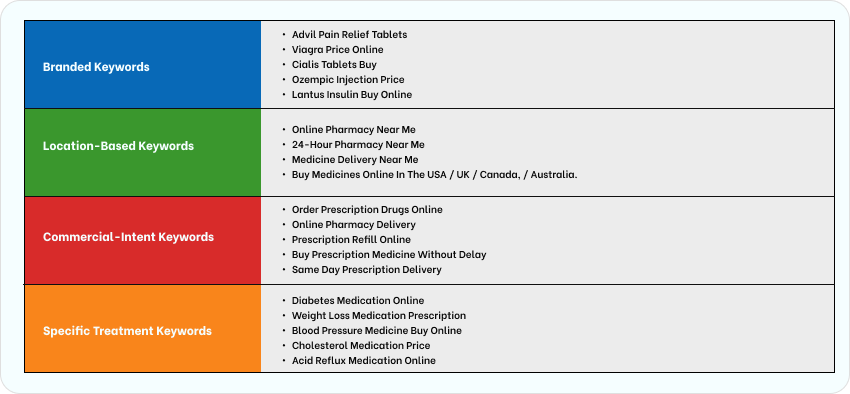
Benefits of contextual targeting
- Reaches users who are actively researching medical conditions or treatments.
- Ensures ad relevance without relying on personal data.
- Builds trust and awareness about the pharmacy brand at the moment.
- Easier to target seasonal illness keywords
- Craft symptom-driven ads that match patient intent
These keywords are highly competitive due to the immediate need, but they attract users closest to checkout, which ultimately reduces CPC.
Best-Performing Advertising Channels for Medicine Ads
To promote medicines online effectively, leverage top advertising channels, including ad platforms, social media, email marketing, and search engine marketing. These pharma advertising channels will help you boost the reach and conversion rates of your medicine ads.
Ad networks: Ad networks have aggregated premium ad spaces from leading web publishers, ready to promote your medicine ads to their audiences. Ad networks offer a user-friendly interface to streamline the creation of pharmaceutical ad campaigns, and robust tracking functionality provides real-time insights to optimize ads and maximize performance while staying within your budget.
You can choose the advertising model (CPC, CPM, CPA) that best aligns with your pharma business goals and requirements.HIPAA- and PHI-compliant healthcare ad networks ensure you consistently receive high-quality, bot-free traffic to build long-lasting relationships and keep you in business. Select a healthcare ad network that can help you create safe, secure, and compliant-friendly medicine ads.
Social Media Advertising: Social media users follow influencers and healthcare professionals to learn about health issues and general well-being to create a better lifestyle. You can choose to advertise your products organically or through paid advertising, depending on your goals and budget.
Organic marketing makes it easier to educate your audience about your products and services and build brand visibility on the platforms where users spend most of their time.They position your brand as a trustworthy and reliable source and build long-term relationships.Paid advertising helps perform precise targeting to reach the right audience and drive results faster. You can create sponsored posts, reels, carousels, and story ads to increase your brand awareness and boost website sign-ups and app installs.
Search Engine Marketing (SEM ): Search Engine Marketing means promoting medicines on search engines through paid ads.
It’s an effective advertising channel because it lets you show your brand’s products to users actively searching for specific medicines, treatments, and clinics.These searches have high intent, and being present for these keywords at the right moment drives high-intent traffic, boosts conversions, and delivers measurable, fast results for online pharmacies.
Email Marketing: Promoting medicine ads via email lets you re-engage with users who’ve already interacted with your pharma brand. Share order updates, refill reminders, upsell or cross-sell relevant medical solutions, health tips, and details on upcoming healthcare programs and events to improve customer retention, increase repeat purchases, and foster long-term engagement.
It’s a cost-effective digital advertising channel that’s easy to measure via UTM links.
You can use all advertising channels or focus on a handful that are more profitable for your business and align with your goals and user personas.
However, we suggest using a multi-channel advertising strategy as it helps you reach a wider audience and create a more prominent online presence. Create a detailed medicine advertising strategy for your selected channels to stay aligned with platform specifications and maximize your profit.
Choosing the Right Ad Network for High-Intent Medicine Ad Campaigns
Healthcare advertising networks boost the reach, visibility, and ROI of medication campaigns. Choosing the pharma advertising platform that offers the best-in-class features, benefits, and customer support is imperative, as it helps you stay within your medication ad budget and avoids the hassle of switching platforms.
Our platform, 7SearchPPC, is among the most trusted and reliable ad networks for healthcare and medical advertising. It’s one of the most popular healthcare PPC platforms, offering exceptional benefits and functionalities for pharma advertisers. Some of the perks and functionalities are listed below:
Reasons to Choose 7SearchPPC:
- Beginner-friendly user interface for smooth campaign creation and launch.
- Self-advertising network that offers full control and transparency.
- Supports high-converting web pharmacy ad formats: banner, native, text, in-page push, and popunder.
- CPM and CPC pricing models for effective pharmacy advertising.
- Supports Stripe, PayU, AirPay, CoinPayments, NOWPayments, Bitcoin, and Wire Transfer payment gateways.
- Follows HIPAA- and PHI-compliant practices in healthcare and web pharmacy, along with secure and responsible advertising guidelines.
- 24/7 dedicated ad manager support to help users of all time zones.
- Conversion tracking using postback (server-to-server) tracking.
- Audience targeting based on GEO, device, and OS.
- Effortless campaign scheduling.
- Real-time insights to monitor and analyze pharma campaigns’ performance to make adequate changes.
- The anti-fraud bot detection mechanism ensures genuine impressions and clicks.
7SearchPPC is an ideal healthcare PPC ad network for medicine delivery websites and apps. It has a large pool of leading web publishers related to the healthcare and wellness niche who can provide genuine, bot-free traffic ready to purchase your medical products. Reach out to us to learn more about advertising pharma products on 7SearchPPC.
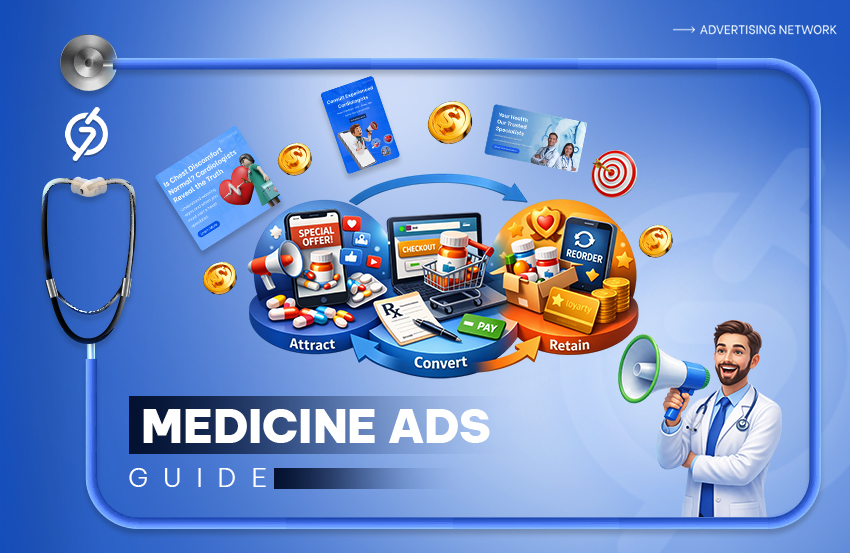
Create High-Impact Medicine Ads That Attract, Convert, and Retain
The online pharmaceutical market is growing because it offers convenience and helps the elderly, caregivers, and busy professionals meet their medication needs without the hassle of visiting a physical store or clinic.
Digital ads remain the growth engine for medicine sellers, as detailed pharma advertising strategies help boost reach, visibility, and conversions. Advanced ad creation and tracking tools make it easier to scale and produce compliant, high-intent medicine advertising campaigns.
Digital advertising, along with traditional advertising, is essential for pharma advertisers to be perceived as an effective pharmaceutical brand. Through e-pharmacy ads, suppliers can offer personalization at each stage of the consumer journey.
Frequently Asked Questions
How do online medicine brands attract customers through ads?
Ans. Online advertising is an effective digital strategy for medical brands, as it helps reach high-intent users in immediate need of medicines. It builds trust by ensuring compliance and highlights benefits such as refill and doorstep delivery to attract and retain users.
How do medicine brands retain customers using ads?
Ans. Medicine brands retain customers through ads by retargeting previous buyers. They create personalized messages, promote refill programs for chronic diseases, and market general health and wellness products. Additionally, they share educational health-related content to build trust and encourage repeat purchases.
Do medicine ads work for both OTC and prescription drugs?
Ans. Yes, OTC and prescription drug ads both work exceptionally well for the pharmaceutical brand. Still, they have different intentions and are subject to different laws and regulations that must be followed to drive better results.
How can online pharmacies reduce ad costs while increasing ROI?
Ans. Online pharmacies can reduce their advertising costs by using high-intent keywords, precise targeting, tracking to optimize ads based on real-time insights, and utilizing top-performing ad formats for the medicine advertisements.
How do medicine ads build trust with buyers?
Ans. Pharmacy advertisers can successfully build trust with buyers by providing clear, compliant-friendly information, integrating real ratings and reviews, and maintaining consistent branding across all digital channels in their medicine advertisements.
Can small online pharmacies take advantage of digital advertising strategies?
Ans. Regardless of business size, anyone can leverage digital advertising strategies to grow their medical business online.
How to maximize medicine ads ROI?
Ans. Maximize pharmacy ad ROI by segmenting your target audience for each funnel and creating relevant ads that match user intent. Additionally, optimize your webpages and app UI to deliver a smooth experience when users click on the ads, reducing bounce rates and cart abandonment.