Key Takeaways!
- Randomly selecting a niche, running untargeted paid ads, ignoring SEO, and aggressively using AI for content creation are among the common affiliate marketing mistakes.
- SEO and content remain among the most prominent marketing channels for affiliates to generate organic traffic.
- Trust remains one of the most important factors in generating affiliate revenue, and thus, maintaining transparency and compliance is mandatory in affiliate marketing.
- Failing to optimize users’ mobile experience is one of the mistakes to avoid as a new affiliate marketer, as 54% of affiliate conversions and 68% of clicks originate from handheld devices.
Ever wondered why the attrition rate in affiliate marketing is so high?
Affiliates constantly put in a lot of effort to find and promote high-commission affiliate offers through various marketing channels. Still, their conversions aren’t impressive enough to encourage them to continue investing in affiliate marketing.
Many affiliates keep picking up offers to make money online, but never consider evaluating their affiliate marketing strategy. It holds them back from achieving real conversions, and as a consequence, they choose to quit. Only to never return again!
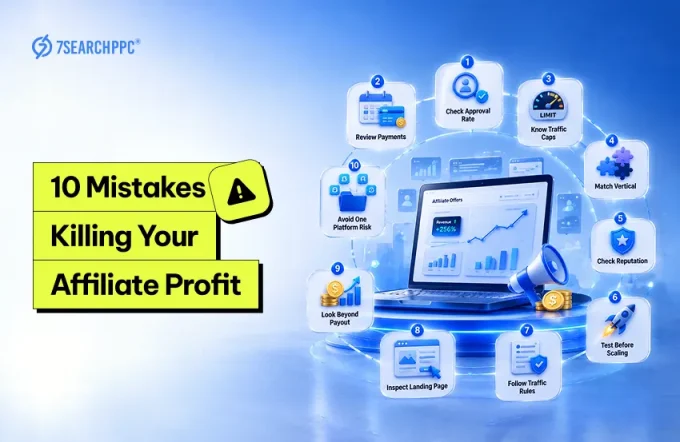
We don’t want you to quit, and that’s why in this post, we’ll break down the 10 biggest affiliate marketing mistakes that affiliates end up committing unintentionally. You’ll also learn how to avoid them to keep up with your affiliate marketing efforts.
Top 10 Affiliate Marketing Mistakes That Kill Conversions (and How to Avoid Them)
What’s silently killing your affiliate conversions, regardless of your constant dedication? Let’s discuss the 10 common affiliate marketing pitfalls, their impact on your affiliate marketing strategy, and how to fix them to make unmatched revenue in 2026.
- Selecting the Wrong Affiliate Niche
- Promoting Affiliate Offers Without Proper Research
- Relying on a Single Source of Traffic
- Running Paid Ads Without Proper Targeting
- Sending Cold Traffic Directly to Affiliate Offers
- Ignoring SEO, GEO, and AEO
- Ignoring Mobile Users and Page Experience
- Publishing Low-Value AI-Generated Content
- Ignoring Compliance Requirements
- Not Tracking Performance Properly
#Mistake 1: Selecting the Wrong Affiliate Niche
Most affiliates choose their niche either based on its commission rates or current market trends. While high-ticket affiliate niches may offer high commissions, they require an engaged audience that trusts recommendations and is willing to spend more.
On the other hand, the audience for trend-based affiliate niches is already too saturated, and their interest spikes only for a limited time. If you enter the niche too late or fail to stand out from competitors, it can become difficult to attract a loyal audience and generate consistent income through affiliate marketing.
Impact: Choosing an unsuitable niche may result in the following issues:
- Failure to build trust and an active following.
- Lack of expertise in the chosen niche.
- Minimal audience engagement.
- Increased promotional spending while revenue remains stagnant.
Solution: Select a popular, profitable affiliate niche in which you have knowledge and can comfortably build your online visibility and audience.
Conduct thorough market research. It’ll help you understand the current demand across different niches and choose the one that’s not only popular but also sustainable, ideal for achieving long-term affiliate goals.
Moreover, avoid participating in every trending niche. Focus only on affiliate niches that resonate with your audience’s intent and have the potential to generate revenue.
Also Read: Trending Affiliate Marketing Niches: Stay Ahead of the Game
#Mistake 2: Promoting Affiliate Offers Without Proper Research

Affiliates aimed to promote as many offers as possible, but in doing so, they shrugged off the need to check offer credibility. They divert all their attention to quantity, assuming it would help them increase their overall affiliate revenue.
Impact: When affiliates prioritize quantity over trust, the long-term consequences can severely damage both audience confidence and overall profitability. As a result, this creates several problems:
- They end up promoting affiliate offers they would never purchase themselves or recommend to a friend.
- The recommended offers lack credibility.
- The audience starts ignoring future recommendations.
- They fail to create a long-term relationship.
- Their affiliate marketing efforts gradually go to waste.
Solution: Adopt a potluck approach while choosing your affiliate offers. Check online reviews, product credibility, and market adoption to select reliable affiliate offers that not just align with your niche and audience, but are also valuable and reliable. You can also use affiliate marketing networks to discover trusted affiliate offers across different niches.
#Mistake 3: Relying on a Single Traffic Source
Most affiliates focus on a single traffic source to leverage the platform to its full potential. That’s a big affiliate marketing mistake.
Over-reliance on a single traffic source is like putting all your eggs in one basket. If the basket breaks, you lose your traffic and conversions.
Impact: Depending on just one platform puts your entire affiliate marketing effort at risk, making your traffic, visibility, and earnings unstable and unpredictable. Here’s how relying on a single traffic source can hurt long-term affiliate growth:
- A sudden algorithm change can lead to a traffic plummet.
- Accounts might get suspended or banned.
- Increases dependency on a single affiliate marketing platform.
- Restricts reach and conversions.
- The platform intensifies competition, which increases customer-acquisition costs.
- Kills your online visibility.
Solution: Adopt diversification in your affiliate marketing strategy rather than relying on a single traffic source. Use organic and paid traffic channels in combination to reduce your dependency, increase your audience reach and conversion potential, and position yourself as a trustworthy resource.
#Mistake 4: Running Paid Ads Without Proper Targeting
Most affiliates treat online advertising as a game of luck. They run paid ads to generate traffic and conversions instantly, but without defining the ad goal, audience, and targeting parameters.
Impact: Without proper targeting, the ads reach irrelevant audiences at random moments. It means you’re just pouring money down the drain. As a consequence, affiliate marketing efforts become inefficient and less impactful:
- The budget is spent on the wrong audience.
- Ad creatives don’t align with audience preferences.
- Missed peak engagement moments.
- Poor lead generation.
Solution: Take your time to understand your affiliate offer’s audience. Outline their demographics, device preferences, interests, and behavior to segment and target the audience based on their intent when the conversion likelihood is at its peak.
Advertising isn’t a game of luck. Online ads need to be crafted with precision, based on data, and targeted to the right audience at the right time. And to avoid this affiliate marketing failure, you can:
By doing so, you can spend your ad budget on the right audience, create creatives that connect emotionally, and better retarget the audience. |
Also Read: Dayparting Guide: How to Schedule Ads for Maximum ROI
#Mistake 5: Sending Cold Traffic Directly to Affiliate Offers
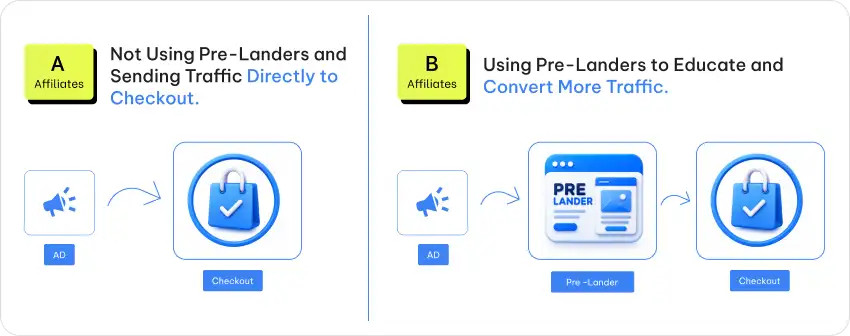
Not using pre-landers to warm up the audience is another common mistake in affiliate marketing done by beginners.
Impact: When affiliates divert traffic directly to offers or landing pages, they miss the chance to warm up their audience and increase their conversion likelihood. Resulting in:
- Impulsive clicks can’t be filtered out.
- Ad spend increases.
- Cost per lead (CPL) increases.
Solution: Remember, not every click on your offers is intentional. Some might result from impulsive thoughts or actions.
You can create dedicated pre-landers to warm up cold traffic and filter out impulsive clicks. So you can retarget and convert those who are really interested in your affiliate promotions.
Also Read: What Is Affiliate Arbitrage? How It Works and Scaling Tips
#Mistake 6: Ignoring SEO, GEO, and AEO
In the rush to maintain consistency and publish content, affiliates often miss the most important factors for organic visibility in affiliate marketing: SEO, GEO, and AEO.
| According to the Ahrefs Content Study, affiliates publish an average of 8 blog posts per month, and affiliate websites have 127 pages on average. Now, what if none of these pages rank on traditional or AI search engines? Would they be able to promote their affiliate offers as intended? |
Impact: If the content isn’t showing up at the top of search engine results or AI searches, affiliates can’t make a profit, even if it contains valuable information, interesting angles, and introduces offers in a non-intrusive way. This lack of visibility can create several challenges for affiliate marketers:
- Increases dependency on paid ads.
- Missing out on potential leads.
- Reduces the website’s organic traffic.
Solution: Online users use AI overviews, AI-generated search engines, and traditional search engines to find information and solve their problems. Aim to appear on search engine results pages alongside AI-generated engines through your content to significantly increase conversions.
To create SEO-friendly content and avoid this affiliate marketing error, take the following steps:
|
#Mistake 7: Ignoring Mobile Users and Page Experience
Affiliates are so engrossed in picking the right offer that they often pay no attention to their target audience’s mobile experience.
|
Impact: The shift toward more handheld devices has made it imperative for affiliates to prioritize mobile optimization. And if the affiliate website pages aren’t mobile-optimized…
- Bounce rate increases.
- Potential leads are lost.
- Search visibility gets affected.
Solution: To overcome this affiliate marketing pitfall, prioritize your audience’s UI experience and take the following steps to improve the average mobile load time. It’ll also help you improve your website’s SEO score and get a higher ranking on SERPs.
- Upload compressed media files.
- Delete unnecessary themes and extensions.
- Implement lazyload.
- Minimize 301 redirects.
- Fix broken links.
- Choose lightweight, fast web hosting.
- Improve web core vitals.
- Avoid unnecessary scripting, and keep the website design to a minimum.
#Mistake 8: Publishing Low-Value AI-Generated Content
According to the Authority Hacker AI Survey 2026, 67% of affiliates use AI tools such as ChatGPT, Jasper, and Claude to generate bulk content in minutes, a 340% increase since 2023.
Impact: Using AI, affiliates are creating content quickly, but it often lacks originality, personal experience, and a human touch, and is filled with excessive, irrelevant keywords.
Online consumers search for helpful and trustworthy content, but often end up with generic, repetitive, and sales-oriented AI-generated fluff. As a result, AI-generated content performs 12% worse in conversions than human-written content. As a result,
- Trust and reputation are never built.
- Content disappears from search engine result pages.
- Bounce rates reach 85–95%.
Solution: Use AI tools to learn about the topic and acquire in-depth information, but craft it in your own style, tone, and structure. It will not only help you give your content a unique and interesting angle but also build your subscriber list and make your audience more receptive to your product recommendations.
To avoid this affiliate marketing mistake, you can:
It’ll help you better interlink your content, avoid keyword stuffing, reduce bounce rate, meet E-E-A-T requirements, and maintain a good SEO score. Your online visibility and credibility will be enhanced slowly, which will improve your overall affiliate conversions. |
So if next time someone says, “Use AI because it reduces content production costs by 78%,” don’t get into the trap!
#Mistake 9: Ignoring Compliance Requirements
Beginners often overlook compliance requirements when promoting affiliate offers online.
Impact: The published content violates customer privacy policies, fails to meet disclosure requirements, and disregards advertising platform rules. This results in the following outcomes:
- Trust is never established.
- The account may be frozen.
- Penalties may be imposed.
Solution: Always disclose that your content includes affiliate links to keep things transparent. Publish content that adheres to the customer privacy policies and advertising platform regulations, as not all affiliate offers can be promoted freely. For instance, health, finance, dating, adult, and iGaming are sensitive topics and must meet all compliance requirements.
To prevent this common affiliate marketing mistake, you can:
Whether you’re publishing content on your website or running paid ads, you can’t brush aside compliance requirements. By avoiding this affiliate marketing mistake, you can prevent penalties, build trust, and ensure long-term profitability. |
Also Read: Tips for Affiliates to Stay Profitable in 2026 Amid Geopolitical Uncertainty
#Mistake 10: Not Tracking Performance Properly
Most affiliates avoid tracking their marketing performance as analytics tools seem complicated and time-consuming. As a result, they prefer focusing on their marketing tasks rather than using analytical tools.
Impact: Affiliates can’t perform A/B testing, make data-driven marketing decisions, or remove the strategies that are killing the overall performance and revenue. This leads to several performance and growth issues:
- Efforts keep revolving around the old affiliate marketing strategies that don’t bring revenue.
- The strategy doesn’t align with current marketing trends.
- Decisions are based on assumptions rather than data.
- Inaccurate marketing attribution.
Solution: Tracking performance helps analyze the current marketing strategy, identify marketing gaps, and make necessary amendments to improve overall affiliate marketing performance and make precise decisions. You can:
- Use a systematic approach to track your affiliate marketing performance.
- Use advanced analytical tools.
- Check performance at regular intervals.
- Use a combination of KPIs.
It’ll help you run A/B tests and focus on the strategies that drive revenue.
Also Read: Top 10 Ad Tracking Tools for Affiliate Marketers
Avoid Common Affiliate Marketing Mistakes!
Affiliate marketers can easily avoid these bad practices by staying consistent, being patient, and focusing on long-term results rather than quick conversions.
If you’re making any of the aforementioned affiliate marketing mistakes, rather than panicking, try to resolve them using the solution we’ve provided to achieve your desired conversions and stay consistent with your affiliate marketing endeavors.
Frequently Asked Questions (FAQs)
Q1. What are the most common affiliate marketing mistakes beginners make?
Ans. The most common affiliate marketing mistakes beginners make are:
- Not taking affiliate marketing seriously
- Expecting quick results
- Choosing a non-profitable niche
- Promoting multiple low-quality affiliate offers
- Relying on a single traffic source
- Avoiding pre-landers and analytics tools
Q2. Can beginners make a profit from affiliate marketing?
Ans. Yes, beginners can earn significant profits by promoting niche-specific affiliate offers across multiple platforms with organic and paid content, as long as they remain consistent in their efforts.
Q3. How long does it take to make money from affiliate marketing promotional strategies?
Ans. Relying solely on organic promotions can take 6 months or more, but with paid promotions, you might see visible results within hours of launch if the ads are targeted precisely.
Q4. SEO for affiliate marketing: how important is it in 2026?
Ans. In 2026, SEO remains one of the most important marketing channels for affiliates to generate organic traffic, build authority, and maintain audience engagement.
Q5. Can I expect quick results from affiliate marketing?
Ans. It depends on your efforts. Affiliate marketing can take time to deliver optimal results through organic channels. It can take months of consistent hard work to build credibility, drive traffic, and generate decent revenue. However, with strategic paid ads, you can expect quicker results.
Q6. How important are mobile users for affiliates?
Ans. According to the SEARCHLAB report, 54% of affiliate conversions and 68% of clicks originate from handheld devices. Not just that, 53% of Gen Z shoppers prefer to complete their affiliate purchase on mobile. The use of handheld devices for web activities is constantly increasing, highlighting that mobile users can no longer be ignored in your affiliate marketing strategy.
Q7. How important is active followership when promoting high-ticket offers in affiliate marketing?
Ans. Affiliate marketing is all about trust. If you’ve built online authority, earned your audience’s trust, and developed an active following, you can promote high-ticket affiliate offers more effectively, increase repeat purchases, and achieve a higher ROI with ease.