Core Insights!
- Spotting affiliate offer selection mistakes early is the best way to protect your budget.
- Always check real approval rates for your specific GEO and traffic source before committing.
- Budget enough cash to survive 2-3 hold periods before you scale.
- Get caps and traffic limits confirmed in writing before launch.
- Match your offer to your traffic source, since what works on push may fail on search.
Paid traffic runs on the clock. Every hour you’re not converting, every dollar spent chasing the wrong offer – that’s money you don’t get back.
This happens to almost everyone at some point, and usually not because the campaign was bad. It’s because the offer itself was picked in a hurry.
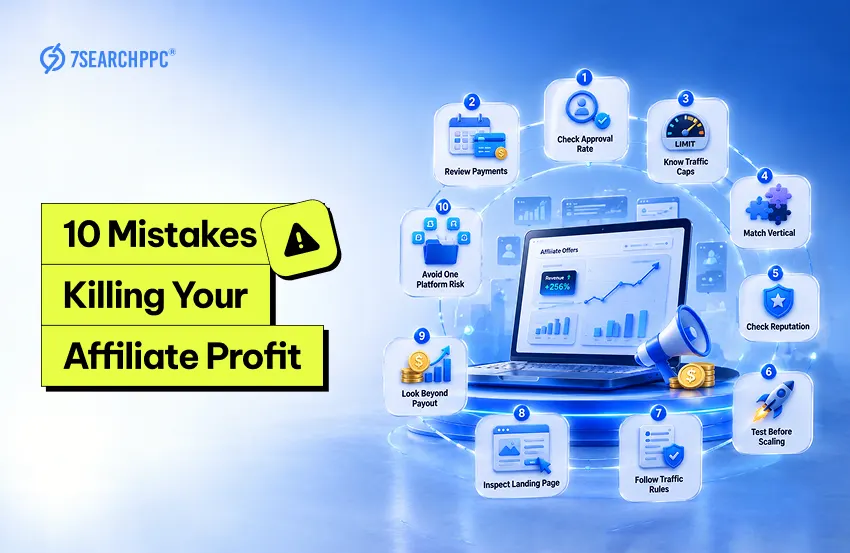
So picking the affiliate program itself (the offer, the network, the vertical) matters just as much as how well you build the campaign around it. Below are ten affiliate offer selection mistakes that you should avoid.
1. Skipping a Real Check on the Approval Rate
A big payout looks great on paper. It means a lot less if only one lead in five actually gets approved. New affiliates tend to fixate on the number listed in the catalog and never ask the manager what approval actually looks like for their GEO and their traffic source. Then the campaign runs, the numbers come in low, and the test budget is gone before it ever had a chance to pay for itself. This is one of the classic affiliate offer selection mistakes that quietly drains a test budget.
Ask for approval data specific to your traffic source — not some blended average pulled across every publisher running the offer. And ask for numbers from the last 30 days, not lifetime stats, as it can make things easy.
2. Overlooking the Hold Period and Payment Schedule
Nobody reads the payment terms closely enough, and that’s a mistake, because they’re really just another line in your unit economics. Say the hold period is 30 to 45 days, but you’re used to turning your ad budget over every few days.
You’re now financing the campaign yourself while the payout sits in limbo. Try to scale under those conditions, and you can end up with a severe cash flow gap – even on a campaign that’s technically profitable. Ignoring hold periods is one of the affiliate offer selection mistakes that hits cash flow the hardest.
Figure out ahead of time how much capital you’ll need to cover two or three hold periods, and build that number into your test budget from day one.
3. Not Asking About Caps and Traffic Limits
An offer can look perfect on the surface and still have a daily or weekly cap buried somewhere nobody bothered to mention. So you get solid numbers, decide it’s time to scale — and slam straight into a ceiling you never saw coming.
By then, the extra budget’s already committed. There’s nowhere left to send it. Missing caps is a small detail, but it’s still one of the affiliate offer selection mistakes that stalls scaling plans fast.
Get the caps confirmed before launch, not after your first results come in, and ask the manager to put the agreement in writing.
Also Read: 10 Affiliate Marketing Mistakes That Kill Conversions in 2026
4. Not Matching the Vertical to the Traffic Source
An offer that performs beautifully on push might do nothing at all on search, and the reverse is just as true. A high payout alone doesn’t tell you whether the audience on a given traffic source is actually a fit for what you’re selling – that’s a separate question, and skipping it is one of the more common beginner traps. It’s also one of the affiliate offer selection mistakes that’s easiest to avoid with a quick sanity check.
Look at case studies and real performance data for your specific traffic type – native, push, social, search — instead of leaning on general numbers for the vertical.
5. Not Looking Into the Network’s Reputation
Late payouts. Approval rates are getting quietly slashed after the fact. Accounts are banned with zero explanation. These aren’t rare horror stories you hear about once in a while — they happen all the time. If you’re picking a network based on payout size alone, without checking what real affiliates are actually saying about them, you’re setting yourself up for trouble.
Skipping this step ranks among the costlier affiliate offer selection mistakes because it puts your whole account at risk.
Check the network in relevant forums and chats. Look at how long they’ve actually been operating. And be skeptical of reviews that read a little too polished – those are often paid for. If you’re in iGaming, it’s worth cross-checking new offers against a trusted gambling CPA partners section before committing, since the strongest programs are the ones with a verified payout history.
6. Scaling Before You’ve Actually Tested
It’s tempting to go all in right away, especially when everyone in the chat seems to be printing money off the same offer. But if you skip the small test run, you’re flying blind — you won’t know your real conversion rate, how good the traffic quality actually is, how fast leads get approved, or whether payouts even show up on time.
Rushing to scale is one of the affiliate offer selection mistakes that turns a promising offer into a losing one overnight.
Set aside a test budget you can genuinely afford to lose, and make your scaling call based on your own results – not someone else’s screenshot.
7. Ignoring the Rules on Traffic Sources
Every program has rules about where traffic can come from, and they’re not optional – incentivized traffic, motivated traffic, certain GEOs or platforms that are simply banned.
Break one of these rules, even by accident, and you’re not just risking the current campaign. You can lose every dollar you’ve already earned but haven’t been paid yet. This is one of the affiliate offer selection mistakes that can cost you earnings you’ve already made, not just future ones.
Read the traffic source restrictions before you launch. Not after the ban notice shows up.
8. Not Checking the Landing Page and Offer Quality
You can have a genuinely strong product and still torch your numbers with a bad landing page — no localization, slow load times, nothing built for mobile. A surprising number of people pick an offer without once looking at what the user actually sees after they click.
Go through the landing page yourself. Different devices, different GEOs. Check the load speed and make sure the forms actually submit.
9. Fixating on the Payout Number Instead of the Payment Model
CPA, CPL, RevShare, hybrid — these aren’t interchangeable. Each one carries its own risk, and treating them as roughly the same thing is where a lot of people trip up.
Here’s the trap: a solid CPA payout can look great on paper, but lose out to a modest RevShare deal once time is factored in — especially in verticals with high lifetime value, like gambling, finance, or subscriptions. Picking a payment model without understanding the economics behind it is a rookie mistake.
So don’t just look at the upfront number. Wherever the model allows it, dig into what a user is actually worth to you long-term.
10. Consolidating All Your Resources in One Place
Running everything through a single affiliate program is its own kind of risk. Terms shift, payouts get cut, new caps appear out of nowhere, payments freeze – none of it is up to you. Pour your entire budget into one offer with one advertiser, and you’ve essentially handed your business over to someone else’s decisions.
Keep several offers and programs running at once, even within the same vertical, so you’ve got somewhere to redirect traffic the moment something changes.
The Bottom Line
Picking an affiliate program deserves the same scrutiny as building the campaign itself — the numbers, the payout terms, the network’s track record, and whether it actually fits your traffic. On their own, most of these mistakes won’t sink you. But stack them together, and that’s exactly how a setup that should’ve been profitable ends up going nowhere. Being disciplined about offer selection is as much a part of the job as tuning creatives or managing bids.
Frequently Asked Questions (FAQs)
Q1. What is affiliate offer selection?
Affiliate offer selection means choosing the right product, service, or affiliate program to promote. You should look at the payout, approval rate, payment terms, traffic rules, and offer quality before making a choice.
Q2. Why is the approval rate important?
The approval rate tells you how many of your leads or conversions are actually accepted and paid. A high payout is not useful if most of your leads are rejected.
Q3. What is a hold period in affiliate marketing?
A hold period is the time between generating a conversion and receiving your payment. For example, a 30-day hold means you may need to wait 30 days before the money becomes available.
Q4. How much money should I keep for a hold period?
It is safer to have enough cash to cover your ad costs for two or three hold periods. This helps you keep your campaigns running while waiting for payments.
Q5. What are common affiliate offer selection mistakes?
Common affiliate offer selection mistakes include ignoring approval rates, focusing only on payouts, overlooking hold periods and caps, choosing the wrong traffic source, skipping offer checks, and scaling too early.