

Key Takeaways!
- Affiliate arbitrage works by buying low-cost traffic and earning higher affiliate commissions from conversions.
- Successful affiliate arbitrage strategies require continuous testing and tracking.
- Paid traffic arbitrage in affiliate marketing helps affiliates generate traffic faster.
- Evergreen niches, quality traffic, and scalable winning campaigns are key to long-term affiliate arbitrage profits.
- Risks include rising ad costs, platform bans, low margins, and cash flow issues from upfront ad spending.
Affiliate arbitrage sounds exciting because, on the surface, it looks simple — buy traffic at a lower cost and earn more through affiliate commissions. But anyone who has tried it knows the real challenge begins after the first profitable campaign.
The big question is: should you scale aggressively or stop before losses start piling up? Many beginners either scale too fast and burn their budget, or quit too early without testing enough.
In this guide, we’ll break down how affiliate traffic arbitrage really works, the signs that tell you it’s time to scale, and the warning signals that mean it’s smarter to pause, optimize, or walk away completely.
What is Affiliate Arbitrage?
Affiliate arbitrage is a marketing strategy where affiliates buy paid traffic at a lower cost and direct it to affiliate offers to generate commissions that exceed their advertising expenses. The profit comes from the difference between traffic acquisition costs and affiliate earnings.
At its core, affiliate arbitrage follows the same foundational framework as advertising arbitrage: buy traffic, send it to an offer, and earn more than you spend.
Let’s take an affiliate arbitrage example to understand how it actually works:
An affiliate spends $60 on ads to engage 1,000 visitors to a landing page promoting an online course. Out of those 1,000 visitors, 20 purchase the course through the affiliate’s link.
If the affiliate earns a $10 commission per sale, the total revenue is: 20 x $10 = $200
What is the profit?
The affiliate’s total revenue is $200. To calculate the profit, subtract the ad cost from the total revenue: $200 − $60 = $140.
So, the affiliate’s total profit is $140.
Benefits of Affiliate Arbitrage
Most affiliates are placing greater trust in affiliate traffic arbitrage because of its benefits, which are listed below.
Rapid Income Generation
One of the main advantages of affiliate arbitrage is the ability to generate income more quickly than with traditional affiliate marketing methods. Instead of relying on long-term SEO or organic audience building, marketers can use paid advertising to buy and drive instant convertible traffic.
If the traffic converts well and your costs stay lower than your earnings, you can see results much sooner. This speed makes affiliate traffic arbitrage appealing to marketers who want to test campaigns and generate income quickly.
Ability to Scale Proven Profitable Campaigns
Once you discover a profitable combination of ad, audience, and offer, you can scale accordingly by:
- Increasing ad spend on winning campaigns.
- Expanding to similar audiences or countries.
- Testing more ad creatives around the same offer.
So instead of building everything from scratch again, you turn up the volume on what’s already profitable.
Global Earning Potential
You can promote offers globally and reach audiences from multiple countries. Benefits of targeting globally include,
- Worldwide Reach: Your online arbitrage ads can be shown to users across different countries, giving you access to a much larger audience.
- Works for All Affiliate Arbitrage Marketing Model: Whether you are doing high-ticket affiliate marketing or promoting low-ticket offers, global traffic can generate consistent profits.
How Affiliate Arbitrage Actually Works
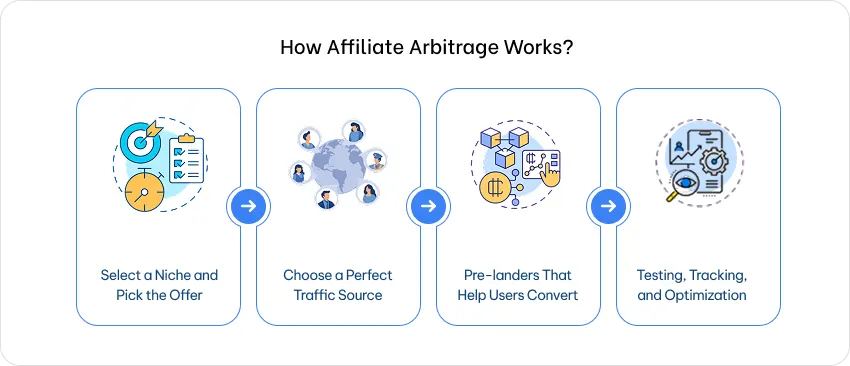
Affiliate arbitrage isn’t just a tactic; it’s a strategic approach that can significantly elevate your affiliate marketing performance when understood properly. Let’s take a look at how it actually works.
1. Select a Niche and Pick The Offer
The first and most important step in any affiliate arbitrage blueprint is selecting a profitable niche and identifying a relevant offer within it. You can’t promote everything—success comes from narrowing your attention to a specific audience and understanding their needs.
When you choose a niche you’re familiar with or genuinely interested in, it becomes easier to promote.
Top niches for affiliate marketing, where products and services tend to sell easily, include:
|
2. Choose a Perfect Traffic Source
Once you have selected your niche and the offer, the very next step is to decide where your traffic will come from. Choosing the perfect traffic source is important, and for that, you can turn to paid traffic sources like advertising networks, which deliver high-quality, targeted traffic—people who are more likely to convert.
3. Prelanders That Help Users Convert
After selecting your traffic source, the next critical step is building an effective pre-landing page. Prelanders for affiliates are important because these are the pages users see before reaching the actual offer, and they play a huge role in conversion.
A good prelander doesn’t try to sell the product right away. Instead, it builds interest, trust, and curiosity. This helps visitors become more engaged, so when they reach the offer or landing page, they are more likely to take action.
4. Testing, Tracking, and Optimization
This is the stage where affiliate arbitrage becomes scalable rather than just guesswork. Once your campaign is live and traffic is flowing through your ads, prelander, and offer, you must constantly measure performance. The goal is simple: spend less on traffic than you earn from conversions.
Some key metrics to track include:
- Click-through rates (CTR)
- Conversion rate
- Cost per click (CPC)
- Cost per conversion
- ROAS per campaign
Track these metrics and understand where you are getting the most results from. Affiliates can also use split testing and ad tracking tools to identify which of their arbitrage ad campaigns performs best.
When is Affiliate Arbitrage Profitable?
Earning profit through affiliate traffic arbitrage comes down to a simple equation: your cost to acquire a visitor vs. the commission you earn from that visitor. If that gap isn’t clearly in your favor, arbitrage efforts collapse quickly.
Here’s when it actually becomes profitable, especially when you apply the right affiliate arbitrage strategies:
When Your Traffic Costs Are Predictable and Low
Predictable traffic costs give you a solid footing for profitable arbitrage, allowing you to plan and scale with confidence. Consistency in cost-per-click (CPC) isn’t just a convenience—it’s essential.
Affiliate marketing margins are often tight, so even small fluctuations in traffic costs can significantly impact profitability. When your traffic costs are predictable and low, you can:
- Maximize profits without worrying about sudden spikes.
- Plan campaigns and budgets with confidence.
- Scale traffic efficiently while maintaining stable margins.
When Commissions Are Large Enough
Low-ticket affiliate products leave almost no margin for arbitrage. It works best with:
- High-ticket affiliate offers (e.g., $100+ commissions)
- Recurring commissions (subscriptions)
- Niches like finance, iGaming software, or insurance.
That’s why many arbitrage marketers focus on high-value ticket offers or niches where a single conversion can more than cover their advertising costs, maximizing the chances of profitability.
When Conversion Rates Are High
If you are seeing positive conversion rates as people actually convert on your affiliate offer, it means you are benefiting from affiliate arbitrage. When conversion rates are high, it benefits affiliates through:
- Increase in Revenue
- Lower Cost Per Acquisition
- More Data for Scaling
The Hidden Pitfalls and Risks Associated with Affiliate Arbitrage
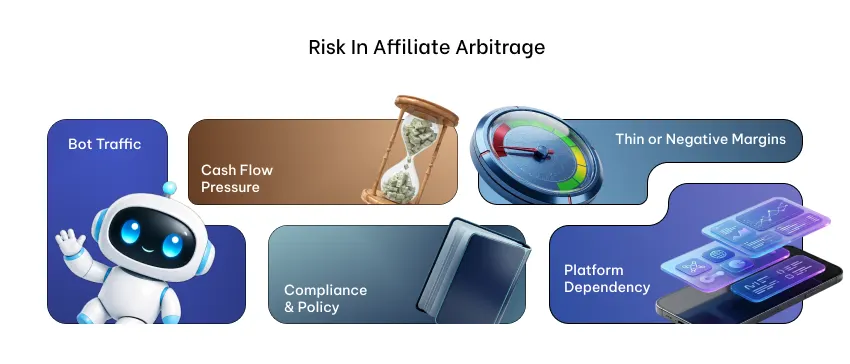
Affiliate traffic arbitrage can seem like a clever way to profit online, but it comes with numerous hidden pitfalls and risks that many newcomers overlook. Let’s break them down carefully and thoroughly:
- Platform Dependency: Relying heavily on one source for traffic or sales is risky. If their rules change or your account faces issues, your income can suddenly disappear.
- Thin or Negative Margins: Sometimes, the money you earn barely covers your advertising or promotion costs. Any small increase in expenses can turn a profitable affiliate arbitrage campaign into a loss.
- Cash Flow Pressure: You often pay for ads upfront but receive affiliate payouts later (sometimes weeks later). If something goes wrong in between, you’re left paying out-of-pocket, which can seriously strain your budget.
- Bot Traffic: Fake clicks from bots can make your stats look impressive, but they don’t buy anything. Here, you can only waste your ad budget.
- Compliance and Policy Violations: Not following rules or hiding affiliate links can create trouble. You might face penalties, lose accounts, or even legal issues if you’re not careful.
How Much Budget Do You Need to Start Affiliate Arbitrage?
You don’t need a huge budget to start affiliate arbitrage. In fact, many beginners start with around $100 to $500 just to test campaigns and learn how things work. Your main expense will usually be paid ads, because that’s where you drive traffic from.
Here’s where your money may go:
- Ads and traffic testing
- Tracking tools
- Landing page builders
- Optional research or spy tools
If you’re just starting out, keep your budget small and focus on learning first. Once you find a campaign that works, you can slowly increase your spending and scale your profits.
What to Do if Your Profitable Affiliate Arbitrage Campaign Suddenly Stops Working?
A profitable affiliate arbitrage campaign can stop working for a few different reasons — platform changes, tracking issues, rising ad costs, offer fatigue, compliance problems, or competitor saturation. The key is diagnosing the failure quickly instead of blindly increasing spend.
Here’s a structured way to troubleshoot and recover.
1. Check if it’s Actually Gone (or Just Volatility)
Don’t make instant decisions; campaigns don’t run in straight lines. A poor 1–2 days of performance do not necessarily indicate a decline, as the issue may stem from technical problems. Always investigate thoroughly before taking action. You should:
- Focus on a 7–14 day trend rather than short-term data.
- Check whether the conversion rate has dropped or if it’s simply a fluctuation in traffic quality.
- If your earnings per click (EPC) are still close to breakeven, the campaign may recover.
2. Break Down the Funnel to Find the Leak
You have to break down things to know where you are actually facing the issue. For that, you have to compare your current data against the period when you were profitable. You can identify the problem by analyzing these metrics and applying the corresponding fixes:
| If the Drop is in | What It Can Mean | The Fix |
| CTR (Click-Through Rate) | Weak ad-message alignment. | Improve headline and creatives. Match intent with copy.” |
| CPC (Cost Per Click) | Bidding pressure. New competitors entered the niche. | Test a new audience or switch to manual bidding. |
| Conversion Rate | The landing page or offer is boring. | Seek help from a pre-lander or utilize split testing. |
3. Ad Fatigue & Audience Saturation
In affiliate arbitrage, one silent killer destroys profitability faster than anything else: ad fatigue. It happens when your audience keeps seeing the same ad repeatedly. What starts as curiosity quickly turns into annoyance, and once that happens, your click-through rate drops and conversions dry up.
How to Fix It
- Rotate multiple ad creatives regularly so your audience always sees something fresh.
- Narrow and refresh your targeting to reach new people before saturation happens.
- Test different headlines, visuals, and angles to find what keeps engagement high.
- Monitor CTR and frequency daily, then pause ads that start losing performance.
Pro Tip: If ad frequency is rising and performance is falling, don’t wait; rotate ad creatives immediately. The faster you refresh, the longer you stay profitable.
Key Factors to Consider When Doing Affiliate Arbitrage
Success in affiliate arbitrage depends on carefully analyzing the critical metrics that drive performance, profitability, and sustainable growth. Let’s take a look at the factors you may consider.
1. Consider the Budget
Affiliate arbitrage becomes viable only when you have a defined budget. For example, if you have $1,000, it doesn’t mean you should spend it all at once. That approach is never effective.
Instead, your budget should be deployed strategically and spent gradually only when you are seeing measurable results.
2. Look for the GEOs
Targeting the right geographies should be a top priority. Focusing ads on the right locations prevents wasted effort in markets with low returns.
Countries are grouped into tiers, and your selection affects both profit margins and competition. Choosing the right tier is crucial for affiliates, as GEO influences costs and payouts. Let’s break it down.
- Tier 1 (USA, UK, Canada): High competition and high Cost-Per-Click (CPC), but massive payouts and high purchasing power.
- Tier 2 & 3 (Brazil, South Korea, India): Low CPC and massive volume. While payouts are smaller, the lower barrier to entry often makes it easier to achieve a high Return on Ad Spend (ROAS).
3. The Niches You Choose Should Be “Evergreen”
It’s important to focus on evergreen niches—those with steady demand and consistent sales potential regardless of market conditions or geopolitical uncertainty. You should prioritize:
4. Focus on Traffic Quality (High-Paying vs. Low-Paying)
Focus on the quality of your traffic, not just the price. Cheap traffic may seem like a good deal, but it can cost more in the long run if it doesn’t lead to conversions. Always aim for visitors who are more likely to take action.
- The Bot Factor: When buying low-cost traffic from ad networks, use third-party tracking tools to detect and filter out bot traffic. This helps avoid paying for clicks with a zero conversion rate.
Ready to Make Affiliate Arbitrage Work for You?
Affiliate arbitrage is all about smart math. Pick the right niche, buy quality traffic, build a prelander people trust, and keep testing. Do that, and the profits follow. Skip a step, and you’ll burn your budget fast.
The real secret? Quality traffic from day one.
Power your next campaign with 7SearchPPC and get affordable, targeted traffic for your offers.
Schedule a Meeting →
Frequently Asked Questions (FAQs)
Q1. What is affiliate arbitrage?
Ans: Affiliate arbitrage is a marketing strategy in which affiliates buy low-cost traffic and direct it to affiliate offers to profit from the difference between ad spend and commissions.
Q2. How does affiliate traffic arbitrage work?
Ans: It works by purchasing traffic, sending it through a landing page or prelander, and earning commissions when users convert on an affiliate offer.
Q3. Is affiliate arbitrage profitable?
Ans: Yes, but only when your traffic costs are lower than your earnings per conversion, and your campaigns are effectively optimized.
Q4. How much money do I need to start affiliate traffic arbitrage?
Ans: You can start with $100 for learning, but a realistic budget is between $500 and $1,000 for proper testing and optimization.
Q5. What is affiliate marketing arbitrage?
Ans: Affiliate marketing arbitrage is another term for affiliate arbitrage, emphasizing the use of paid traffic to generate profit through affiliate offers.