Key Takeaways!
- Instead of guessing, you can clearly understand which marketing efforts are actually driving results through attribution models.
- Each attribution model tells a different story, so choosing the right one depends on your marketing goals and strategy.
- People interact with multiple channels before converting, so relying on just one touchpoint can be misleading.
- The more accurate and connected your data is, the better your attribution insights, which ultimately help you make better decisions.
If you’ve ever wondered which part of your marketing actually deserves credit for a sale, you’re thinking about the touchpoint that truly made an impact.
A customer might click on your ad, read a blog, sign up for emails, and only then decide to buy. So…which one made the difference?
This is exactly where attribution models come in.
Think of attribution like giving credit in a group project. Was it the first person who had the idea? The one who did most of the work? Or the one who wrapped it all up at the end? Marketing works in a similar way—there are multiple touchpoints, and each one plays a role in moving a customer closer to a decision.
In this blog, we’ll break down what attribution models are, why they matter, and how you can use them to make strategic marketing decisions.
What Are Attribution Models?
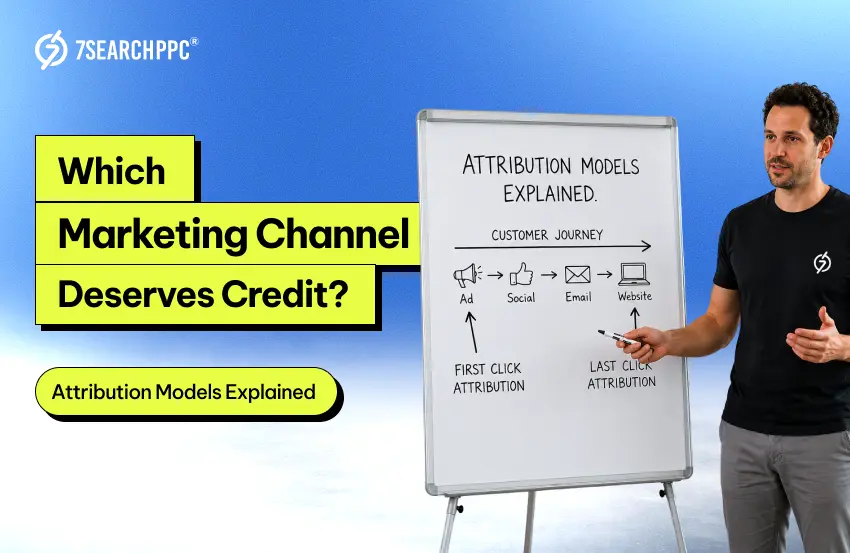
Attribution models, also called conversion attribution models, are frameworks used in marketing to determine how credit for a conversion (like a sale, sign-up, or lead) is assigned to different touchpoints in a customer’s journey.
In simple terms:
When a customer interacts with multiple channels—ads, emails, social media, search, etc. Attribution models help marketers understand which of these touchpoints influenced the decision the most, so they can invest their time and budget more effectively.
Drive More Conversions – Advertise With 7SearchPPC!
Types of Attribution Models in Marketing
There are many types of attribution models available, and understanding them is beneficial for marketers. Below is a detailed overview of different approaches, along with examples.
Single-Touch Attribution Models
In single-touch attribution models, there are two primary approaches. These include:
1. First-Touch Attribution Model
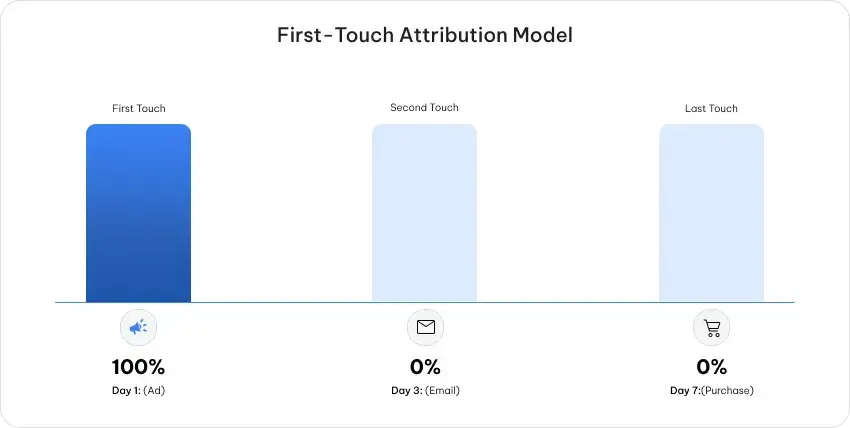
This model gives all credit for a sale or conversion to the very first interaction a customer has with your brand. This could be the first ad they clicked or the first social post they saw. Later interactions don’t count; only that first touch counts.
Let’s take an example:
Emma is considering buying a new laptop. Over the course of a week, she interacts with the brand through different marketing channels:
Day 1: Emma sees an online ad for the laptop.
Day 3: She receives an email promotion from the brand.
Day 7: Emma finally makes the purchase via the website.
Since the first touchpoint was the online ad on Day 1, all credit for Emma’s purchase is assigned to the online ad, even though she later interacted with the email.
2. Last-Touch Attribution Model
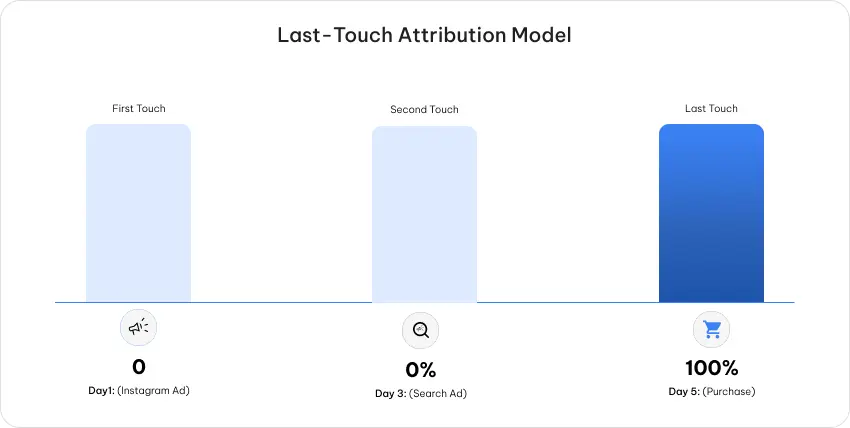
This model gives all credit to the final interaction before a user converts. It is widely used because it clearly shows which action directly led to the conversion, but it overlooks earlier touchpoints that may have influenced the decision.
Let’s take an example:
A customer purchases shoes online.
Day 1: The customer sees an Instagram ad for the shoes, clicks on it, browses the website, but doesn’t make a purchase.
Day 3: The customer searches for “best running shoes” on Google, clicks on a search ad, but still does not purchase.
Day 5: The customer receives a promotional email from the store, clicks the link, and immediately makes the purchase.
Last-click attribution:
The email campaign on Day 5 receives 100% of the credit for the sale. The Instagram and Google ads receive no credit, even though they influenced the decision earlier.
| 53.5% say that the last-touch attribution model is somewhat effective. (Source: Ruler Analytics) |
Multi-Touch Attribution Models
In multi-touch attribution, there are four attribution models, which include:
1. Linear Attribution Model
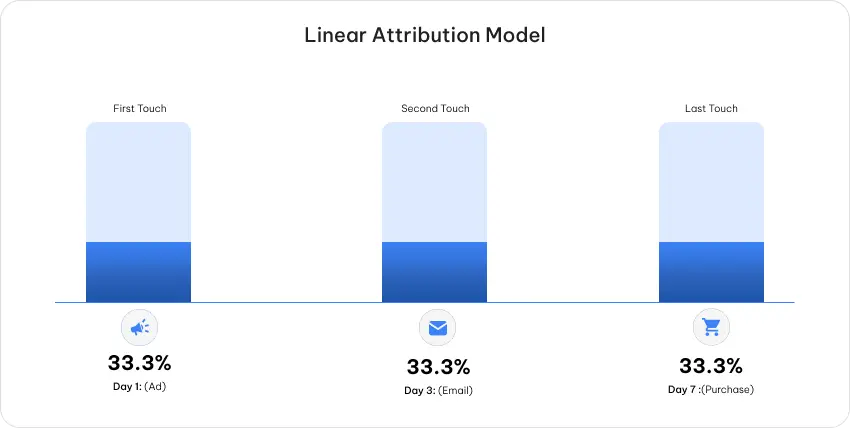
This method gives equal credit to every touchpoint in a customer’s journey, from the first interaction to the final step. It helps you evaluate all marketing interactions fairly, but it may not indicate which touchpoints were truly the most influential in driving the conversion.
Let’s take an example:
A customer buys a $100 online course after interacting with your marketing across multiple channels.
Customer Journey:
Day 1: Sees an online ad.
Day 3: Opens an email newsletter.
Day 7: Visits your website directly and makes a purchase.
Linear Attribution:
The total touchpoints are three. Each touchpoint gets equal credit for the sale. Every channel is considered equally important in influencing the customer, even if one played a stronger role in closing the sale.
2. Time Decay Attribution Model
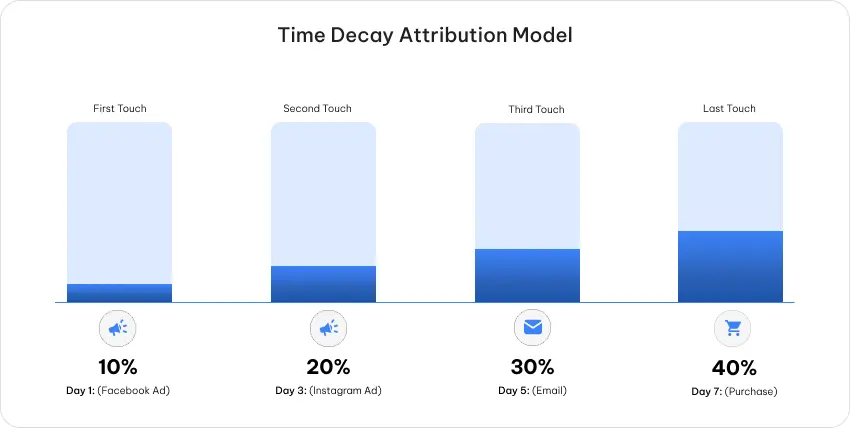
This model assigns credit to customer interactions based on their proximity to the final conversion (such as a purchase). Touchpoints that occur closer to the conversion receive more credit, as they are considered more influential.
Let’s take an example:
A customer is considering purchasing a pair of socks from an online store. Over 7 days, they interact with different digital marketing channels before finally making a purchase.
Customer Journey:
Day 1: Sees a Facebook ad.
Day 3: Clicks on an Instagram ad.
Day 5: Receives and opens an email.
Day 7: Clicks on a retargeted display ad and makes a purchase.
In this model, interactions closer to the purchase receive more credit:
- Retargeted Ad (Day 7): 40% credit
- Email (Day 5): 30% credit
- Instagram ad (Day 3): 20% credit
- Facebook Ad (Day 1): 10% credit
Even though the Facebook ad introduced the product first, the retargeted ad received the most credit because it had the strongest influence on the final decision.
3. U-Shaped Attribution Model
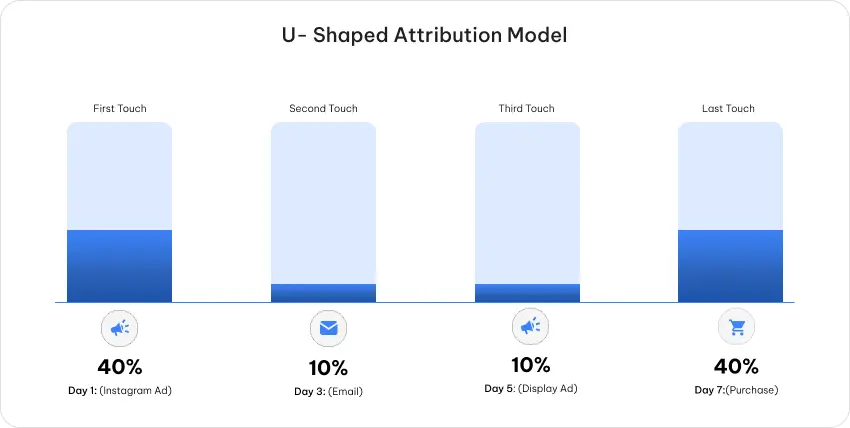
Famously known as the position-based attribution model, this attribution emphasizes both the first and last interactions by giving them the most credit, while distributing the remaining credit among the middle touchpoints.
Let’s take an example:
A customer is buying a smartwatch from an online store. Their journey looks like this:
Day 1: They see an Instagram ad and visit the website.
Day 3: They receive and open a promotional email.
Day 5: They click on a retargeted display ad.
Day 7: They return directly to the website and make a purchase.
How U-Shaped Attribution Assigns Credit Here:
- First interaction (Instagram ad): 40% credit
- Last interaction (Direct visit): 40% credit
- Middle interactions (Email + Display ad): Remaining 20% split equally.
4. W-Shaped Attribution Model
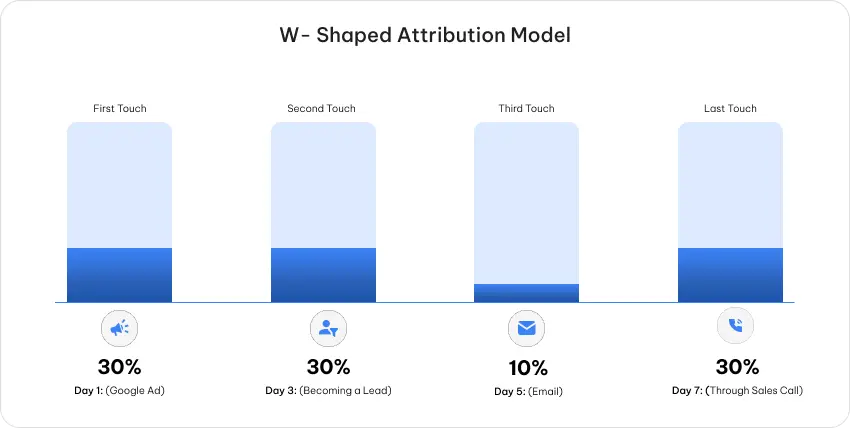
This attribution model uses a multi-touch model that assigns 30% credit to three stages: first touch, lead creation, opportunity creation, and distributes the remaining 10% across other interactions.
Let’s take an example:
A customer is buying a software subscription from a company.
Day 1: The customer clicks on a Google ad and visits the website for the first time.
Day 3: A few days later, they download an eBook by filling out a form (becoming a lead).
Day 5: They engage with emails and retargeted ads.
Day 7: Finally, they speak with a sales representative and make a deal.
Credit Distribution:
- First Touch (Google Ad): 30%
- Lead creation (eBook download): 30%
- Other interactions, emails, retargeted ads: 10% (shared)
- Deal creation through sales call: 30%
Benefits of Attribution Modeling
Attribution modeling is a powerful method for marketers, whether you are an affiliate, performance marketer, or media buyer. It provides clarity at every stage of the customer journey, helping you understand exactly where your best results are coming from.
Here are some key benefits of using an attribution model for marketers:
- Conversion Clarity: Attribution modeling shows you exactly which touchpoints influence your customers so you can double down on what truly works, not just what gets the last click.
- Eliminate Wasted Ad Spend: No more pouring budget into underperforming campaigns. With clear performance insights, you can confidently shift spend toward high-impact channels and maximize ROI.
- Scale Winning Campaigns Faster: When you know which strategies drive results, you can optimize and scale them quickly—leading to better performance without increasing risk.
- Uncover Hidden High-Value Touchpoints: Attribution modeling reveals the impact of early- and mid-funnel interactions that often go unnoticed. This helps you recognize and invest in channels that play a crucial supporting role in conversions.
- Build a Smarter, Multi-Channel Strategy: Your channels don’t work in isolation, and attribution modeling helps you understand how they work together. This allows you to create a consistent strategy that guides customers from first touch to final conversion.
How Attribution Models Actually Work
Rather than attributing credit to a single touchpoint, attribution models understand which interaction points contribute to achieving the desired results. From the first click to the last conversion, every step plays a role. So, how does this actually work? Let’s break it down.
Think of it as tracking a customer journey from start to finish and then distributing credit across each step.
Tracking Customer Touchpoints
Every time a user engages with your brand, it gets recorded. These interactions are called touchpoints, such as:
- Clicking on a Google ad
- Visiting your website
- Downloading an eBook
- Opening an email
- Clicking a retargeting ad
- Talking to a sales representative
All these actions are tracked using methods such as Google Analytics, tracking pixels, UTM parameters, cookies, and other tracking techniques.
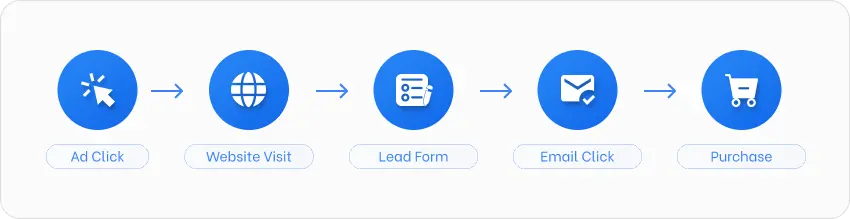
Mapping the Audience Journey
The system connects all these touchpoints into a sequence for a single user.
For example,
Applying an Attribution Model
Now comes the core part: deciding how much credit each step gets.
Different models assign credit differently:
- First-Touch Model
- Last-Touch Model
- Linear Model
- Time-Decay Model
- U-Shaped Model
- W-Shaped Model
Assigning Credit
Once the model is applied, each touchpoint is assigned a percentage of the conversion.
Example (Linear Model):
- Ad Click: 20%
- Website Visit: 20%
- Lead Form: 20%
- Email Click: 20%
- Sales Call: 20%
Generating Insights & Optimization
This data helps marketers:
- Identify which channels perform best
- Optimize ad spend
- Improve campaign strategy
- Understand real customer behavior
It is helpful for marketers to identify their weaknesses and areas needing improvement, which is essential for anyone aiming for success. That’s why understanding how attribution models work becomes beneficial.
Best Practices for Marketing Attribution Models
Marketing attribution models are powerful, but they will fail if you don’t ground them in strategy, data quality, and business context. Here are the best practices that actually make attribution useful.
Know the Benefits and Flaws of Each Attribution Model
No attribution model is perfect; each one highlights certain insights while hiding others. Understanding their strengths and limitations helps you avoid drawing the wrong conclusions.
Align Attribution with Your Business Goals
Before picking an attribution model, clarify what your goal is:
- Are you optimizing for brand awareness, lead generation, or sales?
- Is your sales cycle short (e-commerce) or long (B2B)?
Once you understand your goal, you’ll know where to focus and measure results.
Choose the Appropriate Tracking Tool
Look for an analytics tool that is trusted and widely used, such as Google Analytics. If you choose a platform that manipulates results, you will never be able to understand where your results are coming from.
Adapt to Privacy & Tracking Changes
With cookie restrictions and privacy laws, always look for tracking alternatives and other options to help you overcome these challenges, such as:
- Using first-party data
- Implementing server-side tracking
- Preparing for incomplete user journeys
Link Attribution to Budget Decisions
One of the critical aspects of an attribution model is optimizing the allocated marketing budget to ensure you achieve the best possible results. This can be achieved by:
- Shifting spend toward high-impact channels that drive the strongest outcomes.
- Reducing investment in low-ROI touchpoints that contribute minimal value.
- Reinvesting in channels that support early-stage engagement and influence conversions.
Multi-Touch Attribution vs Marketing Mix Modeling
There is a lot of confusion about what the actual difference is between multi-touch attribution and marketing mix modeling. Here is an easy way that can help you differentiate between the two.
| Aspect | Multi-Touch Attribution | Marketing Mix Modeling |
|---|---|---|
| Definition | Assigns credit to multiple touchpoints in a user’s journey before conversion. | Utilizes statistical analysis to evaluate the effect of different marketing channels on overall performance. |
| Level of Analysis | User-level individual journey tracking. | Aggregate-level overall trends and patterns. |
| Channels Covered | Primarily digital channels such as ads, email, and social. | Both online and offline channels, such as TV, radio, print, digital, etc. |
| Best For | Performance marketers, affiliates, and media buyers. | Omnichannel marketing strategies. |
| Data Analysis | It analyzes real-time data. | It analyzes past data. |
| Example | A customer sees a Facebook ad, later clicks a Google Search result, and finally purchases after receiving an email. MTA assigns partial credit to each touchpoint, e.g., 30% to Facebook, 40% to Google, and 30% to email. | A company analyzes total sales and finds that CTV ads, digital ads, and discounts all contributed. The model might estimate that 50% of sales come from TV, 30% from digital, and 20% from promotions, based on aggregated data over time. |
Key Challenges of Attribution Models and Their Solutions
It’s never easy to start using something new, especially when you’re not very familiar with it yet. Attribution models can feel confusing at first, and it’s completely normal to encounter a few challenges along the way.
Let’s take a look at some of the common challenges and how you can overcome them.
Fragmented Data Leads to Poor Customer Journeys
Challenge: One of the major challenges that you might face is the customers hopping between devices (phone to laptop) and channels (Instagram to Google Search). This might confuse you, as if your data isn’t connected, you may see “three different people” instead of one person on a single journey.
How to Overcome:
- Connect customer identities: Use tools that combine data (such as email logins or device info) to recognize the same person across phones, laptops, and different accounts.
- Keep all data in one place: Store your data in a single, centralized database) So all your marketing tools use the same accurate information.
Bias in Attribution Models
Challenge: Single-touch models, such as last-click attribution, give 100% credit to the final interaction before conversion, ignoring all earlier touchpoints that influenced the customer journey. Consumers typically interact with multiple channels before converting, meaning conversions are rarely driven by a single action.
This creates a systematic bias in which bottom-funnel channels appear more effective, while awareness and consideration efforts are undervalued. This can be a challenge for marketers, as they can’t clearly identify at which point they are engaging users the most.
How to Overcome:
- Data-Driven Attribution Model: Move away from rules-based models (First-Click, Last-Click) and use machine learning models that assign value based on how much a touchpoint actually increased the probability of conversion.
The End of Cookies
Challenge: With the phase-out of third-party cookies and privacy updates, tracking a user’s path across the web has become incredibly difficult. As tracking restrictions rise, marketers are losing visibility into customer journeys, making it difficult to measure ad performance.
How to Overcome:
- Prioritize First-Party Data: Prioritize First-Party Data & Cookieless Advertising Strategies. Collect data directly from your users through newsletters, account sign-ups, and surveys.
- Postback tracking: Move from browser-side tracking to server-to-server tracking. Instead of relying on a user’s browser (which can be unreliable due to blockers or privacy settings), the data is sent directly between servers, making it more accurate.
Conclusion
Understanding attribution models is essential for making smarter marketing decisions. These models help marketers see which channels and touchpoints are truly driving value. Each model offers a different perspective, and understanding how they work helps marketers choose the one that best fits their goals.
Frequently Asked Questions (FAQs)
Q1. What is an attribution model?
Ans. An attribution model is a way to determine which marketing efforts help marketers lead towards the sale or conversion.
Q2. What are touchpoints in marketing?
Ans. Touchpoints are every interaction a customer has with your brand—like online ads, emails, or website visits. It helps you determine at which marketing point the audience engages and clicks the most.
Q3. What is the difference between first-touch and last-touch attribution?
Ans. First-touch assigns credit to the first interaction, while last-touch assigns credit to the final step before conversion.
Q4. What is a multi-touch attribution model?
Ans. It spreads credit across multiple interactions instead of just one, giving a fuller picture of the customer journey.
Q5. What are revenue attribution models?
Ans. Revenue attribution models credit marketing touchpoints based on their impact on sales and revenue.
Q6. What are the different types of attribution models?
Ans. There are numerous attribution models available, including some of which are:
- First-Touch attribution model
- Last-Touch attribution model
- Linear attribution model
- Time-Decay attribution model
- U-Shaped attribution model
- W-Shaped attribution model