Key Takeaways!
- CTV advertising is rapidly growing due to smart TVs and streaming platforms.
- It enables precise audience targeting using data (demographics, interests, behavior).
- Ads are non-skippable and shown in a distraction-free setting, boosting engagement and completion rates.
- Though CPM costs are higher, it offers scalability and access to premium audiences.
- Success depends on clear goals, strong creatives, smart targeting, and continuous testing, while managing challenges like fragmentation and frequency control.
Television is not what it used to be, and that’s exactly the point. What once sat quietly in our living rooms has evolved into a powerful, connected platform shaping how we consume content, interact with brands, and experience entertainment. The global smart TV market is expected to reach USD 521.61 billion in 2026 and grow to USD 1,110.56 billion by 2033, reflecting a strong CAGR of 11.4%.
This transition benefits not only individuals but also advertisers, as it introduces a new way to promote their offerings through CTV advertising. It feels different from traditional advertising—more targeted, more relevant, and sometimes a little too well-timed. In this blog, we will explore how Connected TV advertising works, its advantages, and, most importantly, its challenges.
What is CTV Advertising?
Connected TV advertising, also known as CTV advertising, refers to video ads delivered to users’ screens via their internet-enabled televisions. These ads appear during TV content at appropriate moments to effectively engage audiences.
According to a report by eMarketer, CTV ad spending is expected to grow nearly 15% (14.5%) in 2026, reaching $37.95 billion. This expanding market highlights advertisers’ strong interest, as they find the medium effective and capable of delivering tangible results.
Overall, Connected TV (CTV) advertising enables advertisers to strategically target ads within the content viewers choose to watch, rather than just broadcasting them.
Advantages of CTV Advertising for Advertisers
There are numerous advantages for advertisers when they advertise on CTV devices. Let’s examine some of the benefits of CTV advertising.
Attention Increases Rapidly

One of the things that makes CTV advertising so much better is its attention-grabbing nature. Imagine you are watching something on TV, and a video ad just pops up, and most importantly, it’s of your interest. What are the chances you’ll engage with it? Of course, if it aligns with your preferences, you will definitely engage with it.
Here is how attention increases rapidly through Connected TV advertising:
- Reduced Distractions and Higher Engagement: CTV advertising offers a largely distraction-free environment, as ads are typically unskippable. This ensures viewers are more likely to watch them through to the end, leading to stronger attention, better recall, and improved overall engagement.
- Broader Household Reach: Unlike mobile advertising, which generally targets individuals, it reaches multiple household members simultaneously. This shared viewing experience significantly amplifies audience exposure, making campaigns more impactful.
- Association with Premium Content: CTV ads are delivered alongside high-quality, professionally produced content on OTT platforms. This premium environment enhances brand perception, as viewers associate the advertisement with credibility and value.
CTV ad completion rates average over 95%, and smart TVs account for 70% of all CTV usage, making it one of the most immersive and distraction‑free video ad formats available. Source: MarketingLTB
Interactive Ability

CTV advertising is advantageous because of its interactive nature. Every marketer wants their audience to see their ads and immediately make a purchase or visit their website—an outcome that is universally desired. This is where embedded barcodes can be especially helpful within this method.
CTV ads featuring QR codes (barcodes) transform passive viewing into an active, measurable experience, driving immediate engagement and higher conversions. People scan to see your product, and if they like it, their likelihood of making a purchase increases.
Let’s take an example of a brand utilizing Internet TV advertising, as it makes things clear for you.

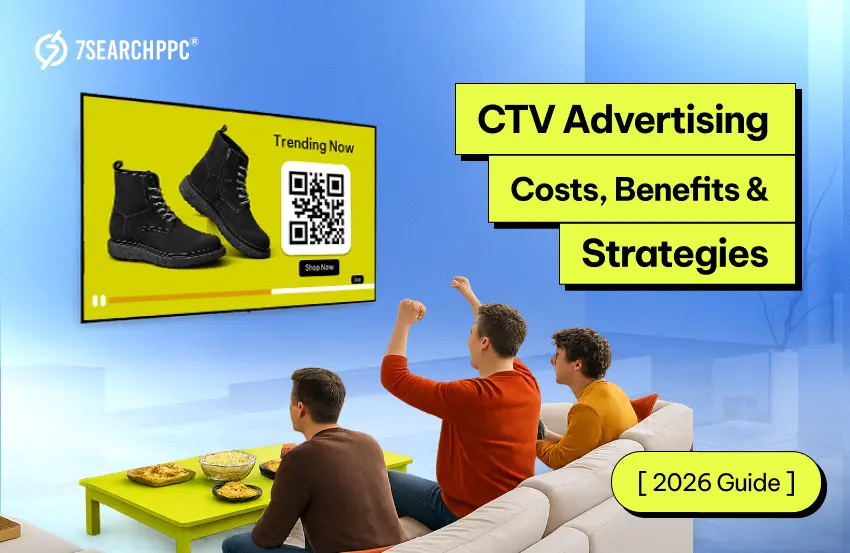
This example demonstrates how a brand showcases a product using CTV ads that include a barcode. The interactive QR code allows viewers to engage with the brand in real time and instantly explore available offers by scanning it.
Flexible Budgeting & Safety

CTV advertising helps advertisers build trust with new audiences—something that has been difficult in the past. Unlike many digital platforms, CTV offers a more controlled and credible environment where only legitimate, compliant brands can typically advertise.
This reduces the presence of fraudulent advertisers by raising barriers to entry and more closely monitoring content, ultimately creating a safer, more trustworthy experience for viewers.
In addition to trust, Internet TV advertising is also highly flexible from a budgeting perspective. Advertisers can scale their campaigns based on their financial capacity, making it suitable for both small test budgets and large-scale campaigns.
Access to Cord-Cutting Audiences

Younger generations love watching matches on their smartphones, whether it’s football, basketball, or even cricket, but small screens can be disruptive, and TV is often the preferred option.
Internet TV advertising is especially effective here because it reaches users who no longer watch traditional cable TV. This includes younger, digitally native audiences who are otherwise hard to reach.
Young people are more interested in these types of sports, and believe it or not, if your ads reach that audience at the right time, it can be very beneficial for you to achieve your digital advertising goals.
83% of Gen Z say they are more open to seeing ads on streaming OTT/CTV than on any other digital channel, indicating they truly prefer CTV over both linear and mobile. Source: theTradeDesk
How Does CTV Advertising Work?
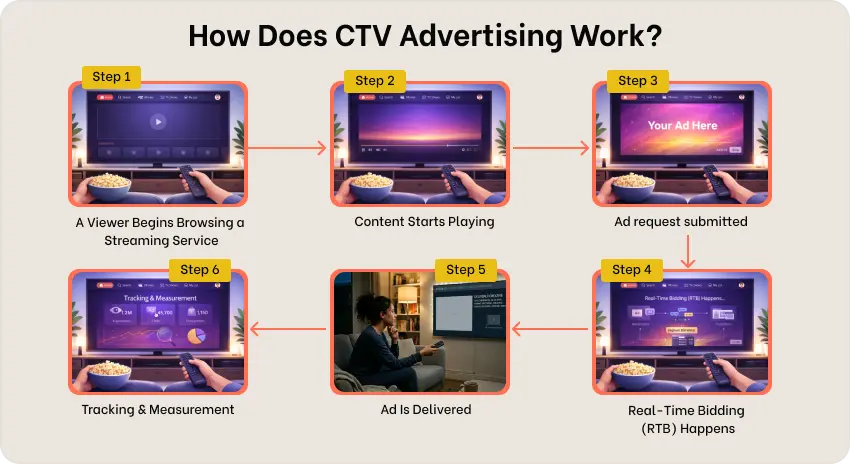
After understanding the benefits of Internet TV advertising, let’s take a look at how it actually works.
Step 1: A Viewer Begins Browsing a Streaming Service
A user launches an app like Netflix, Hulu, YouTube, or Disney+ on their CTV device, and at this moment, the platform identifies,
- Location
- Viewing behavior
- User profile (if logged in)
Step 2: Content Starts Playing
The viewer chooses a show, movie, or live channel on their smart TV device. If the platform supports ads, it includes specific ad slots before, during, or after content, which are commonly known as ad breaks.
Step 3: Ad request submitted
When a user reaches an ad break, the streaming platform sends an ad request to the ad server. Request includes data that has been made anonymous (so no one can be identified), such as
- Demographics (if available)
- Interests
- Device info
- Content category
Step 4: Real-Time Bidding (RTB) Happens
Real-Time Bidding (RTB) is a critical component of the Connected TV advertising process. It allows advertisers to compete in real time for the opportunity to display their ads to a specific viewer. In this process, you, as an advertiser, place bids for available ad space, and the highest bid wins. As a result, the winning ad is delivered and displayed instantly on the CTV device, ensuring highly targeted, timely ad placements.
This happens via platforms like:
- DSPs (Demand-Side Platforms)
- SSPs (Supply-Side Platforms)
Step 5: Ad Is Delivered
The ad has been successfully delivered! The selected ad is streamed to the viewer’s TV seamlessly.
- It plays just like a regular TV commercial.
- Usually non-skippable (depending on platform).
Step 6: Tracking & Measurement
Once your digital CTV ad runs, it provides various insights about users during and after the campaign. Advertisers gather performance data such as:
- Impressions
- Completion rate
- Conversions
Read More : Cookieless Advertising 2026: How Advertisers Can Prepare for the Post-Cookie Era
What is CTV for Local Advertising?
Before expanding into the global marketplace, it is essential to establish a strong, dominant presence in your local market. Building credibility and brand recognition at the local level creates a solid foundation for sustainable growth and long-term success.
This is where local Connected TV advertising becomes a powerful strategy. It enables businesses such as restaurants, clinics, fitness centers, and real estate agencies to deliver high-quality, television-style advertisements directly to audiences within a precisely defined geographic area. Let’s take a look at why local CTV advertisements are profitable.
1. Precise geo-targeting
Instead of paying for an entire TV channel audience, you can target:
- Specific cities
- PIN codes or neighborhoods
- People near your business
2. Cost efficiency
Unlike traditional TV ads, which are expensive and broad, when you use Internet TV advertising locally, it allows:
- Smaller budgets
- Pay per impression (CPM model)
- No wasted reach outside your area
Powerful Ad Creative Ideas for CTV Campaigns
What sets your CTV advertisements apart is how they’re created. We’ve listed some creative ideas to help you drive more engagement in your CTV ad campaigns.
Capture Attention Immediately
There are many ads that run daily on CTV devices, and what sets your ads apart is how you capture attention by creating something that leaves a lasting impression. Viewers can easily skip or tune out quickly. Start with:
- A bold visual
- A question or relatable moment
- Movement or contrast
Ad Copy Should be Top-Notch
Ad copy is the bridge between your brand and your audience. It’s how you communicate your message, spark interest, and inspire action. Strong ad copy doesn’t just inform, it stays with people.
Think of iconic taglines like McDonald’s: “I’m Lovin’ It.” Simple, memorable, and instantly recognizable. That’s the power of effective messaging. To create impactful ad copy:
- Keep it simple and focused: Deliver one clear, core message on your ad. Clarity always wins over complexity.
- Make it memorable: Use language that sticks, short, catchy, and emotionally engaging.
- Avoid clutter: Don’t overload your audience with too many value propositions. One strong idea is more powerful than many diluted ones.
A great ad copy isn’t about saying more; it’s about saying the right thing in the right way, so people remember you long after they have seen your ad on smart TV devices.
Strong Visual Storytelling
Imagine you are running an NGO campaign through CTV digital advertising. The most powerful approach you have is storytelling, right? In a world full of content, facts alone don’t inspire action; stories do. People connect with emotions, not just information. If you want to drive actions, your message must go beyond telling and focus on showing.
Make storytelling the core of your internet TV advertising strategy.
- Show, don’t just tell: Along with stating facts, visually demonstrate impact so viewers feel and understand your message.
- Use real-life scenarios: Show everyday situations people relate to, making your message more believable and personal.
- Leverage emotional storytelling: Create narratives that evoke empathy and inspire action. When people feel something, they’re far more likely to take desired action.
Safe Zones & Formatting
One thing you need to check is the formatting of the TV ads you’ll run. If the ad’s format exceeds the standard, it won’t fit on the screen properly, leaving half of the content cut off. This will make the visuals look terrible, and your effort will be wasted.
To avoid such situations, it’s important for you to,
- Keep key elements inside “TV-safe areas.”
- Avoid edges where content may be cut off
- Standard formats of CTV ads.
- 16:9 (1920×1080)
- MP4 or MOV file types are supported, and there are many other CTV ad formats you can explore.
Ensure that the safe zone area, which includes essential text, logos, and graphics, stays within a 5-10% margin on all sides of the screen. This helps prevent TV overscan, where the edges of the screen might be cut off.
Also Read – Tips for Affiliates to Stay Profitable in 2026 Amid Global Uncertainty
Challenges of CTV Advertising and Ways to Overcome Them
Nothing comes with full-fledged success, as challenges are part of the process. When it comes to Connected TV advertising, you will face obstacles that cannot be ignored. Let’s look at these challenges and how to overcome them.
1. Platforms Rules & Regulations
CTV ad inventory is distributed across platforms such as Netflix, Hulu, YouTube, and Roku. Each platform has its own policies, so you need to review each one to understand what is permitted and what is not.
Why it’s a problem:
- Hard to manage campaigns centrally
- Inconsistent measurement and targeting
How to overcome it:
- Use Demand-Side Platforms (DSPs) that aggregate inventory
- Work with partners offering cross-platform campaign management
2. High CPM Costs
Money plays a pivotal role in advertising effectiveness. To ensure your ads reach the right audience and deliver meaningful results, a sufficient level of investment is essential; low-funding campaigns often generate limited impact. Connected TV (CTV) advertising, in particular, tends to be more expensive than other digital advertising mediums.
According to GroundTruth, it is typically priced on a CPM (cost per thousand impressions) basis, with average rates ranging from $20 to $50 CPM.
Why it’s a problem:
- Higher cost per mille
- Budget constraints for smaller advertisers
How to overcome it:
- Focus on premium audiences and quality over quantity
- Optimize campaigns using performance data
- Test and scale gradually rather than large upfront spends
3. Frequency Capping Issues
Without proper control, users may see the same ad too many times on their smart CTV devices. One thing you have to focus on is frequency capping, as many advertisers just run their ads without understanding how many times they need to show the same ad to people.
Why it’s a problem:
- Poor user experience
- Ad fatigue reduces effectiveness, and people won’t engage.
How to overcome it:
- Set frequency caps at the campaign level (not just platform level)
- Work with DSPs that support cross-device frequency management
Read Also – What Is FTD Tracking in Advertising? Definition, Benefits, and How It Works
OTT vs CTV Advertising: How Do They Differ From Each Other?
Many advertisers are often confused about the difference between OTT and CTV advertising. While these terms may seem similar, they function in distinct ways.
What is OTT Advertising?
OTT (Over-the-Top) advertising refers to delivering ads directly to viewers through internet-based streaming services, bypassing traditional cable or satellite TV. It enables advertisers to reach specific audiences based on their preferences, behavior, and demographics, making it a highly effective and personalized marketing approach.
Let’s examine the differences:
| Factor | OTT Advertising | CTV Advertising |
|---|---|---|
| Device Scope | Works across multiple devices (mobile, tablet, laptop, smart TV) | Limited to TV screens (smart TVs or TVs with devices like Fire TV Stick) |
| Audience Reach | Broader reach due to multi-device access | More focused, TV-viewing audience |
| User Behavior | Often personal, on-the-go viewing | Lean-back, family/shared viewing experience |
| Personalization | Highly personalized ads based on user data | Less personalized (household-level targeting is common) |
| Cost Structure | Generally, lower advertising costs, flexible budgets | Higher CPM due to premium CTV ad inventory |
| Ad Experience | Can be skippable or interactive | Usually non-skippable |
Overall, Connected TV (CTV) is a subset of Over-the-Top (OTT) media that refers specifically to video content streamed over the internet onto a television screen.
Budget Allocation Tips for CTV Advertisers
Connected TV advertising can deliver strong results—but only if your budget is allocated strategically. Here are some expert tips to help you get the most out of your spend:
Start With Clear Goals
What do you want from advertising through CTV? It’s not just a question—it’s about clarifying your goals. Before allocating a budget, ask yourself what you want to achieve:
- Awareness: prioritize reach and completed views
- Performance: optimize toward conversions or site visits
- Consideration: focus on engagement metrics
When you understand the goal, it becomes easy to allocate your budget.
Dayparting is Something You Can Try
Dayparting, also known as ad scheduling, is a valuable strategy for CTV advertisers to optimize budget allocation by showing ads only during specific hours of the day or days of the week when the target audience is most active and receptive.
By analyzing historical data and viewer behavior, advertisers can shift away from “always-on” strategies to focus spending during peak performance periods, reducing wasteful spending during low-engagement hours. It is a widely used strategy, and if you want to succeed, you should try it out.
Follow a Test-and-Learn Approach
Don’t use your entire budget upfront; allocating everything at once without seeing results can make you feel like your effort and money are wasted, which is a harsh reality. You can utilize your budget gradually.
- Allocate 20–30% for testing (platforms, creatives, audiences)
- Use the remaining 70–80% to scale winners where you are getting results from.
While CTV is a strong option and worth considering, it’s definitely not the only path available for advertisers. You can also use 7SearchPPC to run display ads across niche websites/blogs, helping you reach the right audience, increase visibility, and get better results at a lower cost.
Conclusion
CTV advertising is reshaping how brands connect with modern audiences through targeted, immersive, and measurable experiences. Despite challenges like cost and platform fragmentation, its benefits far outweigh the drawbacks. By utilizing smart strategies, compelling creatives, and data-driven decisions, advertisers can unlock CTV’s full potential and drive meaningful, scalable business growth.
Frequently Asked Questions (FAQs)
What is CTV advertising, and how does it work?
Ans: CTV (Connected TV) advertising refers to video ads delivered through internet-connected TVs during streaming content. It works through utilizing data-driven targeting and real-time bidding to show relevant ads to viewers.
What is the difference between OTT and CTV advertising?
Ans: OTT advertising runs across multiple devices, such as mobile and desktop, while CTV advertising is limited to television screens, such as smart TVs and streaming devices.
Is CTV advertising worth it?
Ans: Yes, choosing CTV advertising can be a really worthwhile decision because of the strong results it can deliver. As more families switch to on-demand streaming, CTV provides advertisers with access to high-quality inventory without the usual hurdles of broadcast buying.
How much does CTV advertising cost?
Ans: It usually costs between $20 and $50 CPM (cost per thousand impressions), depending on targeting, platform, and audience quality.
What is programmatic CTV advertising?
Ans: CTV Programmatic advertising uses automated technology and real-time bidding (RTB) to efficiently buy and place ads on connected TV platforms.
Are CTV ads skippable?
Ans: Most CTV ads are non-skippable, resulting in higher completion rates and better brand recall than in skippable formats.
What is white-label CTV advertising?
Ans: White-label CTV advertising allows agencies to offer CTV ad services under their own brand using third-party platforms.