Core Insights
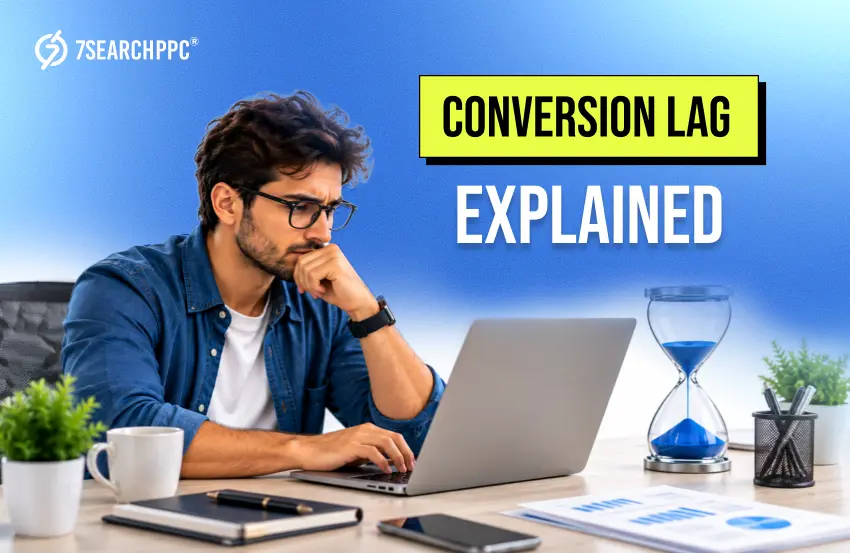
- Conversion lag is the time gap between someone clicking an ad and completing a conversion action on a website.
- Ignoring conversion delay wastes media buyers’ budgets because they end up judging campaigns on incomplete data, cutting or scaling ads before conversion delays are accounted for.
- A weak landing page experience, high-priced products, and shifting focus beyond leads to direct sales are some of the top reasons behind conversion delay.
- S2S tracking and well-defined attribution windows let you record delayed conversions and credit them to the right source.
Nobody tells you this when you start running ads: the report you check every morning is always a little bit off.
It’s not that your tracking setup is wrong. It’s just too early.
Every purchase that’s still on its way, from the person who clicked yesterday and is still “thinking about it,” hasn’t shown up yet. So your numbers look worse than the truth, and you’re making decisions based on a picture that hasn’t finished loading.
That delay between click and purchase has a name: conversion lag. And knowing how long yours lasts might be the most useful thing a media buyer can learn.
This blog helps media buyers understand how long conversion delays last and how to account for them to avoid making incorrect optimization decisions.
What is Conversion Lag?
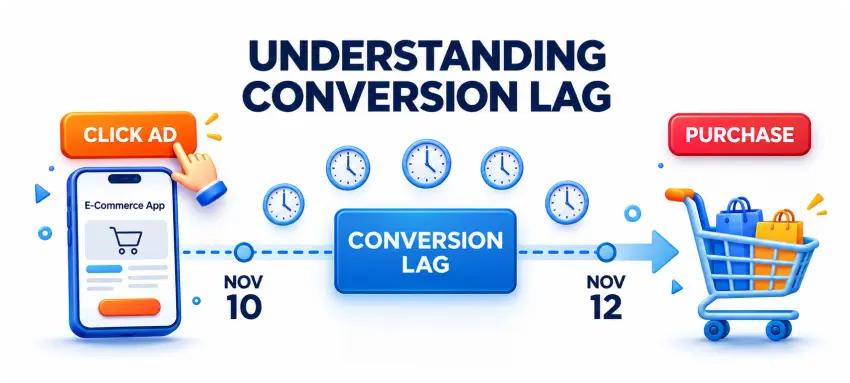
Conversion lag is the time gap between when someone clicks your online ad and when they actually buy, sign up/register, or take another desired action. Some people convert within minutes; others take days or weeks. That’s normal, but it can make early results look worse than they are and push you into hasty, costly optimizations.
How Much Does Conversion Lag Cost Your Campaign?
Let’s talk about a mistake you’ve made at least once.
It’s Wednesday morning. You launched your campaign on Monday and have been refreshing the dashboard every hour since. (Don’t lie; you have.)
Finally, you check the numbers:
↪ Your ad received 20,000 impressions
↪ 200 people clicked
↪ Only 2 bought
That means if you have spent $500, you paid $250 per sale. After reviewing the numbers, you might think: “The campaign is not working; let’s optimize or pause it.” Sounds like a smart move, right?
Wrong. And it just cost you money.
Here’s what you missed. Those 200 people who clicked? Most of them weren’t ready to buy yet. They were comparing prices. They were showing the page to their partner. They were waiting for payday. Some of them forgot about it and came back a week later.
If you had just given it 30 days, here’s what your sales could have looked like:
Day 3: 2 sales
Day 7: 6 sales
Day 30: 10 sales
The ad was the same. The budget hadn’t changed either. But over time, your cost per sale dropped from $250 to just $50.
So, the next time your campaign doesn’t get results in the first few days, don’t rush to call it a failure; give it a limited amount of time.
That gap between the click and the purchase has a name: conversion lag. Most media buyers have heard the term. Many know what it means, yet few know how long to wait. Track Delayed Conversions with 7SearchPPC S2S Postback
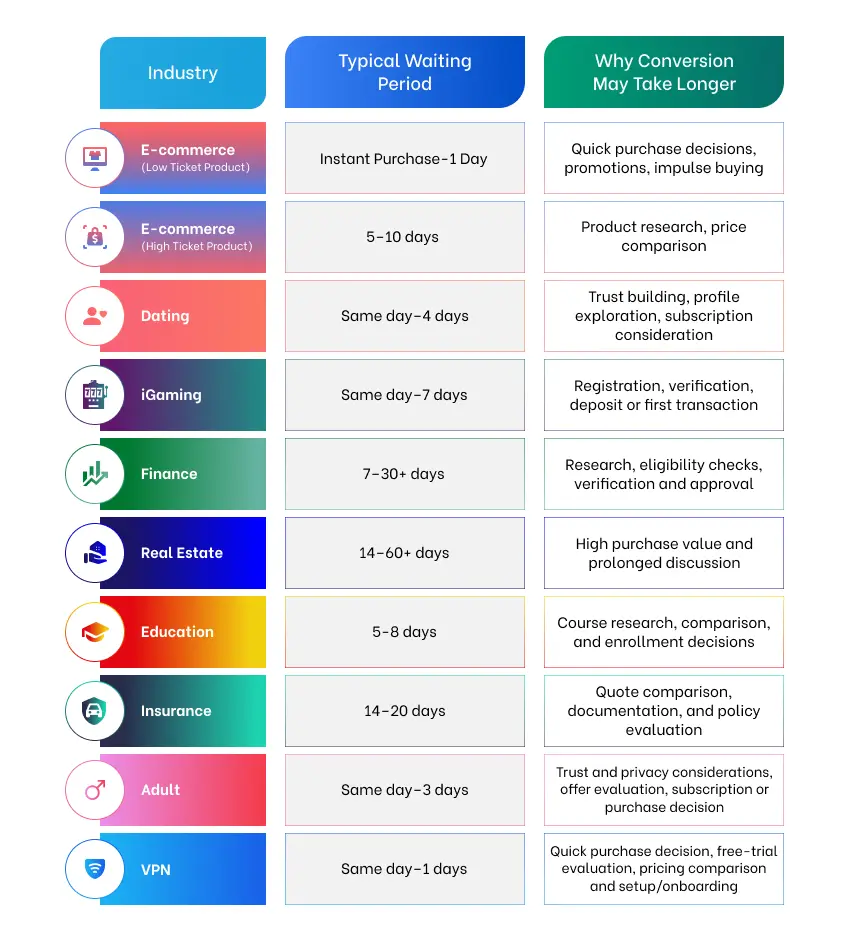
How Long Should Media Buyers Wait: Conversion Lag Across Industries
Not everyone who clicks an ad converts immediately. Some need time to evaluate the product before buying. The real challenge for media buyers is knowing how long people actually take to convert and how much time to allow before judging a campaign.
The table below lists how long media buyers should wait for conversions in different industries. It compiles data from various sources to help you decide the right timeframe for evaluating ad campaign performance.
Top Reasons Behind Conversion Lag
Identifying the factors that lead to conversion delays matters for media buyers. Without a clear understanding, you will repeat the same mistake and exhaust your overall advertising budget in one go.
To reduce conversion delays, media buyers should review the following factors.
1. Feeble Landing Page Experience
Why it happens: A weak landing page can be a major reason for conversion lag. If the page takes too long to load or people get confused while navigating, they naturally start to hesitate. When visitors are unsure about your offerings or find something unclear on the page, their trust drops, which can delay conversions.
Solution: Don’t focus only on ads; improve the landing page by making it faster, clearer, and most importantly easier to navigate, with a CTA in the right place. Make the landing page experience as trustworthy as possible; this helps people feel more secure on the website, which can definitely help overcome conversion delay.
2. High-Value Purchase Products
Why it happens: The more expensive a product or service is, the longer people usually take to make a decision. In industries like software or finance, buyers are making a bigger commitment, so they often don’t convert right away. That waiting period is what creates conversion lag.
Solution: People don’t always make a purchase right after seeing an advertisement. They may need time to think it over or compare different options. Be patient and take the time to understand how long the buying process usually takes in your industry.
For example, if you’re advertising finance products like loans, potential customers may take several weeks to compare interest rates, check eligibility, and prepare the required documents before applying. Give your campaigns enough time to generate meaningful results before making changes. If results still don’t come, move to campaign optimization.
3. Shifting Focus Beyond Immediate Conversion
Why it happens: Securing a lead is just the first step; it doesn’t guarantee that the individual will convert to the offer. If you take too long to follow up or keep delaying the next step, the lead can lose interest. Someone who was interested a few days ago may no longer be interested. If you’re not converting those leads quickly, there’s a good chance another business will follow up with them and take that opportunity from you.
Solution: Prioritize metrics like speed to lead. When a person clicks your ad and lands on the page, encourage them to complete the form immediately. This converts visitors into leads you can easily target. After submission, follow up within minutes. The quicker you respond, the more trust you build, and the sooner the lead reaches a decision, which cuts down conversion lag.
4. Spending on Low Bids and Base-Tier Markets
Why it happens: If you’re bidding low and targeting Tier 3 or base-tier countries, don’t expect people to buy straight away. In these markets, buyers often need more time before they’re ready to make a purchase. They may need to see your offer a few more times or interact with your business before deciding. So you might see clicks and engagement, but sales may take longer to show up.
Solution: Bid competitively and start with tier 1 and tier 2 countries, where you think people are ready to spend. You have to give the campaign enough time to optimize, but set a limit before you launch. Decide in advance how much you want to spend per source.
How 7SearchPPC Helps Media Buyers Reduce Conversion Lag
If you are facing conversion delays, you are not alone. Many media buyers struggle to know their campaigns’ true performance because conversions don’t happen right after the click.
The fix isn’t to wait too long, like months. It is to track conversions in a way that stays tied to the original click, no matter when the conversion happens. This is where 7SearchPPC’s server-to-server tracking comes in.
How 7SearchPPC S2S Tracking Solves This
Instead of relying on browser cookies, postback tracking gives each click its own unique click ID. When a conversion happens, your server or the advertiser’s server sends that ID back to 7SearchPPC, matching the conversion to the exact click that led to it.
Some of the benefits include:
- Accurate attribution: Conversions are matched to the exact click, even if they happen weeks later.
- Real-time reporting: Conversion data reaches your dashboard the moment it occurs.
- No cookie restriction: Longer conversion windows no longer risk data loss.
A Practical Example of Measuring and Reducing Conversion Lag
Step 1: Before Optimization
Suppose you are running an e-commerce campaign on the 7SearchPPC ad network. With weak tracking, you notice that conversions trickle in slowly. After setting up postback tracking and collecting data for 30 days, you measure the average conversion lag:
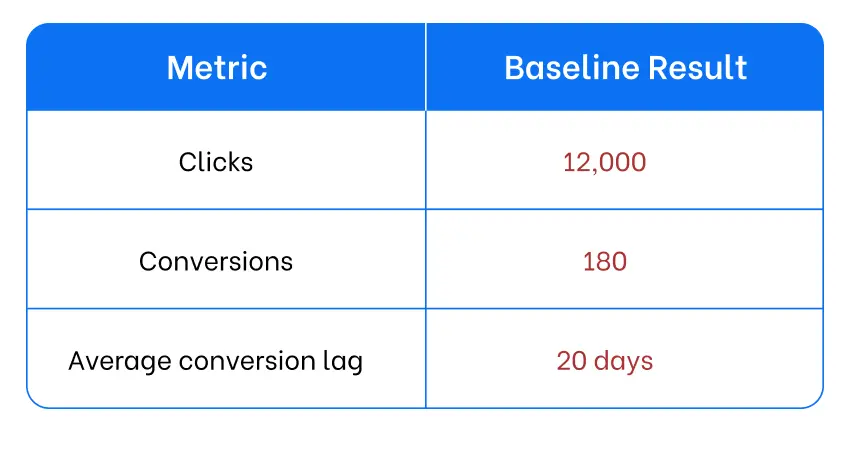
Now you have a clear picture: most conversions happen late, so judging the campaign at day 3 or day 7 would have been misleading.
Step 2: Optimization Using Postback Data
With click-level data from the postback, you analyze which segments convert fastest and best:
- Top sources converting within 3 days get higher bids and more budget. (got whitelisted)
- Slow, low-quality traffic sources (no conversions) are completely blacklisted.
- Make landing page adjustments, such as adding urgency, a free trial, a stronger call to action, or an instant lead form.
Step 3: Re-Check After Optimization
Once you have optimized the ad campaign, wait for another 30 days with the optimized setup, using the same postback tracking:
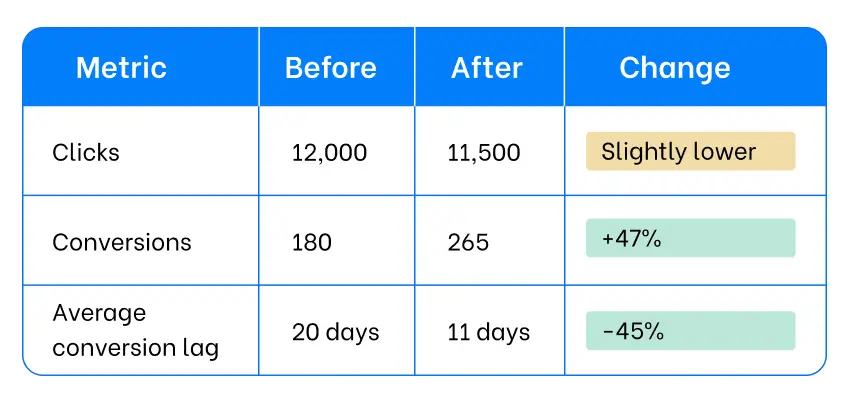
What this shows: Because the postback data was accurate, you were able to identify what shortened the conversion cycle and double down on those factors. As a result, the average conversion delay dropped from 20 days to 11 days.
Postback Tracking Is Just the Start: Unlock More Growth with 7SearchPPC
Beyond S2S tracking, 7SearchPPC gives media buyers an environment built for performance:
- Support for multiple ad formats (text, banner, native, popunder, push, and interstitial)
- Real-time stats and campaign controls.
- Flexible budgeting.
- Targeting by geo, device, and os.
- Affordable bids suited to testing new and premium offers.
Stop Pausing Campaigns That Haven’t Finished Converting
Join 7SearchPPC today, set up your S2S tracking, and let every click get the credit it deserves. Measure Real Conversion Lag and Optimize with Confidence