
Core Insights
- PPC campaign optimization based on assumptions, not data, doesn’t move the needle.
- The 80/20 rule in advertising suggests that roughly 20% of your efforts, such as specific ad channels, audiences, or ads, generate about 80% of your results.
- The Pareto Principle is a precept, not a mathematical law, so the split won’t always be 80/20.
- Don’t optimize campaigns too early; give them enough time to perform and gain data.
- Identify your skew type: no, mild, or strong, to determine how to reallocate the budget.
- Traffic sources that offer native postback integration streamline tracking and help optimize campaign performance.
No matter how well you plan, not every ad you run will deliver the results you expect. Some campaigns bring in quality leads, some drive sales, and others keep spending your budget without giving much back. Yet, advertisers often spend the same amount of time managing all of them. And that’s where things can go wrong. You don’t always need more campaigns, a bigger budget, or another round of testing. Sometimes, you just need to figure out what’s already working and give it more attention. That’s the idea behind the 80/20 rule in campaign optimization.
In this blog, we’ll look at how advertisers can use it to make better decisions, focus on high-performing campaigns, and get more value from their ad spend.
What Is Campaign Optimization Using the 80/20 Rule?

Ad campaign optimization using the 80/20 rule involves identifying the 20% of your efforts (campaigns, ads, audiences, offers, landing pages, and targeting) that deliver 80% of your results (conversions, sales, or leads). Once you know which efforts these are, you can prioritize them during optimization and double down on what’s already working. In short, campaign optimization is about determining what to change, whereas the 80/20 rule tells you what to prioritize.
If a finance advertiser, for instance, ran 20 campaigns on a self-serve advertising platform but only 4 generated 80% of the results, then the ratio would be 80/20. This data helps advertisers pick the efforts (inputs) that drive most results (outputs) and tweak spending strategically without disrupting current results. So, instead of giving equal attention to every input, advertisers can focus on what truly delivers better results.
About 35% of in-flight optimization decisions do not match later actual sales outcomes.
Source: Affinity Solutions
➡️ Wait a second! Is it always 80/20? No, it’s not. Sometimes it’s 70/30, 90/10, or something else. To understand why, let’s quickly review the theory behind the 80/20 rule.
The 80/20 Rule: A Short Background
Vilfredo Pareto, an Italian economist, introduced the 80/20 concept in 1896 after observing that 80% of Italy’s land and wealth belonged to 20% of the population. He also noticed the same pattern in his garden, where only 20% of the pea pods produced about 80% of the peas. Decades later, quality management expert Joseph M. Juran named it the Pareto Principle, suggesting that roughly 20% of causes often account for roughly 80% of the results.

The 80/20 rule is a precept (guiding principle), not a mathematical law, for finding the “vital few.” It compares two quantities: inputs and outputs, so the two numbers don’t need to add up to 100. Sometimes 30% of your campaigns generate 95% of your revenue, or 10% of your targeting generates 75% of conversions, resulting in 95/30 and 75/10, which don’t add up to 100 or satisfy the 80/20 split. In online advertising, the goal is to identify the inputs that drive most of your profit, regardless of the exact split. This lets you optimize digital ads with precision and achieve better results.
Why Use the 80/20 Rule in Campaign Optimization?
You spend your advertising budget on audiences, creatives, GEOs, and other ad segments, but only a few deliver exceptional results, while the rest contribute little. If you run campaign optimization using the Pareto Principle, you can reallocate spend to the best assets and make a few adjustments to improve performance and drive maximum results.
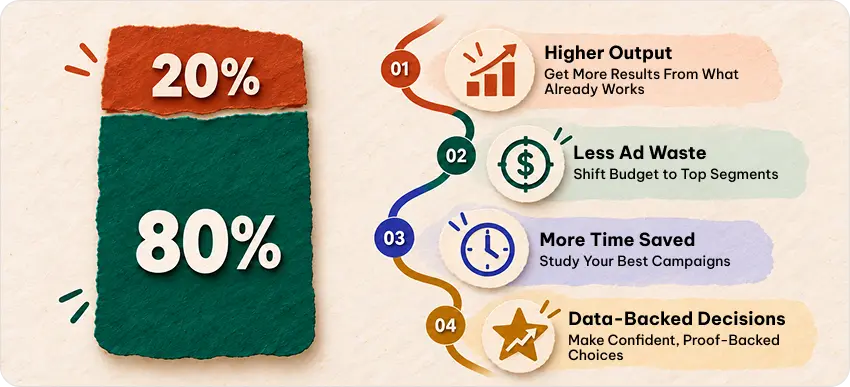
- Stronger Results From What Already Works: You get stronger results by putting a little extra effort into what’s already performing well.
- Smarter Budget Spending: You know what rarely converts, so instead of spreading your budget evenly, you can spend more on segments more likely to improve overall performance after campaign optimization. This way, you can avoid spending time and budget on segments that are barely profitable.
- More Time to Learn From Your Winners: Instead of auditing numerous underperforming campaigns, you can analyze your best campaigns in detail, identify what drives their success (ad angle, creative, location, or audience), and scale, refine, or replicate those elements.
- Confident, Data-Backed Decisions: You can easily eliminate guesswork from your campaign optimization process and make data-driven decisions.
Track Conversions with 7SearchPPC Native Postback Integration
How to Find the 20% of Your Campaign Driving 80% of Results
Export or copy your campaign-level statistics from your ad network or tracker into a single spreadsheet, rank campaigns by your chosen metric (such as conversions), then calculate each campaign’s cumulative share of the total to identify your top performers.
| Targeting Segments | Conversions | Cumulative Total |
| Retargeting (site visitors) | 450 | 450 |
| Lookalike audience | 230 | 680 |
| Interest: fitness | 120 | 800 |
| Age 25-34 (male) | 80 | 880 |
| Mobile device | 70 | 950 |
| Location: tier-2 cities | 50 | 1,000 |
* In the example, each targeting segment is an input and its conversions are the output. You can apply the same pattern to other inputs during your PPC campaign optimization.
To identify the Pareto split, arrange the inputs in descending order, from those bringing the most results to those bringing the fewest, and check the group’s combined output. Once you’ve completed the ordering, prepare a Pareto Chart.
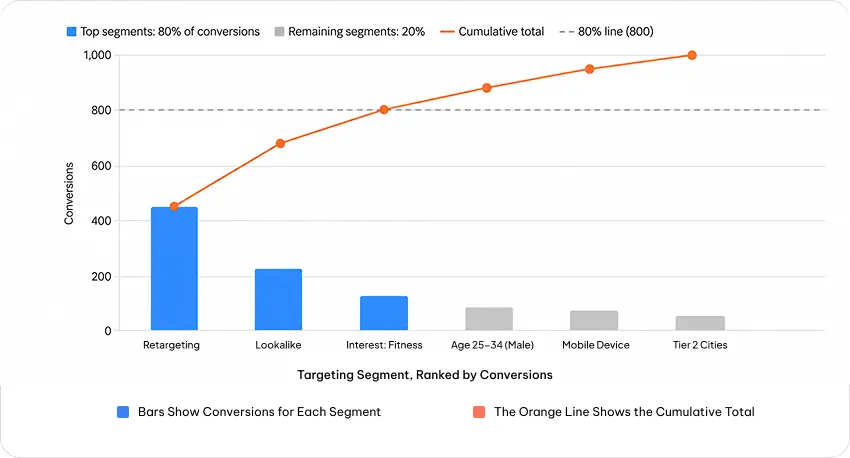
3 of 6 targeting segments generate 80% of conversions, so the split is 80/50, not the typical 80/20. With only six items, the split rarely looks like 80/20. If you evaluate more items, you can get a more precise view of how your online advertising campaigns are performing.
With a mild skew like this, results are spread across several segments, so shift budget gradually toward the top performers and avoid cutting spend too aggressively on the rest while optimizing your ad campaigns.
How to Optimize Ad Campaigns Based on the 80/20 Rule
Using the 80/20 Pareto Principle in ad campaign optimization helps you focus on the winners, make data-driven decisions, and eliminate guesswork. Use the ad spend optimization strategies below to update your ad campaigns the right way.
1. Identify Your Vital Few
Prepare a Pareto Chart and check your cumulative total to identify your top segments that deliver the most results. As shown above, repeat the same process for campaigns, audiences, ad angle, creative, devices, and locations to find the vital few. Just make sure you don’t measure too few segments, as that won’t let you determine the skew type: no, mild, or strong.
2. Reallocate Your Ad Budget
| Skew Type | What it Means | Budget Allocation Strategy |
| No Skew | Results are spread evenly across inputs, so no segment stands out. | No need to reallocate budget; instead, look for new segments to test. |
| Mild Skew | Results are distributed across various inputs, as shown in the example above. | Gradually allocate budget to top performers. |
| Strong Skew | A small share drives most results. | Move budget to top performers in stages, one or two segments at a time. |
Based on the skew, reallocate your online advertising budget. If the results show a mild skew, gradually reallocate your budget, for instance, by 5-10%. If the skew is strong, move the budget to your top-performing segments in stages, one or two segments at a time, so your campaign performance doesn’t drop after optimization. This lets you cut, pause, or eliminate underperforming campaigns and spend only on those with the potential to deliver better results.
3. Make Necessary Changes
Avoid making drastic changes to your top performers. Make only a few adjustments to your campaigns, such as ad angle, creative, landing pages, GEO-targeting, or offer, based on your observations. For example, if you’re currently targeting 5 GEOs, increase it to 8 rather than immediately targeting 20+ GEOs.
4. Review Your Tweaks
Review your campaign results only after a set period, so you have enough data to evaluate. Analyze whether the tweaks improved your results or dropped your campaign performance. If the updates don’t improve results, re-evaluate your decisions or consult an expert who can help with campaign optimization.
Tips for Campaign Optimization Using the 80/20 Rule
By using the tips below in your ad spend optimization strategy, you can optimize campaigns more strategically and fine-tune your results.
- Track the metrics that matter. High clicks and impressions look good on paper, but they don’t tell you how your ad campaigns are actually performing. Measuring CPA, revenue, ROAS, and conversions is a better approach than measuring vanity metrics like CTR and impressions.
- Don’t ignore the other 80%. Initially, prioritize the 20%, make a few changes, and gradually allocate budget to them, while keeping the remaining 80% running at a reduced level so it continues to support your overall results.
- Give campaigns time to mature. Measure campaign performance only after 3 to 4 weeks, as it gives your campaigns enough time to perform and gather data for evaluation. This is especially important if you’re running campaigns on a small budget, since campaigns need time to perform.
- Strengthen the whole funnel, not just the ad. Your ad performance also depends on your marketing efforts, including research, budget allocation, traffic sources, and landing pages. For instance, if you know your industry benchmark, you can set a precise CPA. If you know your audience behavior, you can design landing pages to match it, and if you know which segment converts best, you can target it directly. Use the 80/20 rule in marketing to optimize your digital advertising campaigns in detail.
- Use a traffic source with native tracking. Use traffic sources like 7SearchPPC that offer native integration with third-party tracking tools. This makes tracking seamless and helps advertisers make data-driven decisions during campaign optimization.
All Set to Apply the 80/20 Rule to Your Campaign Optimization?
The 80/20 rule tells you what to prioritize, so your optimization changes go to the segments that matter most and improve overall ad performance. Identifying the inputs that drive profit helps you spend your budget strategically and eliminate ad waste. The ad spend optimization strategies above can help you cut waste, save time, and improve returns without increasing your budget.
Not sure which segments deserve your spend? Our ad managers can help you find your top performers and apply the 80/20 rule to your campaign optimization.
Apply the 80/20 Rule with 7SearchPPC Postback Tracking