Core Insights
- Ad testing for an offer is the process of running controlled ad variations to determine which angles, creatives, and audiences perform best, so you can scale what works and cut what doesn’t.
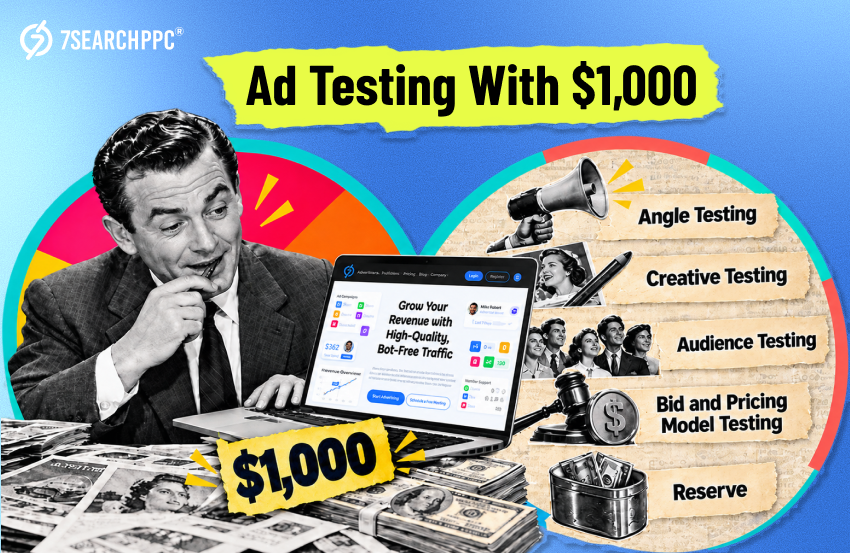
- To get the best results from your $1,000 budget, spend $300 on testing angles, $250 on creatives, $150 on testing audiences, and $200 on bid and pricing model testing. Keep the remaining $100 for further improvements.
- Change one variable at a time and keep everything else constant so you know what caused the result.
- Run each test for 5-7 days without editing mid-test, because changes will restart the platform’s learning phase and waste ad testing budget.
- If every angle fails, the problem is likely the offer itself, so change the offer instead of the ad.
Ask ten affiliates why their first campaign failed, and you’ll hear ten different answers. The ad was weak. The audience was off. The timing was bad. The offer just wasn’t for everyone.
Here’s the thing, though: most of them can’t say for sure. They never tested one piece at a time, so they never found out which piece broke.
That’s the real cost of an untested ad campaign. It’s not only the money you lose, but also the lack of any answer afterward. You don’t need a hefty amount to test your offer. With $1,000, you can run proper ad testing. In this blog, we will show you how to divide your budget, what to test first, and how to evaluate the results.
Why Does Ad Testing Matter When Promoting an Offer?
Digital ad spend is projected to reach roughly $836 billion by the end of 2026; a significant share of that money is likely to be wasted on ads that were never validated. Ad testing helps you avoid that waste.
By testing different ad campaign variables for a specific offer, you can identify which angles, creatives, or audience segments drive the most clicks or conversions.
For affiliate marketers, this matters a lot: even a small $1,000 budget can go a long way when invested strategically. Here are some benefits affiliates gain when testing ads for their offer:
- Make data-backed decisions: Ad testing replaces guesswork with precise data on what works best for your offer, so you can trust every decision you make.
- Reduce wasted ad spend: It helps you find the right campaign setup for promoting your offer. Once you know which variables drive results, you can put your budget behind them instead of wasting it on setups that don’t convert.
- Identify profitable audiences: You can understand different audience segments and focus your budget on the ones most likely to buy.
How Should You Split a $1,000 Budget for Ad Testing?
To split a $1,000 budget for testing, use the 30/25/15/20/10 rule: 30% for angle testing, 25% for creative testing, 15% for audience testing, 20% for bid and pricing model testing, and 10% for reserve.
Budget Split Overview
| Phase | Purpose | % | Amount |
|---|---|---|---|
| Angle Testing | Find the winning message or reason to care | 30% | $300 |
| Creative Testing | Find the winning format, hook, and execution of that angle | 25% | $250 |
| Audience Testing | Test the best ad on different audiences | 15% | $150 |
| Bid & Pricing Model Testing | Find the most cost-efficient way to buy the winning ad and audience | 20% | $200 |
| Reserve | Emergency buffer, retargeting, retesting | 10% | $100 |
| Total | 100% | $1,000 |
Section 1: Angle Testing ($300)

Angle testing is the first step of any ad testing plan, because the message you choose shapes every result that follows. Take a dating app example:
- Serious relationships: “Stop dating for fun. Meet people who want what you want.”
- Safety and trust: “Every profile is verified. No fakes, no catfish.”
- Loneliness: “Moving to a new city? Meet someone who gets you.”
Why Angle Testing Gets 30% ($300)
Your angle is one of the biggest factors that determine how well an ad performs. A strong angle can make an average creative work surprisingly well. But even the best-looking creative can fail if the message behind it isn’t right. Ignoring your angle can cost you 2x to 4x more, which is why it’s worth investing in the right message.
How to Test the Offer:
- Start with 3 angles at $100 each. That’s 3 x $100 = $300.
Only change the angle and keep everything else constant: same audience, format, landing page, and CTA. - Keep the creatives simple and equal in quality because you’re testing a message, not a design.
- Run all angles simultaneously for 5 days. This way, they all face the same market conditions.
What to Measure:
- CTR: Does the message grab attention?
- CPC: How much does each click cost you?
- CPA: How much does it cost to get a desired action?
Output of This Section
You’ll have a clear winning angle to scale. You can also keep the closest runner-up as a backup.
Section 2: Creative Testing ($250)

Now spend your budget on creative tests using the winning angle, but with different execution. The goal is to find the ad versions that stop the scroll and earn the click. Creative elements include:
- Ad Format: A visual representation of the message. Native, popunder, push, banner, interstitial ads.
- Ad Copy: Concise, persuasive text that explains the value proposition and highlights key benefits.
- Call to Action (CTA): The button or text telling the user what to do next.
Why Creative Testing Gets 25% ($250)
Spending on creative testing matters because it replaces guesswork and ensures your ad testing budget goes only to high-performing assets. There is a lot of variation to test, which is why 25% of the total testing budget is allocated to creative testing.
How to Test the Offer:
- Test 5 variations. Split the budget evenly: 5 x $50 = $250.
- Change one element at a time. If you change everything at once, you can’t tell which change drove the results.
- Keep the audience constant; you should use the same audience across all campaigns.
- You can also try running two sub-rounds. Spend $150 on high-volatility elements like ad format and hook, then $100 refining the winner with small tweaks to the headline or CTA.
What to Measure:
- CTR: Is the creative effective at grabbing attention?
- CPC: How much does each click cost you?
- CPA: How much does each conversion actually cost?
Output of This Section
You’ll have a winning creative that actually performs.
Section 3: Audience Testing ($150)
Audience testing shows you who responds best to your current offer. Common targeting options include:
- Broad: No restrictions on age, gender, or location.
- Interest-Based: People have shown interest in related products or services.
- GEO-Based: Targeting a specific location to promote an offer.
Why Audience Testing Gets 15% ($150)
Audience testing is valuable, but it usually brings smaller gains than angle and creative testing, especially since many ad platforms now automate much of the targeting.
How to Test the Offer:
- Test audiences on the basis of age, gender, interest, GEO, etc. Split the budget evenly across them to see which responds best.
- Use only your winning ad, which means your best angle and best creative.
- Keep everything else equal. Use the same budgets, placements, and schedules for every audience.
What to Measure:
- CPC: The most important metric at this stage.
- Landing page conversion rate: How effectively your landing page turns targeted visitors into conversions.
- Quality signals: Look for lead quality and whether they are purchasing the product.
Output of This Section
A winning audience that’s ready to convert on the offer.
Section 4: Bid and Pricing Model Testing ($200)
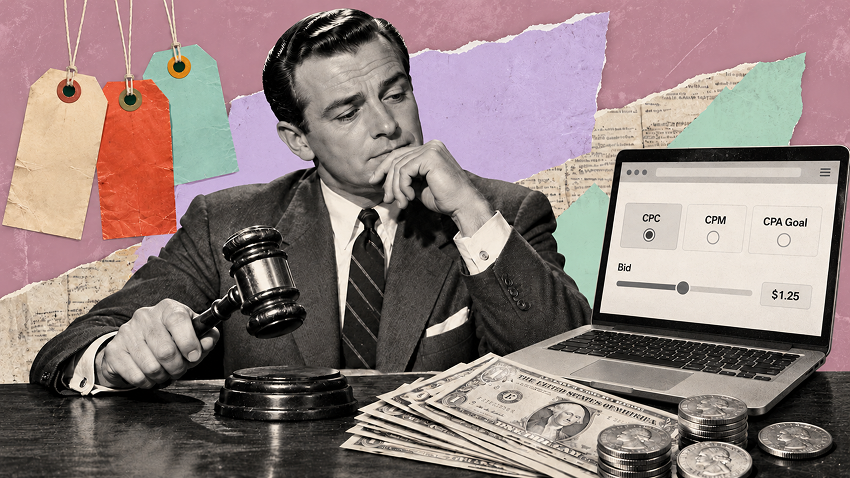
Once you have a winning angle, creative, and audience, focus on bidding and pricing models. The ad stays the same, but the way you pay for it changes. Pricing models include:
- Cost Per Click: You pay only when someone clicks your ad.
- Cost Per Mille: You pay per 1,000 impressions, whether or not anyone clicks. (It is mostly for brand awareness, so it’s usually a poor fit for affiliates because affiliates care more about conversions.)
- CPA Goal: You set a target cost per action, and the ad platform adjusts bids automatically to hit it.
Why Bid and Pricing Model Testing Gets 20% ($200)
By this stage, you know what message to deliver, how to present it, and who to target. However, your cost per conversion can still vary by 10–40%, depending on how you buy web traffic. This step gets a larger share of the budget than audience testing because the price you pay directly affects your profit margin.
How to Test the Offer:
- Invest $100 in CPA Goal, and the rest in other pricing models. CPA Goal is effective, so allocate $100 to it.
- Use only your winning ad and audience: your Best angle, best creative, and best audience.
- Run all setups simultaneously for 5 days, so they face the same competition and traffic quality.
- Don’t adjust bids mid-test, as editing during the run restarts the learning phase and muddies your data.
What to Measure:
- CPA: How much does each conversion cost?
- Traffic volume: A cheap bid is useless if it barely delivers.
- ROAS: How much revenue you earn for every dollar spent on the ad.
Output of This Section
You will know which bid and pricing model gets you conversions at the lowest cost, so you can scale with confidence.
Section 5: Reserve ($100)
Most advertisers plan only for the testing phases, then run out of money the moment something unexpected happens. The reserve is the part of your budget that keeps ad testing alive when a phase doesn’t go as planned. Use it for:
- Spend extra when the top two options are nearly tied.
- Retargeting people who have already engaged with your ads.
- Replacing a rejected ad and getting back into the test without losing momentum.
Why the Reserve Gets 10% ($100)
Testing rarely goes in a straight line. You may hit rejected ads, a test with no clear winner, or the most frustrating case: an ad that performs well early and then fades. Without a buffer, you either stop ad testing with incomplete data or pull money from other phases, and both weaken your results.
How to Use It:
- Release it only after a phase ends. Wait until you have the results in hand, so the money goes where the data points.
- If you are using a reserve budget on any of the testing again, document what you learn. Note what was tested and what the outcome was, so your next campaign starts with real knowledge.
What to Measure:
- Re-test results: The gap between the top two options after the extra spend.
- Frequency: To make sure warm audiences aren’t seeing the ad too often.
Output of This Section
The reserved budget can be used to test uncertain variables or retarget the audience, providing greater flexibility.
The Complete Picture
Phase | Output |
Angle Testing ($300) | The winning message |
Creative Testing ($250) | The winning format and execution |
Audience Testing ($150) | The winning audience |
Bid and Pricing Model Testing ($200) | The right bid and pricing model |
Reserve ($100) | Retargeting and a safe path to scale |
Launch Your $1,000 Test Campaign with 7SearchPPC
What Are the Biggest Ad Testing Mistakes That Waste Your Budget?
Most advertisers don’t run out of budget because their ads are not performing. They run out because small, invisible leaks drain the $1,000 before it can teach them anything.
Here are the four biggest leaks, and what each one costs.
Testing Too Many Variables at Once
If you are testing too many variables at once, it ruins your data and drains your ad testing budget by making it impossible to know which headline, image, or audience drove the result.
How to Fix: Change one ad campaign variable at a time, and keep everything else (landing page, placement, dayparting) identical. This makes it easy to see which variable drove the results.
Estimated Leak: $200-$300, money spent without producing any insight.
Testing Too Late
Most affiliates skip proper ad testing because they see it as another unnecessary step. But testing tells you what works and what doesn’t.
The mistake is waiting until you have a finished campaign to discover a weak hook, inefficient creative, or an audience that isn’t responding.
How to Fix: Test your angles, creatives, pricing, and audiences before committing your full budget.
Estimated Leak: $200–$300, because ad testing too late can force you to spend most of your budget before you discover what you should have tested from the beginning.
Testing the Creative When the Offer Is the Problem
You have tested everything within that $1,000 budget but still aren’t satisfied with the results; the problem may not be the ad but the offer you’re promoting. If people are not interested in the offer at that price or with that promise, no hook will engage or convince them. This is the most expensive mistake because it can drain the entire $1,000.
How to Fix: Focus on testing the angle first (that’s why it gets 30% of the budget). If every angle fails, change the offer.
Estimated Leak: The full ad testing budget with no results.
Editing Mid-Test
Making changes during a campaign’s testing phase can be risky and lead to problems. Many advertisers make the same mistake. For example, on day 3, if an ad isn’t performing well, they increase the budget by 60%, change the headline, and adjust the target audience all at once.
You have done your part; now the campaign will do its part. Each significant edit can restart the platform’s learning phase, and learning costs money.
How to Fix: Give a campaign a set testing period of 5-7 days. If something important is broken, like a disapproved ad, fix only that.
Estimated leak: $100-$300, assuming 2-3 resets at roughly that rate each.
Ready to Put Your $1,000 Ad Testing Plan Into Action?
A smart ad testing plan only works when the platform behind it gives you control over your budget and targeting. 7SearchPPC lets you test angles, creatives, audiences, and bid models across text, native, push, popunder, interstitial, and banner ads, starting with a small budget. Track campaign performance with the postback, find your winning setup, and scale only what converts.
Launch your first test campaign with 7SearchPPC today. Find Out What Makes People Click on 7SearchPPC