Key Takeaways!
- Retail Media Networks (RMNs) enable brands to advertise directly to high-intent shoppers using valuable first-party data, improving targeting and conversions.
- RMNs are rapidly growing due to the rise of eCommerce, making them a crucial channel for modern digital advertising
- Key benefits include higher conversion rates, better personalization, and measurable ROI.
- Choosing the right RMN requires aligning with business goals, evaluating audience quality, analyzing ad formats, and ensuring transparent pricing.
- Despite their advantages, RMNs present challenges such as high competition, rising costs, limited transparency, and varying audience reach across platforms.
If you’re planning your media mix today, there’s a good chance retail media networks are already on your radar—or they should be. They’re not just another online ad channel to test; they’re changing how advertisers reach and convert customers.
Instead of targeting broad audiences and hoping for conversions, RMNs let you engage shoppers using real purchase behavior and first-party data. That shift makes a big difference in both performance and measurement. But before you invest your budget here, it’s important to understand them fully.
In this blog, we’ll explore what these networks are, their benefits, types, challenges, and more. Keep reading!
What are Retail Media Networks (RMNs)?
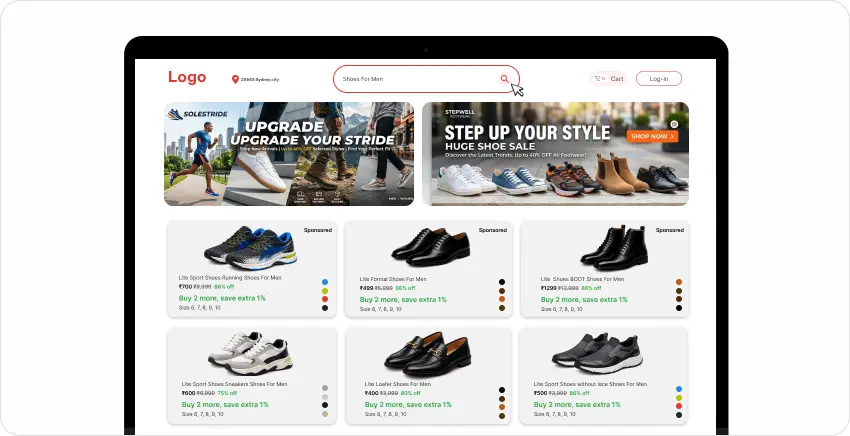
Retail media networks (RMNs) are ad platforms owned by retailers that allow businesses to promote their products and services through ad campaigns that target shoppers and encourage them to make purchases.
Advertisers use first-party shopper data like browsing history, purchase history, and preferences to create personalized ads on RMNs, which can increase conversion rates by up to 30%.
Let’s take an example for better understanding:
Imagine you open a shopping app. As you browse, you start seeing advertisements for dark chocolate bars because you have previously purchased premium chocolates and frequently browse snack categories. This is how retail media ads target you and encourage you to view, click, and buy.
Also Read – Tips for Affiliates to Stay Profitable in 2026 Amid Global Uncertainty
Benefits of Choosing a Retail Media Network
The retail media market is projected to reach $203.9 billion in 2026, growing at 14% year over year, more than double the overall advertising market’s growth rate. This shows how beneficial it is for advertisers to choose a retail media network.
Here are some advantages of this channel for advertisers:
Visibility to High-Intent Shoppers
Retail Media Networks (RMNs) offer a major advantage by reaching customers who are already browsing or searching for products, which puts them much closer to making a purchase. This eliminates the need for extensive effort to attract their attention, as your brand is already being showcased to users actively looking for similar products.
As a result, businesses benefit from:
- High Conversion Rate: Higher engagement drives higher conversion rates, as the likelihood of a click rises rapidly.
- Minimal Ad Spending: More efficient ad spending because you know your target audience and where you want to showcase your digital ads.
First-Party Data Advantage
Retailers have rich first-party data (purchase history, browsing behavior, preferences), which allows advertisers to:
- Highly targeted campaigns
- Better personalization
- Reduced reliance on third-party cookies
Using data helps you target shoppers who are already interested in your product, making it easier for them to engage with your ad campaign and increasing overall effectiveness.
Increased Brand Visibility & Growth
Even if people don’t convert through your retail media ads, you can still increase brand visibility and drive long-term growth. Results may not be immediate, as your ads on RMNs contribute to more than just conversions.
- Not every campaign leads to immediate sales—and that’s normal.
- Many customers already have strong brand preferences, making instant conversion unlikely.
- However, even without a purchase, your ads increase brand visibility and influence future buying decisions.
Apart from this, your online retail ads appear within a trusted retail environment, which:
- Build confidence as customers associate your brand with reliable retailers.
- Avoid the risk of showing up next to inappropriate or irrelevant content.
Works on PPC and Offers Measurable Results
Some RMNs are highly cost-effective because they primarily operate on a pay-per-click (PPC) advertising model. This means advertisers only pay when a shopper shows genuine interest, directly connecting advertising expenses to active intent. Here’s how they benefit:
- Waste Elimination: Brands pay for engagement rather than passive views, ensuring the budget targets shoppers who are actually interacting with the product.
- Closed-Loop Tracking: Every dollar spent is traced to a specific transaction, allowing advertisers to calculate their exact Return on Ad Spend (ROAS).
- Automated Efficiency: Systems automatically pause ads if a product goes out of stock, preventing any wasted spend on unavailable items.
Read Also – What Is FTD Tracking in Advertising? Definition, Benefits, and How It Works
Top Retail Media Networks
Instead of guessing who might want a product, retail media networks help you target shoppers with a history of buying in that category. However, the real question is which one you should choose to promote your products. Below are some examples of RMNs to consider.
- Amazon Ads: In the world of retail media, Amazon is the giant on whose shoulders everyone else stands. They didn’t just pioneer the RMN—they defined the gold standard for sponsored products.
- Instacart Ads: Ideal for FMCG (Fast-Moving Consumer Goods) advertising, as ads appear right when users are building their weekly grocery baskets.
- Walmart Ad Center: Walmart’s self-service advertising platform empowers sellers to promote their products directly on Walmart.com and its mobile app. What sets it apart is its ability to seamlessly connect digital ad exposure with in-store purchases—bridging the gap between online discovery and offline buying.
- eBay Advertising: Excellent for search-driven marketplaces where shoppers are actively comparing prices and specific models. It benefits advertisers through precise, cookieless advertising, closed-loop attribution, and increased brand visibility.
- Roundel: Known for being “brand-safe” and highly curated. It’s a great example of a retail media network that uses shopper data to deliver personalized ads across channels.
These are not the only options, as there are other retail media network alternatives that can deliver more effective results.
Among these, 7SearchPPC is one option advertisers may consider when planning to promote products and services. Our ad network offers high-quality and premium traffic to drive better engagement and higher conversions for your retail campaigns.
How to Choose an Effective Retail Media Network
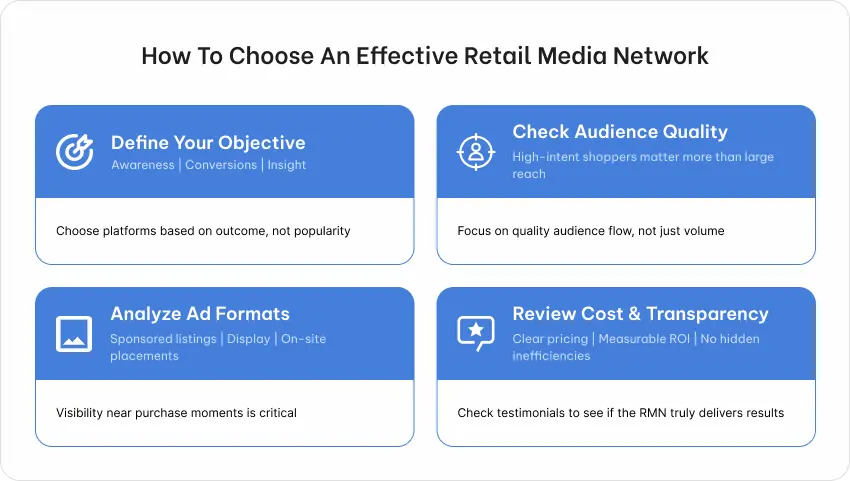
Choosing an effective Retail Media Network (RMN) isn’t just about picking the biggest platform; it’s about finding the one that aligns with your brand’s goals, audience, and data needs. Here’s how to choose wisely:
Start with Your Objective
Once you know your brand’s objective, you can identify which platform best supports it and select accordingly. Different RMNs serve different purposes. Be clear on what you want:
- Brand awareness: Look for high-traffic retail media networks.
- Sales conversion: Prioritize networks with strong purchase intent data.
- Customer insights: Choose RMN with robust analytics.
- Be clear: Are you aiming to drive sales, build brand recall, or gather shopper insights? Clarifying your goals helps you better understand the platforms. For example, an RMN like Amazon Ads excels at conversions, while Walmart Connect provides reach both in-store and online.
Evaluate Audience Quality
Retail advertisers come in many forms; that’s simply the reality. Every brand defines its audience differently. Some prioritize consumers with higher disposable income, while others focus on value-driven shoppers seeking affordable options. Because of this, it’s essential to assess whether the RMN you choose aligns with the specific audience your brand is trying to reach.
A large audience alone doesn’t guarantee results. Reach is only valuable when it’s relevant. Instead of focusing purely on scale, ask the right questions:
- Does the platform’s audience align with your target demographic?
- Are users actively searching for products in your category?
Ultimately, effective retail advertising isn’t about being seen by the most people; it’s about being seen by the right people.
Look at Ad Formats & Placement Options
Retail Media Networks (RMNs) have become a critical channel for brands seeking to influence shoppers close to the point of purchase. However, relying on a limited set of ad formats or placements can significantly restrict a brand’s visibility and overall campaign effectiveness.
Key advertising formats and placement options to look for include:
- Sponsored product listings: These appear within search results or category pages, helping brands capture high-intent shoppers and drive conversions.
- Display advertising (on-site and off-site): On-site display ads reinforce brand presence within the retailer’s ecosystem, while off-site ads extend reach across external websites and platforms, improving awareness and retargeting capabilities.
- Email and app-based promotions: Personalized communications through retailer-owned channels help brands re-engage customers and drive repeat purchases.
Transparency & Cost Structure
Affordability is crucial for any advertiser, as transparency and cost structure are important factors to understand when choosing an RMN. Target retail media networks where you find advertising cost-effective, but results are better with less expenditure and improved outcomes. Watch out for:
- Hidden fees
- Minimum budget requirement
- Unclear reporting
Challenges of Retail Media Networks
With every benefit comes a challenge. It’s important to identify the challenges associated with choosing a retail media network for digital advertising. Here are some of them:
High Costs and Rising Competition
Retail media networks are typically expensive due to increasing competition, which is the reality. As more brands invest in retail media networks:
- Ad inventory becomes more competitive
- Cost-per-click (CPC) and cost-per-mille (CPM) increase
Small brands using retail media networks should start with low-budget, hyper-targeted campaigns for high-intent audiences, focus on top products, and optimize quickly for maximum ROI and visibility.
Lack of Transparency and Brand Safety
Retail Media Networks can face both transparency and brand safety issues, even though they are considered more controlled than open web advertising. These platforms operate as closed ecosystems where advertisers have limited visibility into campaign performance, making it difficult to verify data or understand how results are measured.
Lack of Transparency occurs because:
- Data is aggregated and not fully shared with advertisers.
- Limited insight into bidding, pricing, and competition.
Brand Safety risks arise due to:
- Ads appear next to low-quality or counterfeit products.
- Misplacement through broad or ambiguous keyword targeting.
- Reduced control when ads are shown on third-party partner sites.
Less Audience Reach
Beyond the largest retail media networks (RMNs) like Amazon and Walmart, many smaller networks struggle with limited impressions, a fundamental challenge marketers must navigate.
While over 200 RMNs exist globally, the market remains heavily concentrated, with Amazon alone generating more than six times the impressions of any other network and commanding a dominant share of advertiser activity. Source: SensorTower
Advertisers must accept that not all RMNs can deliver strong reach—many simply don’t have enough audience scale.
Conclusion
RMNs are perfect for retail advertisers looking to reach a high-intent audience with their products and services. RMNs platforms such as Amazon Ads, Walmart Connect, and Instacart Ads stand out as leading options for maximizing visibility and conversions. While challenges like high costs and limited transparency persist, these can be effectively managed with the right strategy and optimization approach.
Frequently Asked Questions (FAQs)
Q1: What are Retail Media Networks (RMNs)?
Ans: RMNs are advertising platforms operated by retailers that enable brands to promote their products directly to shoppers across retailers’ websites and apps.
Q2: How do retail media networks work?
Ans: RMNs enable brands to buy advertising space directly on a retailer’s digital channels (websites or apps), showcasing their products to the audience and engaging them to purchase.
Q3: Why are retail media networks on a trend?
Ans: RMNs are growing rapidly due to increased eCommerce activity, the decline of third-party cookies, and the demand for highly targeted, data-driven advertising solutions.
Q4: What are some examples of top retail media networks?
Ans: Some of the best RMNs include Amazon Ads, Walmart Connect, Instacart Ads, eBay Advertising, and Roundel.
Q5: How do retail media networks ensure brand safety?
Ans: RMNs ensure brand safety by providing a controlled advertising environment where retailers manage the content, placement, and context of ads. RMNs use first-party data and strict guidelines to ensure ads reach the right audience in a safe, trusted space, giving brands more control over where and how their ads are shown.