Core Insights!
- Perform tight targeting, improve your post-click experience, measure the performance of the advertising platform, pick high-intent keywords, and optimize your creatives to lower cost per click.
- Advertisers can use the standard average CPC formula: total ad spend divided by total clicks, to calculate whether they’re spending more, less, or equal to their actual CPC.
- If the cost per click is higher, you’re getting fewer clicks, and your budget is being wasted.
- A good CPC is one that helps you gain significant clicks within your PPC advertising budget.
How badly does the advertising budget fluctuate when the cost per click spikes? We all know that feeling! It’s terrible. It exhausts our entire ad budget and leaves us with a handful of clicks.
It can happen for several reasons, including low quality score, broad targeting, and more. It isn’t that you can’t lower your cost per click. By strategically creating and optimizing your pay-per-click advertising campaigns, you can make it happen.
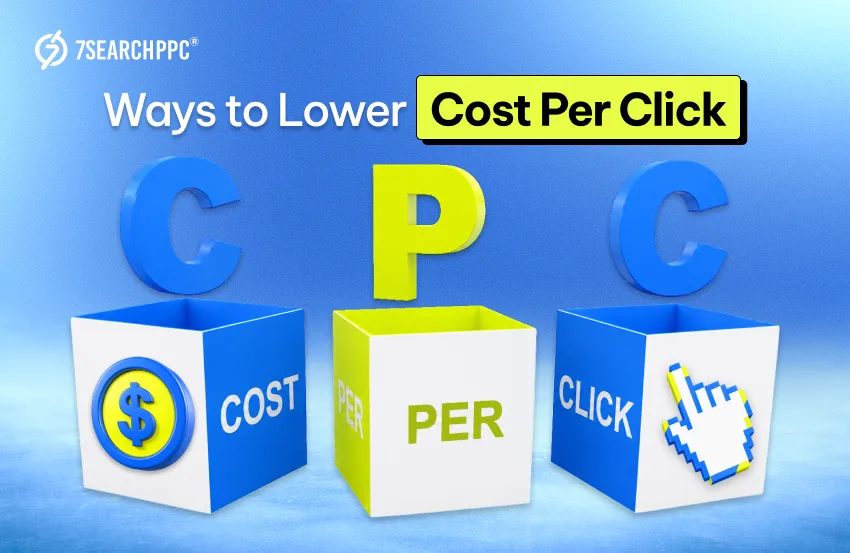
In this post, you’ll learn how to do so. We’ll share 7 effective ways to lower cost per click and increase ROI.
All the PPC campaign optimization strategies outlined in this post were gathered with our ad manager’s support, who knows the ins and outs of cost-per-click advertising. Let’s start shedding light on the CPC optimization best practices.
Why a Lower Cost Per Click Matters for Advertisers
Just tell us one simple thing! Would you like to gain more clicks and revenue, or would you rather have fewer clicks and revenue potential within the same budget? Of course, you would want more clicks and a good CVR at the same price. A low cost per click for ads means you can:
- Increase traffic, leads, and conversion potential within the same ad spend.
- Save budget to create new campaigns, test creatives, and better optimize CPC ads.
- Pay less for the same or better ad placement.
A lower cost-per-click lets you multiply your advertising results without increasing your pay-per-click (PPC) costs. To evaluate how much you’re spending per click, you can use the following formula:
| Cost Per Click = Total Ad Spend (÷) Total Number of Clicks |
If your average cost per click is higher than your actual CPC, it indicates you’re spending more per click than the amount set during campaign creation. You need more clicks within the same ad spend to lower your CPC.
A good cost per click is the one that generates a significant amount of clicks within the total PPC marketing budget.
7 Smart Strategies to Lower Cost Per Click in 2026
We’ve outlined several strategies you can start implementing today to lower your cost per click.
1. Improve Your Quality Score
Quality Score is a performance metric used by search engine advertising platforms to evaluate how relevant the ad is to the users who see it. The metric measures relevance, landing experience, and expected CTR.
A high score means that your CPC ad is highly suitable for the user’s search query, and you can get better ad placements at a lower CPC. It means you don’t have to increase your budget to beat your competitors.
How to do it
- Align ads and search intent to improve relevance and click-through rates.
- Improve your overall post-click experience. From landing on your website to checkout, make sure everything is perfectly aligned.
- Closely monitor your CPC keyword performance and remove the underperforming ones.
- If you’re targeting the BOFU audience, you can use sought-after keywords. If not, try to avoid them as they’re expensive and have higher CPC.
Useful Tip
Prevent targeting a broad audience segment and keywords. Instead, choose exact and phrase match variations, along with long-tail keywords, to target a specific group that’s more interested in making a purchase rather than just clicking. Also, prepare your negative keywords. It’ll prevent you from spending on irrelevant traffic.
A Quality Score increase from 5 to 8 can lower CPC by 30–40%. Source: Ryze
2. Tighten-Up Your PPC Ad Targeting
Broader ad targeting shows your ads to audiences who have nothing to do with your offers. You aren’t able to fine-tune your messages or touch their peak moments. In short, you can’t capture the attention of the right audience.
If you hyper-target, you can mold your messages, tap into your audience’s emotions, and naturally increase your CTR while reducing your advertising costs.
How to do it
- Identify your top-performing segments (geo, audience, ad formats, devices, and offers) to increase your bidding efficiency.
- Use dayparting to target the audience when they are actively browsing or searching.
- Perform device and platform targeting, and customize your creatives to match each platform’s appearance and style.
- Create ad variations to identify the combination that’s driving more clicks and conversions.
Useful Tip
Your focus shouldn’t be just on clicks, but also on your overall PPC conversion rates. Targeting too narrowly can limit your pay-per-click ads’ reach and reduce your conversion prospects. Find the right balance to prevent audience bloat and acquire a good number of genuine clicks and conversions.
3. Don’t Pick Too Many Keywords for a Specific Ad Group
Car Insurance Ad Group
|
Targeting too many broad keywords in a particular ad group reduces relevance and alignment with users’ search intent. For instance, car insurance and affordable car insurance target two different ad groups. Splitting them into two groups will let you personalize your ad message and lower cost per click.
How to do it
- Choose only highly relevant cost-per-click keywords based on your ad group’s theme.
- Instead of adding 20+ broad, unrelated keywords, keep the number of related keywords moderate.
- Check if your CPC ad can target enough keywords from the group. If not, eliminate irrelevant keywords and focus on more specific ones.
- Analyze the intent behind the keywords before adding them to any ad group.
Useful Tip
Split your keywords by user intent and funnel. Further, avoid adding multiple keyword variations to a single ad group. It’ll help you improve ad performance and lower your cost-per-click. If you want to target a specific term, it must align with your cost-per-click campaigns and target audience.
4. Implement Ad Extensions
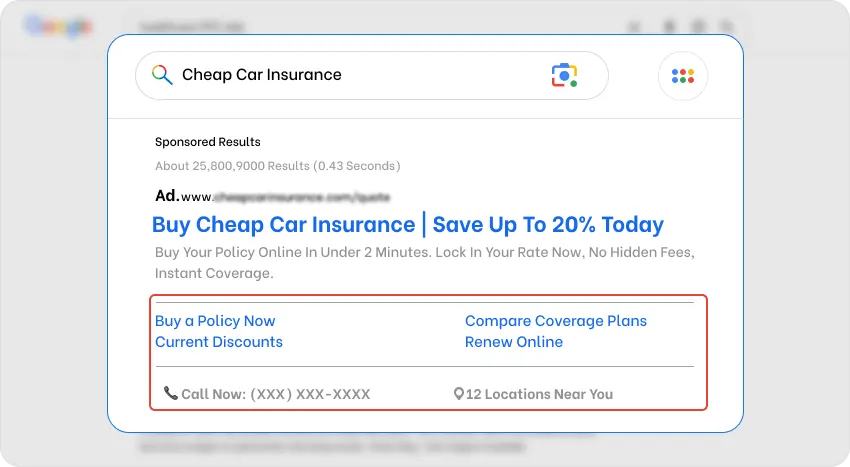
Ad extensions, popularly known as assets, are used to expand search ads with useful information that motivates users to click and engage with the brand. Sitelink, callout, review, location, and video are some of the assets you’ve probably noticed in search ads.
If your ad is just a combination of high-volume keywords and compelling ad copy, it’s not enough. You’ve to make it action-oriented using the relevant ad extensions to increase your CTR and reduce your cost-per-click. This way, you can capture more visual space, attract your audience’s attention, and encourage them to interact with your brand.
How to do it
- Review your pay-per-click ads and determine which ad extensions will naturally prompt users to click and connect with your brand.
- Assess your assets’ performance to determine if they are effective or if you should try a different asset combination for your CPC ads.
- Avoid overloading your ad space with too many irrelevant assets.
- Thoroughly review your assets to confirm accuracy and avoid broken links.
Useful Tip
Analyze your users’ intent and campaign needs to choose highly relevant assets and guide users to the appropriate pages.
5. Bid on High-Intent Keywords
Instead of choosing keywords with the lowest CPC, focus on high-intent queries that directly connect with your target audience. This not only increases your chances of getting clicks but also boosts your conversion rate. You’ll be spending on keywords that are more likely to be clicked, especially those with strong purchase intent.
How to do it
- Identify high-intent keywords.
- Allocate more budget to keywords with high conversion potential rather than treating each one equally.
- Avoid bidding on head terms, as they capture broad traffic and are too expensive.
- Use a reliable keyword tool that provides accurate search volume, CPC, trend, intent, and difficulty.
Useful Tip
During specific seasons, events, and festivals, CPC advertising rates spike, so choose keywords wisely to prevent budget fluctuations. Mention your focus keyword in the headlines and description.
6. Choose Manual Over Automated Bidding
Turning on the automated bidding feature too early results in erratic performance. Initially, don’t automate your bidding; instead, perform manual bidding to maintain more control and let the system gradually learn from your past data.
How to do it
- Perform market research to determine the average cost per click in your industry to avoid overspending.
- Monitor performance closely to avoid budget fluctuations.
- Once you’ve collected enough conversion data, you can automate bidding.
Useful Tip
You just can’t set and forget bidding. You’ve to manually monitor PPC campaign performance and adjust bids regularly to maintain a good cost-per-click.
Also Read: AI vs Manual Advertising Campaign Management: Which One is Ideal for Better ROI?
7. Set Frequency Capping
Setting up frequency capping prevents your CPC ads from being shown to users who aren’t engaging with your offers after the limit is reached. This way, you can avoid spending on users who ain’t interested in your brand’s offering, maintain ad relevance, avoid ad fatigue, and lower cost per click.
How to do it
- Determine an optimal frequency for your CPC campaigns based on your audience behavior and funnel stage.
- Create a series of ads and test different frequencies to identify the one that converts best while maintaining a positive user experience.
- Increase your frequency count for the peak hours and events.
- Monitor performance and conversion metrics, along with ad frequency, to assess whether the set frequency is optimal.
Useful Tip
Analyze your CPC campaign requirements instead of blindly setting a frequency cap. For example, someone who hasn’t heard of your brand might need to see your ads more often than someone who is already familiar with your brand. Consider all the parameters before capping your campaign with frequency count.
How 7SearchPPC Helps Advertisers Achieve Lower Cost Per Click
7SearchPPC offers advertisers strong targeting potential, flexible pricing options, and a dayparting feature that helps them reach and engage the right audience at the right time. We also have an extensive network of reliable publishers for specific niches. In short, we help our advertisers generate qualified traffic at an affordable cost-per-click rate.
Our ad managers have years of experience and can provide end-to-end campaign support from setup to the optimization phase. Their valuable advertising insights will help you decrease your cost per click and achieve more valuable results. Feel free to contact us with your PPC advertising queries.
Frequently Asked Questions (FAQs)
Q1. Why lowering CPC is important for advertisers?
A low cost per click allows you to capture more traffic within the same advertising budget and increases your odds of converting potential leads into customers.
Q2. How to lower cost per click in PPC advertising?
There are many ways to lower the CPC of your pay-per-click ads. For instance, you can segment your audience to improve ad relevance and enable hyper-targeting.
Q3. How does landing page quality affect CPC?
A fast, relevant, and user-friendly landing page improves the user experience and Quality Score, which can help lower cost per click.
Q4. Should I use more specific keywords for CPC bidding?
Target exact and phrase variations, along with long-tail keywords, to reach users with the highest intent to click and a stronger inclination to purchase.
Q5. Can device targeting help me reduce my cost-per-click?
Yes, it is effective because you can reach your audience on the devices they utilize most.