Key Takeaways!
- Google’s Average Search CPC increased by 12% YoY in Q1 2026 to $2.96, up from $2.64 in Q1 2025, and one of the reasons is AI search results.
- The paid CTR dropped by 68% in September 2025.
- Businesses should allocate their advertising budget across multiple networks to continue buying traffic at affordable CPCs.
- Legal services, insurance, B2B software, and healthcare see the highest CPCs compared to the eCommerce industry.
Running Google Ads isn’t simple anymore. You get less search space, and the CPC bids keep rising. A big part of that squeeze traces straight back to AI search results, which now sit above the fold on nearly every query that used to send a click your way.
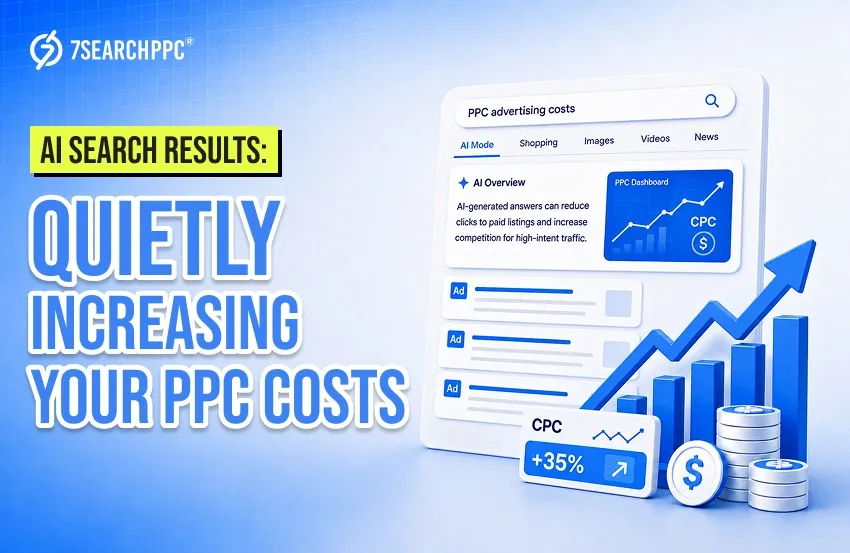
Recent reports indicate that Google’s Average Search CPC (ASCPC) increased by 12% YoY in Q1 2026 to $2.96, up from $2.64 in Q1 2025. Even if you bid higher, AI search results take up the most space and compel users to stop scrolling, further affecting the visibility and conversion of your PPC ads.
AI Overviews and Mode aren’t merely reshaping the place people look for information. They’re altering the nature of search ads on Google, and that’s directly impacting cost per click.
All advertisers who are running Google Ads at this moment have observed that the cost per click is steadily rising, and it’s not because you bid less; it’s because competition has increased. In this post, we’ll explore how AI search results have intensified competition and what it means for advertisers.
The Mechanism Behind the Search Explained
There are a few broad classifications of search intent. Navigational, Informational, Commercial, and Transactional.
These four types of traffic were previously on the same Google page, and there was a good balance between non-commercial and transactional traffic. This is the confluence that is now breaking apart. More and more, answers to inquiries like “how does X work” and “what is the difference between X and Y” are being provided directly in AI search results, without users having to click any blue links. That shift alone explains why so many advertisers feel like their funnel has gotten shorter overnight, even though nothing changed in their own campaigns; the disruption is coming entirely from AI search results absorbing the top of the funnel.
Research carried out by BrightEdge found that 48% of Google searches now include AI Overviews. The paid CTR continued to drop, and by the end of September it was down 68% from the baseline.
The person continued to search. The paid advertising plan was still in place, but the click you’re paying for often never happens.
So here’s what you’ll have left. The search traffic that continues to pour into the paid auction is becoming more commercial and transactional, the most valuable, most competitive keywords that advertisers are already battling over.
You’re no longer fighting for more clicks; you’re competing for the space that’s now minimized because of AI search results.
Numbers That Prove It’s True
According to a study by Search Engine Land, ad spending in Google Search increased by 9% year on year in the first quarter of 2025, while Google Search click volume saw a slight 4% rise. The five-point gap is the clearest single number in this whole story, and it lines up almost exactly with how much ground AI search results have taken from the organic and paid results below them. There are fewer and fewer clicks, and the rest is traditional auction theory.
Reports show that cost per click increased across 87% of industries, while conversion rates indeed improved in nearly two-thirds of markets over the same period. This isn’t that ads got worse.
Advertisers are paying more per click, but the clicks they do get are converted better, because the traffic reaching them has already been filtered for real buying intent by the AI layer sitting above the ad auction.
Zooming out further, LocaliQ’s long-running benchmark data shows average CPC has more than doubled over the past decade, from 5.42 today, measured across a broader cross-industry blend of ad formats. The AI-driven intent compression happening right now is not the only force behind that longer trend, but it is very likely the sharpest acceleration point within it.
Also Read: AI vs Manual Advertising Campaign Management: Which One is Ideal for Better ROI?
Why This Hits Some Industries Harder Than Others
Industries where people research heavily before buying, such as legal services, insurance, B2B software, and healthcare, see the highest CPCs because these niches tend to have more informational queries. It makes it difficult to capture and convert users in the first place, largely because AI search results now intercept so much of that early-stage research.
A personal injury law firm once attracted people researching legal issues through informational content. Now, much of that traffic is being answered by AI Overviews, while transactional keywords are getting more expensive with each passing quarter. It makes it difficult to buy search space at an affordable CPC rate.
If you’re in eCommerce or local services, you’re less affected because your customers often search with a clear intent to buy. These searches are less impacted by AI search results. If your industry involves genuine research before a purchase decision, expect this pressure to keep building rather than level off.
What This Really Means for Where You Spend
When CPCs rise, cutting spending may seem like the best option. But higher CPCs often mean more valuable traffic with stronger buying intent. If you stop advertising, you may lose customers who are closer to making a purchase.
Diversification, not pulling back, is the better approach. Businesses should combine organic visibility with paid search and explore other channels to reduce their reliance on one PPC advertising network. Moreover, the limited advertising space intensifies competition, raising overall pay-per-click bids and making it difficult for advertisers to reach, engage, and convert leads for their business.
Google Search is facing higher costs because AI is answering more informational queries. Users instantly get the answer they’re seeking, which reduces the need to explore further. Cost per click in other ad networks isn’t affected the same way as it’s in Google Ads, as they compete for different types of traffic.
It’s better not to rely too heavily on Google Ads. Try allocating a portion of your online advertising budget to other platforms. This won’t replace Google Ads, but it can help control your overall advertising costs plus drive more qualified traffic.