Key Takeaways!
- Ad stacking fraud poses a serious risk in digital advertising, where multiple ads are layered in a single slot but only one is visible, yet all are counted as impressions.
- Advertisers often pay for invalid traffic (IVT), fake impressions, and clicks that never reflect real user interest.
- Choosing trusted ad networks and avoiding low-quality publishers reduces exposure to ad stack manipulation.
- Quick action (pausing campaigns, reporting publishers) is critical when ad layering fraud is suspected.
- Ultimately, ad overlay fraud damages ROI by inflating impressions and clicks without delivering real outcomes.
You set aside $300 to test a new campaign, expecting to see how it performs before scaling further. The impressions start rolling in, and everything looks promising at first. But when it comes to conversions, there’s nothing to show for it.
If that sounds familiar, you’re not alone.
This is a common issue many advertisers face today, often driven by a practice known as ad stacking. This kind of ad overlay fraud is becoming a costly challenge that silently drains budgets without delivering real results.
In this blog, we’ll break down what ad stacking is, why it’s a problem, what it means for advertisers trying to get real value from their campaigns, and how to prevent it.
What is Ad Stacking?
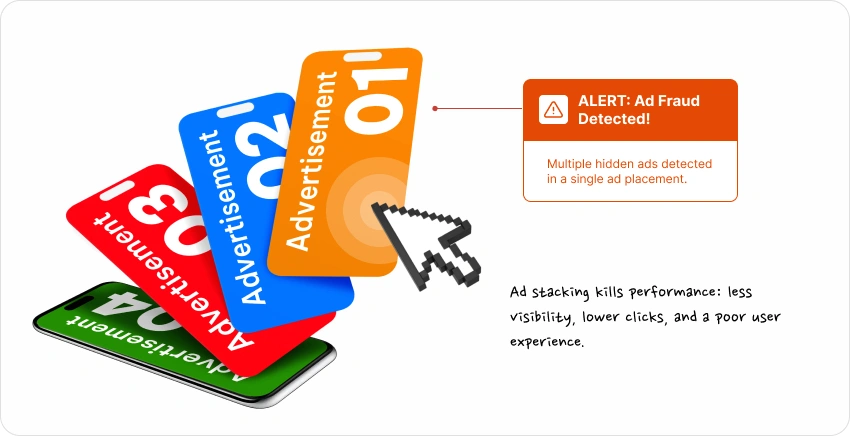
Ad stacking is a type of digital advertising fraud where multiple ads are placed on top of each other in a single ad slot, but only the top ad is actually visible to the user.
Some publishers, particularly newer or less transparent ones, carry out this practice by stacking multiple ads within a single placement to earn extra revenue from ads that users never actually see.
How it Impacts Advertisers:
- Impression Fraud: Even though only one ad is visible, every ad in the stack registers an impression, leading advertisers to pay for views that never occurred.
- Click Spamming: When a user clicks the single visible ad, it can trigger clicks for all the hidden ads beneath it, leading to fake click-through rates.
- Financial Impact: ad stacking and related impression fraud techniques cost advertisers roughly $100 billion globally.
- Data Distortion: It causes major discrepancies in campaign data, showing higher impressions but extremely low conversion rates, resulting in poor ROI.
Before diving deeper, it’s important not to confuse ad stacking with “card stacking ads.” While ad stacking is a fraudulent ad-delivery method, card stacking is an influential advertising technique that presents only selective, positive information to influence user perception. Despite the similar names, one is a messaging strategy, while the other is a form of ad fraud.
How Does Ad Stacking Work?
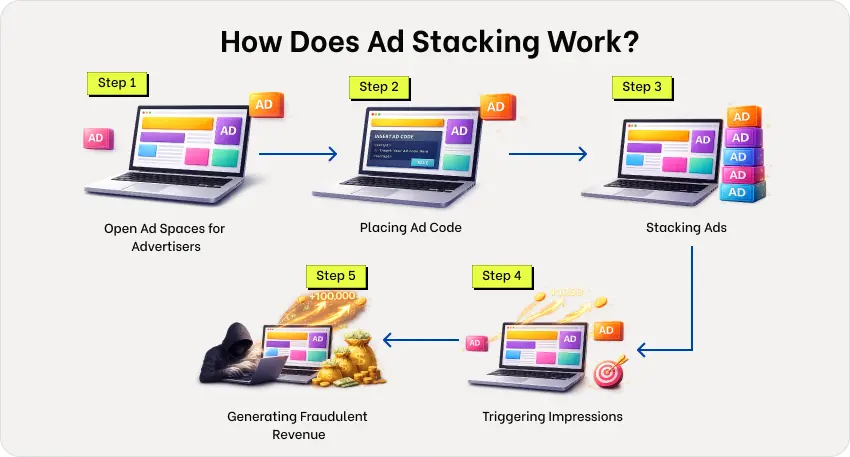
Advertisers must understand how ad layering or stacking actually works, as it helps them take a more careful and precautionary approach to managing ad performance and avoiding inefficiencies. Here is how it works.
- Open Ad Spaces for Advertisers: The publisher opens ad spaces on their website where advertisers can place ads by contacting them or agreeing on pricing and placement terms.
- Placing Ad Code: Now, a fraudster publisher inserts multiple ad codes into a single ad slot, preparing the space to load more than one ad simultaneously.
- Stacking Ads: The publisher layers multiple ads on top of each other, so only one ad is visible while the others remain hidden underneath.
- Triggering Impressions: When the page loads, all ads (visible and hidden) register impressions, making it appear that each ad was actually viewed by users.
- Generating Fraudulent Revenue: Advertisers are charged for these inflated impressions, allowing the publisher to earn money unfairly without delivering real visibility or genuine engagement.
Let’s break this down with a simple ad stacking example:
Example: Imagine you run a finance platform and rely on ads to attract genuine investors. But a publisher engages in ad stacking fraud—placing an iGaming ad visibly on top, while your finance ad sits hidden underneath.
Users think they’re clicking the iGaming ad, but your ad also registers the click and impression in the background. As a result:
- You’re charged for traffic that never actually saw your ad.
- Visitors land on your platform with zero interest in finance.
- Conversions drop because the audience is completely mismatched.
In short, you end up paying for fake engagement driven by misleading ad placement rather than real investor intent.
Where Everything Takes Place?
- Low-quality or fraudulent websites/apps
- Programmatic ad exchanges with weak monitoring
- Sometimes via malicious scripts injected into legitimate pages
How to Determine If Advertisers Are Experiencing Ad Stacking
Advertisers need to detect ad overlaying fraud, as failing to recognize the signals can lead to wasted ad spend with no results. Here is how to detect ad fraud.
Abnormally High Impression Counts
One key metric you need to monitor closely is impressions. If you notice something unusual, such as higher impressions but few or no conversions, it could indicate an issue like ad stacking.
However, it’s important to remember that this isn’t always the case. High impressions with low conversions can also point to an ineffective strategy. It may simply mean that your ads aren’t resonating with your audience, leading to low engagement and poor click-through rates.
Before jumping to the conclusion, carefully review your ad creatives and ensure they are well-designed. If, after optimizing your creatives, the results still don’t improve, ad stacking may be a concern.
Low CTR Despite High Impressions
When your ad is shown many times but barely gets any clicks, something’s off. Normally, more impressions should bring at least some clicks. But with ad stacking, many of those impressions aren’t genuinely seen by users. Since people can’t interact with ads they don’t see, your click-through rate (CTR) stays low.
So, a combination of high impressions and low CTR often signals that your ads might not actually be reaching real viewers.
How to evaluate:
- Unusually high CTR with low conversions: Many clicks but little to no sign-ups, purchases, or meaningful actions.
- Very short session duration: Users leave the site almost immediately after clicking the ad.
- High bounce rate: Most visitors exit after viewing only one page because it doesn’t serve their interests.
- Abnormal geographic patterns: Clicks coming from locations that don’t match your target audience.
- No downstream activity: No form fills, add-to-cart actions, or navigation beyond the landing page.
Unusual Revenue Patterns
The unusual revenue patterns also hint that something might be fishy. If you experience sudden drops in your revenue that don’t align with your campaign changes or seasonal trends, it could indicate fraud.
Ad stacking can result in irrelevant impressions that don’t drive meaningful engagement or conversions. As a result, the revenue graph may go downwards.
Read More : Cookieless Advertising 2026: How Advertisers Can Prepare for the Post-Cookie Era
Third-Party Ad Stacking Detection Tool Can be Useful
Third-party ad fraud detection tools help advertisers ensure their ads are actually seen and not stacked or hidden behind other ads. These ad fraud prevention platforms track viewability, placement, and engagement, flagging impressions that occur off-screen or in invisible ad slots.
They provide detailed reports on metrics like viewable impressions, time-in-view, and ad fraud indicators, helping advertisers identify suspicious activity. Cross-check the publisher’s data against your own using the ad-stacking detection platform; if the results don’t match, it may indicate digital advertising fraud.
Some of the most well-known ad fraud detection tools include:
- Integral Ad Science (IAS)
- Adjust (Fraud Prevention)
- Kochava
- Doubleverify
Also Read – Tips for Affiliates to Stay Profitable in 2026 Amid Global Uncertainty
Healthy vs. Fraudulent Data: Comparison Table
Here is a reference on how you can easily monitor whether your ad is generating real results or falling victim to ad fraud.
| Metric | Healthy Campaign | Suspected Ad Stacking |
|---|---|---|
| CTR | 0.5–1.5% (Industry avg) | 0.01–0.06% |
| Conversion Rate | 1–5% (Industry avg) | Near zero |
| Site Quality | Recognizable, premium sites | Long lists of “junk” or “made-for-advertising” sites |
| Impression Volume | Aligns with the budget and reach | Massive spikes without increased engagement |
Tips for Advertisers to Avoid Ad Stacking
Understanding how to prevent your ads from being ad-stacked is crucial, as it can save you significant effort and, most importantly, your ad budget. Here are some helpful tips to avoid it.
Choose High-Quality Ad Networks
Ad stacking and other fraudulent practices become significantly less likely when you work with verified, high-performing advertising networks. Reputable ad networks invest heavily in fraud detection technologies and enforce strict compliance standards, making it difficult for publishers to manipulate ad placements.
To reduce risk and ensure campaign integrity, consider the following practices:
- Partner with reputable ad networks: Choose ad platforms known for robust anti-fraud systems, real-time monitoring, and a strong industry reputation.
- Go for the reviews: When choosing an ad network, always check reviews and testimonials from other advertisers. Look for reviews that show the genuineness of the traffic, as this makes it much easier to evaluate the network’s effectiveness and trustworthiness.
- Use the data provided by ad networks: Partnering with a trusted ad network provides transparent reporting tools to monitor campaign performance, impressions, click-through rates, and conversions. This visibility helps identify irregularities and ensures effective budget use.
7SearchPPC is a trusted advertising network focused on transparency, performance, and ad fraud prevention, making it a smart choice for advertisers seeking safer and more accountable campaign results.
Monitor Traffic Quality
One important thing to monitor is the quality of traffic publishers provide you, because that’s what you’re ultimately fighting for. Every advertiser strives for better traffic, and if ad stacking occurs, traffic increases, but it may not be valuable.
However, the real question many advertisers ask is how to check the quality of the traffic, whether it’s real or it’s invalid traffic (IVT). Here are some things you can look for when monitoring traffic quality
- Bounce Rate: A lower bounce rate typically indicates that visitors find your site engaging. If it increases, then it means clicks are unworthy, as people are leaving your site.
- Average Session Duration/Time on Page: Higher engagement indicates that visitors spend more time on the page, which signals high-quality traffic, whereas unusual traffic may have very short sessions.
- Conversion Rate: Track how many visitors become leads or customers (e.g., form submissions, purchases).
Run Regular Audits & Test Campaigns
Staying active on your ad campaign performance is essential—after all, you’re investing money and expecting meaningful results in return. Make it a habit to regularly review and refine your campaigns so you know what’s working and what isn’t.
Look closely at key metrics such as:
- Click-through rate (CTR)
- Conversion rate
- Cost per click (CPC)
- Return on ad spend (ROAS).
Act Quickly on Suspicious Activity
Act immediately if you notice anything suspicious—don’t delay. Unusual activity on an advertising campaign can undermine your efforts and lead to serious consequences, including a drained advertising budget, brand safety issues, and reduced conversion rates.
Read Also – What Is FTD Tracking in Advertising? Definition, Benefits, and How It Works
Ad Stacking vs. Other Ad Fraud Types Advertisers Should Be Aware Of
Ad stacking is just one concept that affects advertisers so much. There are many other terms with a similar impact, but advertisers are unaware of them. Let’s take a look at these ad fraud types to better understand them.
| Ad Fraud Type | How It Works | What It Fakes / Inflates | Visibility to User |
|---|---|---|---|
| Ad Stacking | Multiple ads layered in a single slot; only the top ad is visible. | Impressions are fake | Top ad visible; others hidden |
| Pixel Fraud | Ads shrunk to a tiny 1×1 pixel. Hard for people to notice. | Impressions are fake | Invisible |
| Domain Spoofing | Low-quality sites pose as a premium domain. | Inventory quality | Visible, but misrepresented |
| Click Fraud | Bots generate fake clicks on ads. | Clicks/engagement | May appear real |
| Ad Injection | Ads inserted by malware, extensions, or other scripts. | Impressions/clicks | Third-party software |
Final Point!
Ad stacking can significantly affect advertisers, primarily by impacting their ad budgets. However, by adopting the right strategies, you can protect yourself from its impact. Choosing high-quality ad networks, closely monitoring traffic quality, and conducting regular audits are practical and effective steps to prevent ad stacking. By staying proactive, advertisers can ensure their campaigns run efficiently, maximize ROI, and avoid unnecessary losses.
Frequently Asked Questions (FAQs)
Q1: What is an ad stack?
Ans: Ad stacking is a fraudulent practice in which multiple ads are layered in a single placement, with only the top ad visible, while all ads register impressions and clicks.
Q2: How does ad layering or stacking affect advertisers?
Ans: This ad fraud impacts many advertisers by causing wasted ad budgets, impression manipulation, fake clicks, low conversions, and distorted ad performance metrics.
Q3: How can advertisers detect ad stacking?
Ans: Advertisers can quickly identify ad stacking through analyzing unusually deep impressions with low CTR or conversions, irregular geographic patterns, and inconsistent revenue spending.
Q4: Which tools help detect ad stacking fraud?
Ans: Third-party ad fraud detection tools like Integral Ad Science (IAS), Adjust Fraud Prevention, Kochava, and DoubleVerify can monitor viewability, placement, and engagement.
Q5: How does ad stacking impact ROI?
Ans: It inflates data such as impressions and clicks without driving genuine conversions, resulting in wasted ad spend.
Q6: Is ad stacking illegal?
Ans: Yes, ad stacking is unlawful due to its fraudulent tactics. Advertisers can take legal action if they discover a publisher or partner engaging in ad stacking, as it constitutes digital ad fraud and breaches contractual agreements.