
One of the biggest mistakes advertisers make is targeting the wrong countries for their online ad campaigns. You might have a great ad and a strong offer, yet the results still disappoint. The reason often lies in a lack of understanding of the advertising tier.
In digital advertising, traffic from different countries is grouped into Tier 1, Tier 2, and Tier 3. Each tier has different advertising costs, competition levels, and user purchasing power. Without knowing how the advertising tier system works, it becomes easy to waste budgets or miss better opportunities.
That’s why understanding these tiers is important before launching any PPC ad campaign. In this blog, we’ll explain Tier 1, Tier 2, and Tier 3 traffic in a simple way.
What Are Advertising Tiers?
Advertising tiers are a classification system used by advertisers to group countries, regions, or audiences based on factors such as economic value, purchasing power, and advertising costs. This system helps advertisers determine where to allocate budgets and how to target ad campaigns effectively.
The tiers primarily influence ad pricing, expected revenue, and overall digital advertising strategy. Let’s take a look at the three tiers: tier 1, tier 2, and tier 3, and understand what they really mean.
Tier 1
Tier 1 markets include highly developed countries with strong economies and high consumer purchasing power. Advertisers pay the highest cost-per-click (CPC) or cost-per-thousand impressions (CPM) here because audiences are more likely to buy products or subscribe to services.
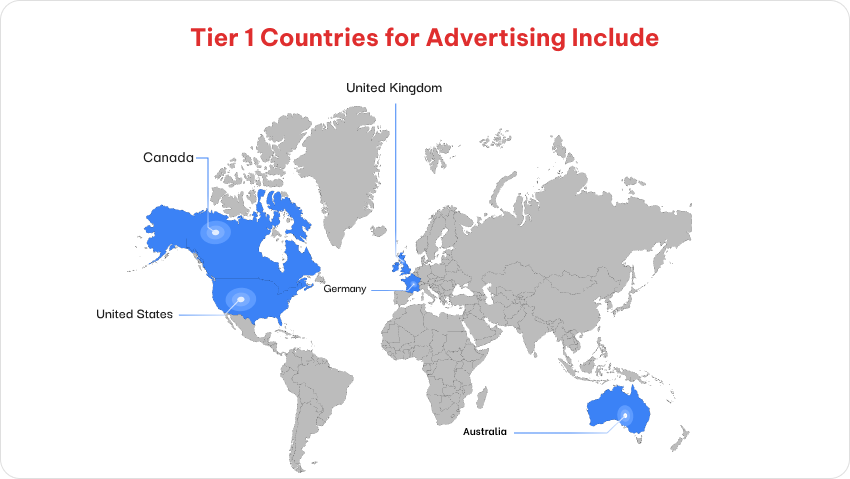
Tier 1 Countries for Advertising Include:
- United States
- Canada
- United Kingdom
- Germany
- Australia
Tier 2
Tier 2 markets represent countries with moderate economic development and growing digital adaptation. Advertising is cheaper in tier 2 countries than in tier 1, enabling significant savings. These markets are attractive for advertisers seeking a balance between cost and reach, making them common targets for scaling ad campaigns.
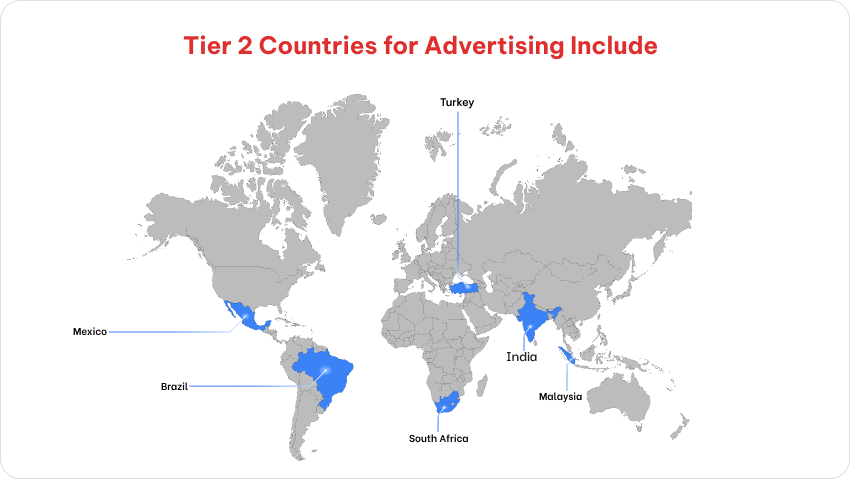
Tier 2 Countries for Advertising Include:
- India
- Brazil
- Mexico
- Turkey
- South Africa
- Malaysia
Tier 3
Tier 3 markets include developing countries with lower purchasing power and lower advertising costs. CPC and CPM are much cheaper, but conversion rates and spending per customer may also be lower. However, this doesn’t mean you won’t get results; you can still achieve them with the right strategy. Advertisers often use these markets to build brand awareness or drive app installs.
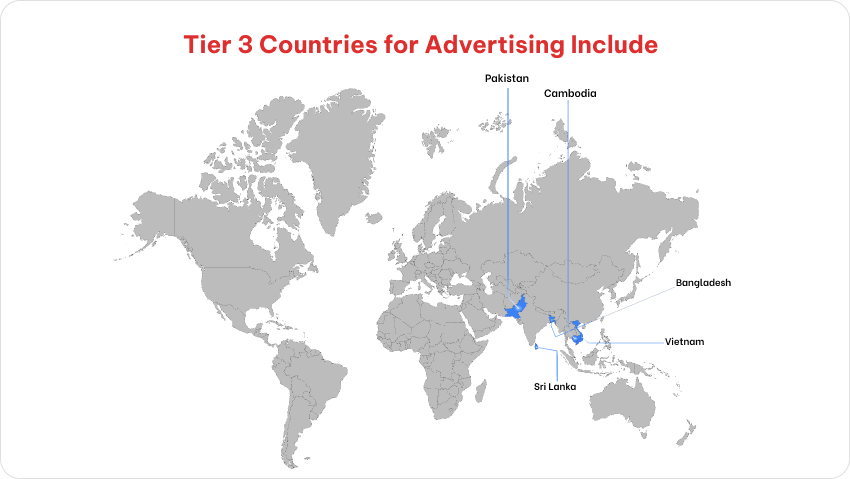
Tier 3 Countries for Advertising Include:
- Pakistan
- Vietnam
- Cambodia
- Sri Lanka
- Bangladesh
Choose the Best Tier & Start Scaling Today!
Breaking Down Advertising Tiers for Better Decision-Making
Understanding the right advertising tier is essential because it helps you see what each option offers and how it can support your goals. By knowing the features and benefits of each tier, you can make a more informed decision and choose the one that best fits your needs.
Below are some key points to help you identify which advertising tier will work best for your online ad campaigns and deliver the most effective results.
Advertising Tier 1
Let’s examine the key characteristics of this Tier 1 advertising.
1. High Purchasing Power
One of the biggest advantages of Tier 1 advertising is the strong purchasing power of the audience. People in these markets are generally more willing to spend money if they find a product useful or valuable. Because of this, marketers often don’t need overly aggressive selling strategies; simply placing the right product in front of the right audience can be enough to generate consistent sales.
“ The average online shopper in the USA spends far more per order than someone in developing countries. Also, subscription services and premium apps perform very well in tier 1 countries.”
2. High Advertising Cost
Advertising in tier 1 markets can be quite costly, as you need to invest heavily to see results. However, the outcomes tend to be highly effective because people are interested, and the likelihood of spending remains high. Tier 1 is ideal for advertisers who can invest higher budgets and want access to high-value audiences.
When to choose Tier 1 for maximum impact
Selecting Tier 1 countries depends on your advertising goals, whether you intend to sell your product or simply seek engagement. Here are some scenarios where choosing Tier 1 maximizes impact.
- When You Want Maximum Reach: Tier 1 advertising offers greater reach, as your ads are shown to a highly engaged audience where conversions are easier.
- When the Goal Is High ROI: Tier 1 markets usually deliver better long-term return on investment, even if the upfront cost is higher.
- When Targeting Premium Audiences: If your product or service is high-value or premium, Tier 1 audiences are more likely to convert.
- When Resources Are Limited, but Impact Must Be High: Instead of spreading effort everywhere, focusing on a single strong Tier 1 opportunity can create a greater impact.
- When You Want Faster Growth: Tier 1 countries typically offer faster scaling opportunities due to higher engagement, as your ads reach audiences already seeking your services and scale quickly.
Advertising Tier 2
Let’s examine the key characteristics of this Tier 2 advertising.
1. Massive Audience Reach
Tier 2 countries such as India, Brazil, and South Africa represent some of the most compelling growth opportunities today. Together, these markets are home to billions of people, many of whom are rapidly coming online and engaging with digital platforms. As a result, Tier 2 markets offer a powerful opportunity to reach large audiences at relatively lower costs.
2. Medium Purchasing Power
People in Tier 2 countries do spend, but not everyone, since purchasing power is moderate. Therefore, advertising strategies need to be carefully planned. Effective results only occur when your offer is engaging, and you reach the right audience.
When to choose Tier 2 for maximum impact
Choosing Tier 2 usually means focusing on mid-level opportunities that balance cost, reach, and flexibility. Tier 2 options often provide good impact without the high cost or competition of Tier 1.
Here are some scenarios where choosing Tier 2 maximizes impact.
- When the Budget Needs Careful Allocation: Tier 2 options usually cost less than Tier 1, making them ideal when you want good results while controlling ad budget.
- When Targeting Niche Audiences: Tier 2 regions often have more specific or niche communities, which can improve engagement.
- When Building Experience: Tier 2 countries help build experience, improve processes, and develop expertise before advancing to Tier 1.
- When Tier 1 Is Too Competitive: Sometimes, Tier 1 markets are saturated with competitors. Tier 2 can give you a better chance to stand out in your market.
- When You Want a Better Cost: Tier 2 often offers strong value for money, providing solid reach without premium pricing.
Advertising Tier 3
Let’s examine the key characteristics of this Tier 3 advertising.
1. Lower Spending Per User
Advertising in tier 3 countries generally involves lower spending per user. While the results may not be as significant as those from tier 1 or tier 2 countries, you can still achieve measurable outcomes at a lower cost. People generally spend less money in Tier 3.
2. If You Are New to Advertising, then it’s Best
If you are new to business and planning to advertise, starting with Tier 3 markets can be a smart choice. People in these areas usually have limited spending power, but it can still help you test and sell your product with a smaller budget. If you start getting good results, you can expand your advertising into Tier 2 or Tier 1 markets to reach a larger audience and achieve stronger growth.
If results are not satisfactory, review your product and advertising strategy. Consider adjusting pricing, marketing approach, or product value.
When to choose Tier 3 for maximum impact
Opting for Tier 3 countries means focusing on a low budget while aiming for effective results. Although Tier 3 may lack the prestige or broad reach of higher tiers, it can generate significant impact through scale, experimentation, and early positioning.
Here are some scenarios where choosing Tier 3 yields maximum impact:
- When the Budget is Very Limited: Tier 3 traffic is usually the most affordable, allowing you to start with a minimal investment.
- When Targeting Untapped Audiences: Choose Tier 3 when targeting untapped audiences with lower competition and high potential reach.
- When Starting From Scratch: New businesses or creators often begin with Tier 3 to gain experience, build resources, and prepare for higher tiers.
- When Speed Matters More Than Perfection: Tier 3 options often allow fast deployment and quick actions without complex requirements.
- When Testing Multiple Ideas: Tier 3 is ideal for rapid experimentation, where you try many strategies and see which works best.
Tip: Targeting Tier 1 countries can be a great strategy if it aligns with your overall business goals. However, combining Tier 1 and Tier 2 markets often delivers better results. This mixed approach helps you balance high-value audiences with cost-effective reach, enabling you to connect with more potential customers. As a result, you can optimize your ad spend while increasing revenue opportunities.
Quick Comparison Table
| Tier | Cost | Purchasing Power | Best For |
|---|---|---|---|
| Tier 1 | High | High | Premium offers |
| Tier 2 | Medium | Medium | Scaling campaigns |
| Tier 3 | Low | Low | Testing & installs |
Why Tier 4 Market is Not Ideal for Advertisers
Most advertisers primarily focus on Tier 1, Tier 2, and Tier 3 markets because these segments are widely recognized and frequently discussed within the advertising industry. These markets typically offer better infrastructure, stronger purchasing power, and higher conversion rates.
However, Tier 4 markets are often overlooked despite their presence in the global advertising ecosystem.
What Are Tier 4 Markets?
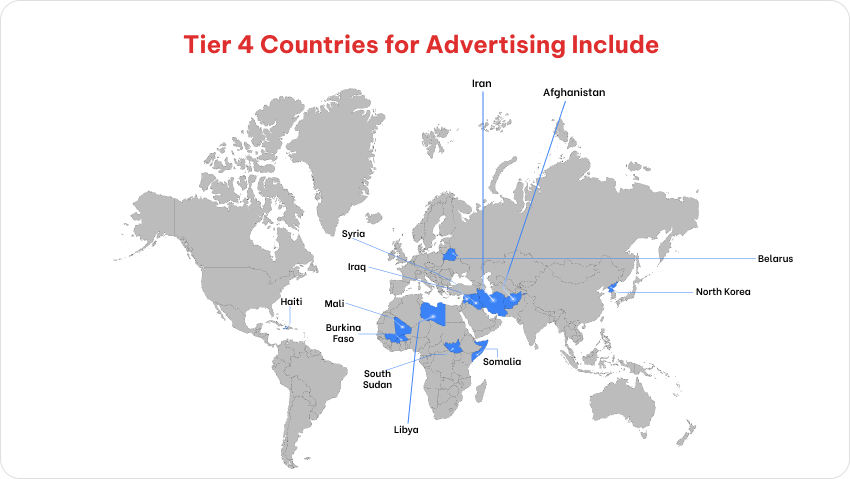
Tier 4 markets generally consist of developing or economically challenged countries with limited digital infrastructure and purchasing power. Because of these factors, many advertisers hesitate to invest heavily in these regions. These markets are frequently characterized by:
- Lower conversion rates compared to higher-tier markets
- Low purchasing power among consumers
- Limited digital and advertising infrastructure
- Political or economic instability
- Restricted media channels and marketing opportunities
Why Some Advertisers Still Target Tier 4 Countries
- Despite the difficulties, some businesses still choose to target Tier 4 markets. This is usually because:
- Certain businesses operate locally within these countries and need to reach their domestic audience.
- Advertising costs can sometimes be significantly lower, allowing brands to generate awareness at minimal expense.
Some countries commonly categorized in Tier 4 markets include:
| Afghanistan | North Korea |
| Belarus | Libya |
| Burkina Faso | Mali |
| Haiti | Somalia |
| Iran | South Sudan |
| Iraq | Syria |
Which Advertising Tier Fits Best for Different Verticals?
Whether you are advertising igaming, adult, finance, healthcare, or dating platforms, it is important to understand which tier best suits your platform, as this makes it easier to target those countries for better results.
We are focusing on key verticals, identifying which tiers stand to benefit the most, and determining which countries are best suited for advertising.
| Verticals | Advertising Tier/Countries |
|---|---|
| Adult (18+) | “Tier 2 and Tier 3 Markets”
You can select countries like Brazil, Mexico, Argentina, Japan, Thailand, Malaysia, South Korea, Bangladesh, Cambodia, etc. Review the guidelines before targeting these countries, as they are only effective if you understand the regulations, allowing you to create ads accordingly. |
| Finance | “Tier 1 and Tier 2 Markets”
You can select countries such as the USA, the United Kingdom, India, Germany, Australia, Canada, Brazil, Japan, South Korea and others. Understand people’s needs and what they are looking for, and direct your ad campaign accordingly, as Tier 1 and 2 countries tend to invest more in finance-related businesses. |
| Dating | “Tier 1 and Tier 2 Markets”
You can select countries such as India, Brazil, Mexico, Turkey, South Africa, Malaysia, the United States, Canada, the United Kingdom, Germany, Australia, and others. Dating is a universal concept that exists across all countries. However, subscription-based dating platforms pose significant variation in adoption rates. Users in Tier 3 markets are excluded from the analysis because the likelihood of spending on paid subscriptions is comparatively lower. |
| Healthcare | “Tier 2 and Tier 3 Markets”
You can select countries such as Indonesia, India, Thailand, Brazil, Pakistan, Vietnam, Cambodia, Laos, Sri Lanka, Bangladesh, Azerbaijan, Armenia, Uzbekistan, and others. Healthcare advertising in developing countries is beneficial because people are earning money and seeking healthcare services to avoid financial losses caused by health issues. The engagement rate is high in tier 2 and tier 3 markets. |
| Gambling / iGaming | “Tier 1, Tier 2, and Tier 3 Markets”
You can select countries such as the UK, the USA, South Africa, Bangladesh, Brazil, Nigeria, the Philippines, Sri Lanka, Georgia, Armenia, Turkey, and others. Look up the gambling laws in the countries you are targeting with your gambling ads, as each country has its own rules and regulations to follow. It helps you perform better overall without any restrictions. |
Exploring the Opportunities and Challenges of Tier 1, Tier 2, and Tier 3 Regions
Knowing the benefits and challenges of each advertising level helps improve decision-making. Here’s an overview of the key advantages and challenges that each tier presents to advertisers.
Tier 1 Traffic for Advertising Campaigns
| Opportunities | Challenges |
|---|---|
| High purchasing power | High competition among brands |
| Early adoption of trends | High CPM and CPC rates |
| Advanced digital ecosystem | Traffic is lower compared to tiers 2 and 3 |
| High disposable income | High expectations from brands |
| Opportunity for brand building | High demand for personalization |
Tier 2 Traffic for Advertising Campaigns
| Opportunities | Challenges |
|---|---|
| Growing middle-class population | Moderate purchasing power |
| Expanding digital reach | Dependence on trust and word of mouth |
| Less brand saturation | Need for Deep Localization |
| Better consumer engagement | Complex Targeting and Personalization |
| CPC and CPM are lower compared to tier 1 | Strong regional preferences to focus on |
Tier 3 Traffic for Advertising Campaigns
| Opportunities | Challenges |
|---|---|
| Lower CPC and CPM than Tier 1 & 2 means you can achieve great results with a much smaller budget | Low Brand Awareness |
| Untapped markets | Lower Disposable Income |
| Strong community engagement | High cost per conversion due to lower engagement and conversion rates |
| Less competition & more chances | Trust and Consumer Behavior is very low |
| The increase in digital penetration and the growing consumer base | Data and Measurement Limitations will affect targeting |
Conclusion
Understanding advertising tiers helps marketers allocate budgets more effectively and target the right audiences. Tier 1 markets offer high purchasing power and strong ROI potential but require larger investments. Tier 2 markets provide a balance between cost and reach, making them ideal for scalable growth. Tier 3 markets are useful for testing strategies and building brand awareness on a limited budget.
Frequently Asked Questions (FAQs)
What are advertising tiers?
Ans: Advertising tiers are a classification system that groups countries based on factors like purchasing power, economic strength, and advertising costs. Marketers typically divide countries into Tier 1, Tier 2, and Tier 3 to allocate budgets and target campaigns effectively.
What are Tier 1 countries in advertising?
Ans: Tier 1 countries are highly developed markets with strong economies and high purchasing power. Examples include the United States, Canada, the United Kingdom, Germany, and Australia. These markets usually have the highest CPC and CPM rates and also offer strong conversion potential.
Which advertising tier offers the best ROI?
Ans: Tier 1 markets often deliver the highest ROI because users have stronger purchasing power. However, many advertisers combine Tier 1 and Tier 2 markets to balance cost and conversion potential.
What factors determine advertising tiers?
Ans: Advertising tiers are usually determined by economic development, internet penetration, purchasing power, digital infrastructure, and average advertising costs. These factors help advertisers understand which advertising tier is perfect for running an ad campaign.
Which advertising tiers are best for affiliates?
Ans: Affiliate marketers often use Tier 2 and Tier 3 traffic for lower costs and high volumes, whil e Tier 1 traffic is preferred for high-value offers such as finance, SaaS, and premium services.