
Unsold ad slots really hurt! You constantly put in effort to create high-quality, niche-specific content, adhere to terms and policies, and use various ad monetization strategies. Yet, you still end up with a low ad fill rate that makes it difficult to meet your end revenue goals. It might be possible that your ad network doesn’t have enough relevant ads to fill all your available slots, or there’s a technical issue, or something else.
In this post, we’ll help you know all the possible reasons for low ad fill rates and how to fix them like a pro to monetize every visit to your website. So, let’s put an end to your hustle for high ad fill rates!
Start Monetizing Your Traffic With 7SearchPPC!
What is Ad Fill Rate and How to Calculate it?
Ad fill rate is the percentage of ad slots on your website that are successfully filled with an advertisement, compared to the number of ad requests made to generate ad revenue.
Let’s use an example to better understand what ad fill rate is.
Suppose you’ve a lifestyle website with plenty of useful pages and decide to sell 120 ad spaces through an ad network to monetize your site traffic. 70 of your ad inventories are successfully filled with ads. Here, you can use the following formula to calculate the ad fill rate:
Ad Fill Rate = ( Ad Served ÷ Total Ad Request Made) x 100
Ads Served: Total number of ad slots that show an advertisement.
Total Ad Request Made: Total number of ad requests you made for your web pages.
Ad Fill Rate: The percentage of ad slots that successfully display ads on your website.
In the above example, we’ve;
Ads Served = 70
Total Ad Requests = 120
Ad Fill Rate = (70 ÷ 120) × 100 = 58.33%
The ad fill rate is 58.33%, indicating that the website is generating a low fill rate, making it challenging for you to earn money from ads.
Also Read: Ad Inventory Management: Proven Tips for Success
Why is Having a Good Ad Fill Rate Important?
Ad fill rate depends on several factors, including your niche, target audience, and demand sources. It isn’t just another regular KPI for publishers. It’s an important metric as it decides:
- How much ad income are you going to generate?
- What will be your users’ experience on your site?
- How strong will your relationship be with your demand partners?
Fill rate directly impacts:
- Ad Revenue: If your fill rate is lower, fewer ads will be served, and fewer impressions will be monetized, leading to lower earning potential.
- User Experience: If ads take longer to load or don’t load at all (leaving blank ad spaces), your website looks unprofessional to your audience.
- Ad Quality & Brand Safety: In the race to achieve a high fill rate, publishers connect with multiple demand sources, which often result in low-quality or irrelevant fallback ads appearing on the site. For users, it’s an unsafe and inappropriate advertising experience.
- Relationship with Demand Partners: If you’re generating bot traffic, unable to deliver quality traffic, or genuine clicks to advertisers, publisher monetization platforms might choose to restrict ad serving or even blacklist your website from their database.
Websites with a fill rate above 80% are considered good, while those with a fill rate of 60% are considered low. If your ad inventory utilization is below 60%, you need to implement various ad monetization strategies and address major ad fill rate issues to increase your ad revenue.
A high fill rate means everything is in the positive, while a low fill rate indicates missed opportunities to generate revenue, build trust, and strengthen relationships.
Advice: You shouldn’t aim to achieve 100% fill rate; instead, focus on posting high-quality, high-paying ads that’ll help you maintain a good fill rate and increase your overall ad revenue. Strive to achieve the highest fill rate without compromising the quality of their ad inventory. Fill rates between 70% and 85% are considered ideal for publishers to maintain a consistent stream of ad revenue.
After exploring what fill rate in advertising is and why it’s important to have a good fill rate. Let’s now discover how fill rates in advertising drop.
What Causes Low Ad Fill Rate?
Factors such as user ad blockers, technical errors, and a mismatch between ad inventory and advertiser demand make it tough to guarantee that every ad request will be filled with a suitable ad. We’ll explore these top reasons in detail, along with a few more, to help you understand why ad fill rates drop and identify the common causes of low fill rates.
1. Advertising Region Affects Ad Fill Rate
Marketers prioritize Tier-1 regions (the US, UK, Canada, and Australia) because they have a higher potential to generate ROI for the business compared to Tier-2 and Tier-3 regions. Thus, publishers from Tier-1 regions always receive a high ad fill rate.
Advertising Tier Regions
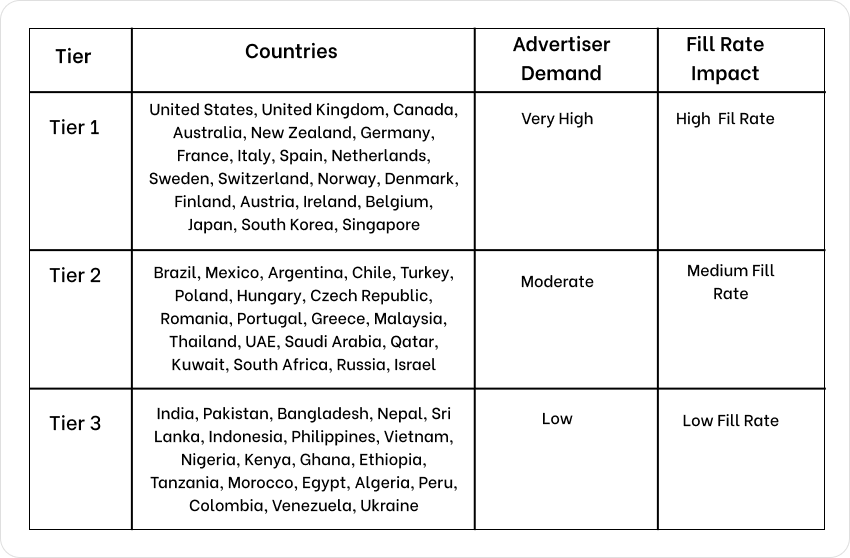
Even if you’re maintaining content quality, implementing ad monetization best practices, and generating quality traffic, you’ll still receive a low ad fill rate if advertisers don’t want to pay for the regions you’re targeting.
Tip: Use an effective keyword strategy to target top to medium-performing, worldwide, region-specific, and event-specific keywords to cover tier-1, tier-2, and tier-3 regions to align with advertisers’ demand and increase your site’s ad fill rate.
2. Technical Issues Affect Ad Fill Rate
Some of the technical errors that might reduce ad fill rates are:
- Misconfigured Ad Codes: If ad tags aren’t placed correctly on the website, ad requests may not be sent to demand sources.
- High Server Latency: If ad servers or SSPs take too long to respond to an ad request, and a user leaves the site before the ad loads, the result is wasted ad impressions.
- Device and Browser Incompatibility: Ads aren’t optimized for different devices, operating systems, and browser versions, leading to failed ad impressions.
- Content Rendering: In content rendering, lazy loading, dynamic rendering, and other techniques are used to load ads only when users are near them. But sometimes ads below the first fold take too long to load or fail to load, which impacts user experience and ad fill rates.
- Ad Blockers: Users implement ad blockers on their devices to prevent ad scripts, trackers, or requests from loading, affecting publishers’ ad revenue and fill rates.
- Poor Internet Connection: When the user’s internet connection is weak or unstable, the ad server doesn’t respond, lowering ad fill rate.
Hint: Use hosting services from reputable providers that offer great uptime, speed, and reliability. Also, install fast-loading themes and avoid adding too many plugins or apps to maintain good page speed and make your advertisements load faster, thus improving eCPM.
3. Seasonal Fluctuations in Ad Budgets
Advertisers increase their content promotion and ad budgets during Q4 (October to December), busy seasons (spring and summer), festivals (Christmas, Black Friday, and Halloween), and major events (Olympics and Commonwealth Games), as shoppers tend to compare and purchase more during these periods.
Advertisers are ready to purchase premium ad spaces at high bid values to increase the visibility and sales of their products/services. During this period, publishers can easily achieve a higher fill rate.
Except for these periods, getting a good bid value for ad inventory is always challenging for publishers, as advertisers reduce their budgets and advertise less often, leading to a low ad fill rate.
Tip: You can increase your floor price during the peak season, but in the off-season, try to reduce it to maintain a good inventory fill rate. [Floor price: the minimum amount set by publishers for which they’re ready to sell their ad inventories.] Test and adjust your floor prices.
4. Strict Ad Targeting
Advertisers use strict targeting to reach their target audience, improve campaign performance, and maximize advertising ROI. They often target specific devices or browsers, regions, and restrict access to adult and gambling websites to meet their advertising goals.
As a result, the ad is being served only on the publishers’ websites that satisfy the ad criteria set by the advertisers. In such cases, fewer ad requests are being successfully served, and the rest of the publishers’ inventories go unnoticed.
5. Policy Violations
If an ad network finds out that you’re generating bot traffic, then the ad network might choose to stop fulfilling ad requests or even choose to block your website. This is done to protect advertisers from overspending and to let them pay for real clicks and impressions rather than fake ones.
This is also done to maintain advertisers’ trust in the network and build a long-term relationship with them. Thus, publishers are advised to never use bots on their websites.
Now, let’s see how you can improve your advertising fill rates.
How to Fix Low Ad Fill Rate Fast in 2026?
Use the following optimization strategies to fix your low ad fill rate and boost display advertising revenue in 2026.
1. Improve Ad Placement and Viewability
Ad networks analyze ad unit performance, flag low-viewability zones, and decide to block low-viewability units to maintain platform quality. Some ad networks facilitate publishers with automated tools and advanced insights to analyze their ad unit performance. The viewability metric helps you track:
- Ad units that are seen more often.
- Identify high-performing ad units.
Use this data to adjust your ad placements. To increase your ad unit viewability, you can:
- Place ad units above the first fold to secure immediate viewability.
- Don’t place ads near navigation buttons or clickable UI to prevent accidental clicks.
- Use different ad formats to identify the top ones that drive more clicks and impressions.
- Avoid placing ads in the footer, after a long page scroll, or in less-viewable sections of your site.
- Implement lazy loading for the ads below the first fold to improve page speed for your users.
More ad viewability means better eCPM, better campaign performance, and a uniform high inventory fill rate across demand partners. If you consistently have low ad visibility, the ad network might reduce your fill rate or even freeze your account due to poor performance.
Also Read: Ad Placement Strategies That Actually Work
2. Connect With More Demand Sources
Relying solely on a single ad network can limit your fill rate of ads and revenue. Thus, try to connect with more trustworthy and reputable ad networks, SSPs, and ad exchanges. If you verify your website across several platforms, you’ll never have unsold ad slots and will always generate consistent revenue by displaying digital ads.
There will be more advertisers bidding for your ad slot, increasing bid competition and helping you receive higher bid values and increase ad fill rate.
Some ad monetization platforms provide ad fill rate insights in their user interfaces. If not, you can ask your ad network for details to take steps to increase your fill rates.
“7SearchPPC is the ad network that many leading web publishers select to monetize their website traffic. It has a diverse range of trusted advertisers running ad campaigns on CPC and CPM pricing models, and offers bi-monthly payouts. You can use 7SearchPPC alongside other advertising networks and ad exchanges to ensure you never have unsold ad slots and miss out on monetizing your website traffic.“

3. Improve Content Quality & Compliance
Create high-quality content that maintains user intent and relevance to keep attracting high-quality traffic to your website. The more high-quality traffic you generate, the easier it’ll be to get verified from an ad network and stay within its publisher ecosystem. Avoid targeting topics that don’t satisfy your user base and niche. You can:
- Create user-centric content to get visibility in SERPs.
- Target niche-specific topics and keywords.
- Create a topic cluster and perform internal linking to boost the visibility of your website content.
- Structure your content in a way that’s easy to digest by the reader.
Never recommend something that’s not worth your audience’s consideration, or provide incomplete or misleading information to maintain your readers’ trust in your content. Ensure brand-safe content by avoiding adult and illegal content. Create genuine traffic that’s interested in your content and loves to consume more content from you! This will help you generate more engaged traffic and improve your eCPM.
Read: Proven Blog Traffic Tips to Grow Your Audience
Bonus: Best Practices to Maintain High Ad Fill Rate
Use these quick, effective ad fill-rate optimization tips to increase your ad’s fill rate.
- Allow passback tags, also known as fallback ads, to never have an ad slot empty.
- Place ads where they attract the most audience attention without interrupting your onsite users’ experience.
Adhere to ad networks’ terms and policies to continue receiving ad codes for your website. (Ad networks want to maintain their advertisers’ trust and keep them retained. So, it’s your responsibility too, to help them maintain that trust.) - Use heatmaps to analyze your page performance; they help with ad layout audits.
- Make your webpages mobile-friendly to provide a consistent user experience across devices.
- Use several ad networks to perform A/B testing and choose the top ad networks that are helping you achieve a high ad fill rate.
- Target keyword for Tier-2 and Tier-3 regions, along with Tier-1, as advertisers also prefer targeting these regions to reach a wider audience, increase digital content consumption, and reach users who are constantly seeking inspiration to make purchases.
- Allow more ad formats across platforms.
Also Read: Balance Ad Revenue and User Experience
Increase Your Ad Fill Rate!
Strive to achieve a fill rate between 70% and 85%, but never compromise on ad quality. Place high-paying ads to generate consistent revenue without affecting your users’ experience.
Start increasing your fill rates with the 7SearchPPC ad platform to never leave ad space blank, and withdraw bi-monthly payments to keep growing your website.
Frequently Asked Questions
What are the Google AdSense fill rate problems?
Ans. Some of the Google AdSense fill rate problems are:
- Low advertiser demand for tier-3 regions.
- New websites receive a low fill rate due to their newness and little traffic.
- Ad blocking prevents ad requests from reaching the demand source.
Does traffic location impact fill rate?
Ans. Yes, traffic location does impact fill rates. Advertisers perform geo-targeting to reach their specific audience and reduce their overall ad budgets. Tier-1 regions achieve higher ad fill rates than tier-2 and tier-3 regions.
What is the difference between programmatic ad fill rate and ad network ad fill rate?
Ans. In programmatic advertising, several ad exchanges connect SSPs, DSPs, and ad networks to facilitate real-time bidding for ad slots, resulting in low ad fill rates because the inventories of leading web publishers that can offer dedicated traffic are filled first, then those with lower website traffic.
In ad networks, ad fill requests are handled by a single network, and fill rates depend on the targeting specified by advertisers; this usually results in high fill rates.
What are ad monetization alternatives to make money online?
Ans. Affiliate marketing, memberships, donations, content licensing, and selling products/services are popular website monetization strategies that can be implemented alongside ad monetization strategies.
Can you recommend some reliable Google AdSense alternatives for small bloggers?
Ans. 7SearchPPC, Setupad, and Adversal are some of the top Google AdSense alternatives for small bloggers.
How can I choose the right ad network for my website?
Ans. Select the ad network that can deliver advertisements related to your niche and target audience, offer payouts at least twice a month, support a wide range of display ad formats, user-friendly analytical dashboard, and assist you with your ad monetization queries.