Key Takeaways!
- Target CPA (cost-per-action) is the average cost advertisers are willing to spend per conversion.
- It is an automated, algorithm-driven bidding solution that is ideal for advertisers looking to increase leads, subscribers, and app installs.
- Advertisers can’t use tCPA’s functionality without properly configuring conversion tracking.
- Automated CPA bidding is more popular among advertisers of iGaming, healthcare, finance, and adult verticals.
Want to control your cost per conversion? Use the target CPA bidding strategy to automate auctions and hit placements that are more likely to convert within your set CPA goal.
In this post, you’ll learn:
- What is the target CPA, and how does it function
- How to set a realistic CPA goal without affecting ad performance
- Benefits of target CPA bidding
- tCPA best practices to achieve conversion goals… and a lot more.
It’ll help you get desired conversions, reduce costs, and maximize ROI. Let’s get started!
What Is Target CPA?
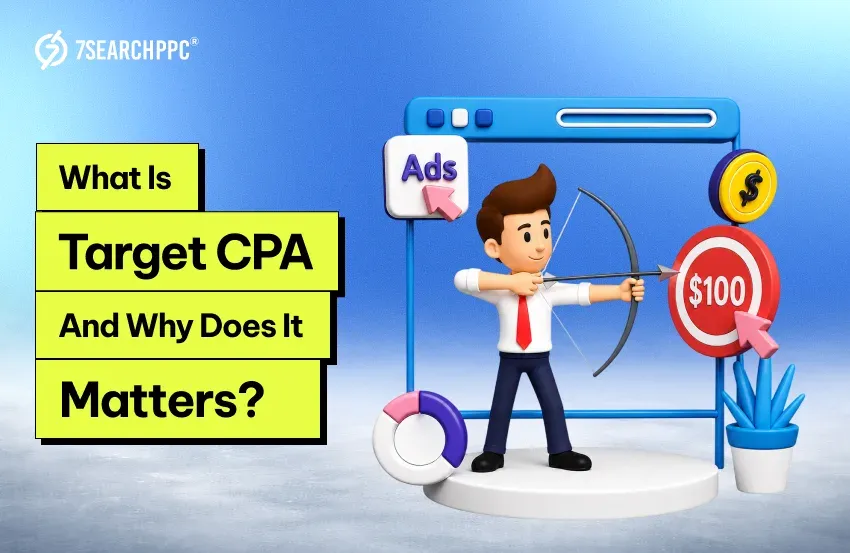
Target CPA is a smart bidding strategy used by advertisers to automate bidding, hit the right auctions, and maintain their per-conversion cost.
Advertisers set a target conversion cost, and the system automatically adjusts bids based on signals like audience, device, location, etc., to acquire more conversions at or below the defined value.
For example, if your defined CPA goal is $200, the algorithm will automatically adjust bids so that the average cost per conversion (sign-ups, deposits, installs, etc) is around $200.
Some conversions may cost more than $200, some may cost less, but the overall average will stay at or near your target. This helps you consistently achieve higher average conversions within your set CPA.
Benefits of Target CPA Bidding:
- The ad budget can be spent more effectively.
- No need to manually adjust bids.
- Maximize conversions while keeping the cost at or near the defined per acquisition value.
- Achieve higher ROI.
How to Calculate the Target CPA?
There is no fixed formula for calculating a Target CPA. It is the average amount you’re willing to pay for an action or conversion based on your business goals, profit margins, and advertising objectives.
However, you can calculate your actual CPA (Cost Per Acquisition) and compare it with your Target CPA to see if your campaigns are performing as expected.
CPA Formula CPA = Total Ad Spend ÷ Total Conversions |
- Total Ad Spend: The amount spent on your advertising campaigns.
- Total Conversions: The number of conversions generated from those campaigns.
- CPA: The average cost per action.
For example, if you spend $500 on online ads and generate 20 conversions, your CPA would be $25.
Once you know your actual CPA, compare it with your Target CPA. If your CPA is lower than or close to your Target CPA, your campaign is on track.
CPA Goal · 7SearchPPC
Tired of High Ad Spend with Low Returns?
Let 7SearchPPC’s CPA Goal do the work — smarter bids, better ROI, zero waste.
How Does Target CPA Work?
Target CPA uses advanced machine learning to automate auctions for slots with the highest likelihood of converting while staying within the defined acquisition cost. It works as follows:
- Advertisers create campaigns.
- Choose the target CPA or CPA Goal as their pricing model.
- Specify per-action cost.
- The system’s algorithm analyzes past conversion data or real-time signals, such as audience, location, device, and time.
- Now, based on the data, bids are placed in real time where the probability of the user clicking and engaging with the ads is highest.
- The system automatically increases bids for auctions where users are more likely to convert and decreases bids for auctions with lower conversion probability.
- The system keeps on refining the predictions to maximize conversions.
It allows advertisers to focus more on campaign planning and processes, rather than going through bulk data to make data-driven decisions and maximize conversions.
When to Use Target CPA Bidding Strategy?
You can use the target cost-per-acquisition bidding strategy for your online ad campaigns when:
- You have sufficient conversion data. The algorithm needs at least 20-30 days of past conversion data (it can vary by industry) to learn customer behavior and demographics. It helps the system make smart predictions and bid for placements that are worth your ad spend.
- You have a clear CPA goal. You have a clear CPA goal. You know exactly what you want to achieve: leads, deposits, bookings, or installs, and at what target cost per action. Target CPA works well when you have a clear vision for your campaigns.
- You have a budget for tracking tools. Automated CPA bidding only works if you have a proper ad-tracking setup in place. If you can invest in robust tracking tools, you can automate manual bidding and avoid dealing with large volumes of data.
- You have the same conversion value. Target CPA bidding works best when each conversion has roughly the same amount. If it varies, performance may be less efficient.
Verticals Where Target CPA Often Performs Well
Industries where the target CPA can be effectively applied are listed below.
- iGaming: iGaming advertisers have the same conversion value for leads and a lot of first-party and conversion data that help the algorithm make more optimized bidding decisions.
- Adult: In this vertical, advertisers usually aim to generate more sign-ups and paid memberships from potential leads, which have almost the same acquisition cost.
- Finance: Finance advertisers seek to generate qualified potential leads rather than unintentional traffic. Thus, the target CPA is a more optimal solution for them.
- Healthcare: Healthcare advertisers typically focus on attracting patients who are likely to book appointments or request consultations. With consistent conversion goals, target CPA helps achieve more qualified leads at a predictable cost.
All these verticals have a clear CPA goal, identical conversion values, vast historical data, and trackable actions. Therefore, CPA Goal bidding is extremely popular among advertisers of these verticals or niches.
Target CPA vs. CPC: Which Is Better for Your Ad Campaigns?
Target cost per acquisition and cost per click are different bidding strategies, and the better choice depends on your campaign goals, available data, and stage of optimization. So, which one is the right fit for you? Let’s take a look below.
Target CPA: It is an automated, algorithm-driven solution used to maintain cost per acquisition.
CPC (Cost-Per-Click): It’s a pricing model in which advertisers pay for each click, regardless of whether a conversion occurs.
Both pricing models work exceptionally well for advertisers. If your main goal is to automate bidding and maximize conversions within a set value, then tCPA is better. Otherwise, choose CPC if you want to drive more traffic to your website.
In Short:
- Use Target CPA for conversion-focused campaigns.
- Use CPC for traffic-focused campaigns.
How to Set a Target CPA in 2026?
Setting a Target CPA requires analyzing your campaign goals, historical performance, and conversion costs to establish a realistic acquisition target.
- Define your campaign objectives.
- Review historical conversion data and perform market research to identify your average cost per action.
- Calculate a target CPA that aligns with your budget and campaign goals. Your daily budget should be no less than 3x–5x your target CPA (source: 30characters)
- Analyze customer lifetime value to ensure your target supports long-term growth.
- Choose an ad network that offers Target CPA or CPA Goal as a pricing and bidding model.
- Set up ad tracking in your preferred tracking platform to accurately measure conversions and acquisition costs.
- Implement the target CPA within your campaign setup.
- Monitor campaign performance and conversion trends regularly.
- Adjust your target CPA over time based on performance data, campaign goals, and market changes.
➡️ Learn why adopting a hybrid campaign management approach is ideal for businesses through our post.
Common Mistakes Advertisers Make When Running Target CPA Campaigns
Common tCPA campaign mistakes that hurt ad campaign performance are listed below. Make sure you’re not making any of these:
- Running campaigns in a competitive market with a lower CPA Goal bid.
- Failing to use a robust conversion-tracking platform. It results in inaccurate CPA bid optimization.
- Setting unrealistic CPA goals without proper research, analysis, and calculations.
- Starting with a low average CPA, narrow targeting, and a limited advertising budget.
- Launching target CPA campaigns without having adequate conversion data.
- Too frequently changing the target CPA bidding strategy.
- Setting the same average acquisition cost for all advertising campaigns.
What 7SearchPPC Suggests: Do not just focus on achieving a lower CPA. Focus on improving quality to increase user LTV and the business’s revenue.
Target CPA Best Practices for Achieving Conversion Goals
Best practices advertisers can adopt to effortlessly reach their cost per acquisition goals are:
- Analyze industry CPA benchmark, seasonal trends, competitors’ activity, and consumer purchase demand and intent. It’ll help you perform thorough market research and analyze trends to set a realistic CPA goal.
- Use a reliable conversion tracking platform and run a conversion test to ensure accurate attribution across all advertising touchpoints. It will help the system perform precise bidding and refine predictions.
- Perform broader campaign targeting. It’ll help CPA ad platforms have more data for evaluation and run auctions for placements with the highest likelihood of converting and generating revenue for the business.
- Monitor conversion data manually to analyze GEOs, traffic sources, formats, devices, and audience segments that contribute to your overall conversions. It can help you optimize target CPA campaigns. You can also use this data when setting up your future campaigns to ensure CPA Goal bids are placed for the right ad spots.
- Use target ROAS alongside target CPA. Target CPA will help you acquire more possible conversions within a predefined financial amount, while target ROAS will help you maximize your ad profit within your ad spend. If you use both together, you can not only gain potential acquisitions but also generate sustainable revenue to stay competitive in the market.
- Evaluate conversion quality along with quantity. If you’re getting volume but it doesn’t add value to your ROI, consider analyzing and making necessary adjustments to your Target CPA bidding optimization strategy.
- Segment the audience into different groups. For optimized Target CPA bidding, segment audiences into groups and craft campaigns with CPA goals that align with each group’s purchase intent.
-> Evaluate your landing page speed and ensure the content and design align with the ad content to gain leads’ trust, make conversions, and increase their customer lifetime value with your business. It’s a simple but practical tip to increase tCPA ads revenue.
Ready to Launch Your CPA Goal Campaigns?
If you’re looking to launch CPA goal ad campaigns, consider 7SearchPPC, one of the leading ad networks that offers strong features and benefits. It provides:
- High-Quality Niche Traffic Across Top GEOs.
- Precise Ad Targeting.
- Popunder, Native, Text, In-Page Push, and Banner Ad Formats.
- Server-2-Server Postback Tracking.
- Pricing Models: CPC, CPM, and CPA Goal.
- Daily Budget Control.
- Ad Scheduling.
It’s designed for performance marketers, media buyers, affiliates, and custom advertisers who want power, ease, and real results.
Frequently Asked Questions (FAQs)
Q1. What is a target CPA in online advertising?
Ans. Target CPA is a smart bidding strategy where advertisers set an average cost per conversion they are willing to pay to achieve specific actions, such as sign-up, deposit, download, or play.
Q2. Who can use the target CPA?
Ans. Anyone who wants to get more conversions at a specific average cost per acquisition can use Target CPA bidding.
Q3. What happens if the target CPA is too low?
Ans. If you set a low CPA goal and target too narrowly from the start, you’ll earn fewer ad impressions and conversions. In short, it limits your ad delivery. The best approach is to set your target CPA closer to your average CPA you’ve achieved over the past 20-30 days from digital advertising efforts.
Q4. What is the difference between tCPA and target ROAS?
Ans. Target CPA is the amount you’re financially committed to spend per conversion, while target ROAS is the profit you aim to make from your total ad spend.
Q5. Is using target CPA ideal if I have a limited online advertising budget?
Ans. Yes, you can choose to advertise using tCPA with a limited ad budget, since it targets potential leads more likely to convert for your business. However, you should consider increasing the budget once you start seeing stable ROI, as it will help you get more conversions.
Q6. Do I need to integrate conversion tracking tools before setting my target CPA goals?
Ans. Yes, setting up tracking tools is required as the target CPA needs conversion data to analyze and make accurate real-time bidding adjustments.