Key Takeaways!
- Ad frequency is the number of times a user sees an online advertisement over a timeframe.
- Online ad frequency can’t be measured alone. Advertisers have to monitor and track conversion and performance KPIs to assess ad impact.
- If the CTR decreases while ad frequency continues to rise, it means the audience starts subconsciously avoiding ads, which diminishes ad returns.
- Repeatedly showing the same ad to the same audience can lead to banner blindness, audience saturation, ad fatigue, and poor brand perception.
- Creating multiple ad creatives and copies to promote a brand message is more prominent than showing the same ad repeatedly to the same audience.
Do you want to spend on an audience that has already started ignoring your advertisements? Absolutely not!
Today, as technology has advanced, market saturation has reached its peak, and the audience’s knowledge of marketing and advertising has expanded. It has become more challenging for advertisers to maintain their brand integrity while balancing ad frequency and user experience. Modern advertisers keep on asking:
- Do I need to shout at the same user with the same ad 50 times?
- Is it okay to display the ad only 3 times?
- What is the optimal ad frequency for my campaigns?
- Ad recall vs annoyance: which one should I prioritize?
– and the list goes on… all the queries revolve around finding an ideal ad frequency in online advertising. If high ad repetition can cause ad fatigue, then low ad exposure can lead to poor brand recall.
In this post, let’s clarify the ideal ad frequency benchmark you should follow to stay competitive and maximize ROAS without hurting your audience’s experience or your budget.
What is Ad Frequency?
Ad frequency is a supporting metric that measures how many times a single user encounters an advertisement while engaging with online content over a specific period.
In simple terms, the number of times an ad is viewed by a single user within a specific timeframe.

How to Calculate Ad Frequency?
Ad frequency is calculated by dividing the total ad impressions by the total number of unique visitors reached within a specific timeframe.
For instance, if you’ve generated 2000 impressions and reached 1000 unique visitors through your advertisement, then your ad frequency will be 2000/1000, i.e., 2. It means 1000 users have viewed your online ad twice while your campaign was active.
Why Is Tracking Ad Frequency Important?
Tracking ad repetition, or frequency, is an important metric that often goes unnoticed by advertisers. They focus on ROI, ROAS, CPC, CPA, impressions, and whatnot, but often overlook measuring ad frequency when analyzing and tracking campaign performance.
When you track ad frequency in digital advertising, it lets you know:
- How often does a user see the same ad?
- Are users getting tired of watching the ad repeatedly?
- Are you increasing your audience reach or just spending more on the same impressions?
So, you can evaluate whether you’re delivering a positive or negative brand experience to your audience and optimize your presence to increase ad impact.
Attention: Ad frequency can’t be measured alone. You have to measure performance and conversion metrics to determine the ideal frequency for your online ads.
Does High Ad Frequency Hurt Conversions?
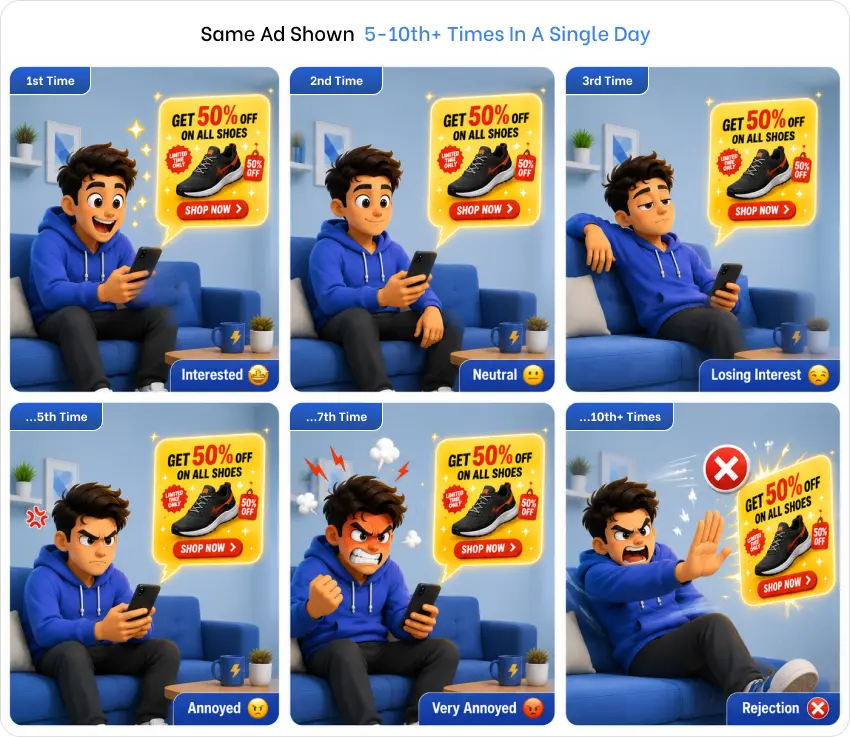
Seeing the same advertisement repeatedly is like someone pushing you to know or buy something you’re somewhat or merely interested in. It frustrates users and falls short of conversion expectations.
Ask yourself: Would you prefer to see an online advertisement 50 times a day? Or 5-7 times a week? Of course, anyone would prefer to watch ads at a minimum frequency!
| 75% of consumers lose interest in a brand when they see the same ad repeatedly. Source: WifiTalents |
Now, users are much smarter than you think. They know exactly when a brand is intentionally trying to sell something through their digital ads and how to ignore it.
Let’s take an example: A user visiting a live cricket score website for match updates repeatedly encounters a retail media advertisement. After a while, they deliberately start to ignore the display ad, leading to banner blindness.
Here, the budget is being spent on the same impression, while ROAS remains stagnant or starts to decline. Also, coming across a brand that doesn’t care about its audience experience.
In short, high ad frequency creates:
- Banner blindness
- Ad fatigue
- Negative brand perception
- Audience burnout
– all of which affects the CTR and ROAS of digital advertising campaigns.
What Causes High Ad Frequency?
Ad frequency in digital advertising increases for the following reasons:
- The advertising platform doesn’t have enough ads to fill the ad slots, so it keeps showing the same ad multiple times.
- The platform has a limited number of publishers, which restricts your audience reach.
- Frequency capping is not set during the campaign planning and development stage.
- Running the ad with the same creative and copy to promote a specific message for a longer period.
- The audience targeting is already too narrow, forcing the platform to show the ad to the same users repeatedly.
Is a High Ad Frequency Always Harmful for Advertisers?
No, a high ad frequency isn’t always bad for the advertisers. For instance, you might want to retarget your cart abandoners, create awareness before the official launch, or build trust for high-consideration products.
Here, a high ad repetition or frequency isn’t harmful to advertisers, as users need multiple impressions across touchpoints to determine whether products are worth their attention and money before making a final decision.
High ad frequency isn’t a problem when you’re:
- Running Retargeting Campaigns: When you’re targeting a smaller group that’s already aware of your brand and has a high intent to convert into customers.
- Seeking to Build Brand Awareness: Constant brand exposure creates recall and familiarity for the new business or offers.
- Advertising High-Consideration Products: Selling products or services where users need to be fully assured before making a purchase.
- Running Short-Term Online Campaigns: Running digital advertising campaigns only for a specific occasion, festival, or time.
However, high frequency is only acceptable in these cases if you are generating stable engagement and ROI. If the ad frequency continues to increase and the conversion and performance metrics keep failing, then you need to make changes even in these situations.
What Happens When Ad Frequency is Too Low?
If excessive ad repetition can cause user burnout, then too little ad exposure might lead to poor brand recall. It can equally harm your campaign’s performance as much as a high ad frequency does. Let’s examine what happens when the frequency of an online ad is too low.
- Poor Brand Recall: If users see your ads only 2-3 times in a 30-day period, they won’t remember your brand or consider it for future purchases. Here, you would be spending on ad impressions that aren’t bridging the gap between your audience and your brand.
- Audience Engagement Decline: If the ad is visible to your users only a few times, it won’t capture the attention you intended, and as a result, your performance metrics start to drop.
- Missed Potential Conversions: Users need multiple impressions across platforms to build trust and feel assured before making any purchasing decisions. If the ad frequency remains too low, the cold audience stays cold. As a result, you struggle to convert them throughout the funnel.
In short,
- Lack of brand reinforcement and user engagement.
- Difficulty in converting users across the funnel.
- Spending the budget on ads that have no impact.
How Often Should Ads be Shown to Users?
Let’s recall what classic and modern marketing theories say about ad frequency to find the benchmarks advertisers can follow to maintain user engagement and ROI.
- The rule of 7, a traditional advertising theory popular between the 1930s and 1950s, states that users need at least 7 exposures to a message to remember it.
- According to Herbert Krugman’s advertising theory and the marketing rule of 3, users need 3 exposures to remember and recall the brand message.
- Modern advertising theory uses a multi-touch attribution model, as users require multiple touchpoints across different channels to convert for the business.
From above, it’s clear that there isn’t a precise number for how many times digital ads should be shown to users. All the theories are driven by consumer psychology, which clearly states that consumers need to see the same message multiple times to remember it, recall it, and take the desired action.
Moreover, users respond differently to diverse products. For instance, daily essentials might require less exposure than products that demand significant trust, visibility, and assurance, such as financial insurance products, 18+ dating, or lifestyle-changing services. So what’s the solution?
Modern advertisers can choose to establish visibility across multiple touchpoints and set an optimal ad frequency for each customer funnel. For instance, they can set a frequency benchmark as:
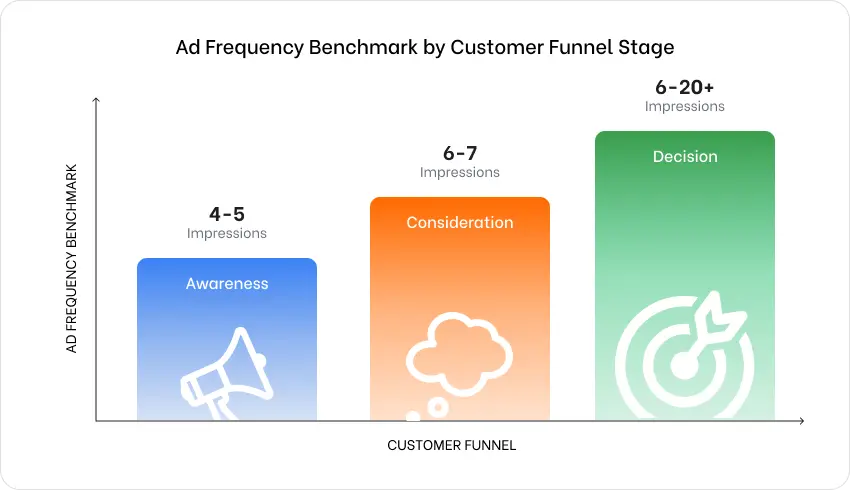
Users need multiple impressions to remember the brand message. You might be spending 6-20+ impressions per user. But by strategically distributing frequency across customer stages, you can prevent ad fatigue, provide a consistent user experience across channels, and sustain brand credibility.
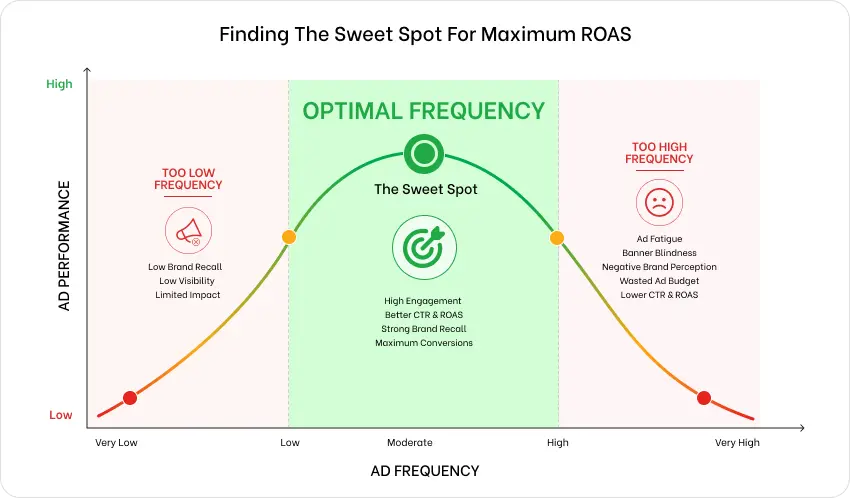
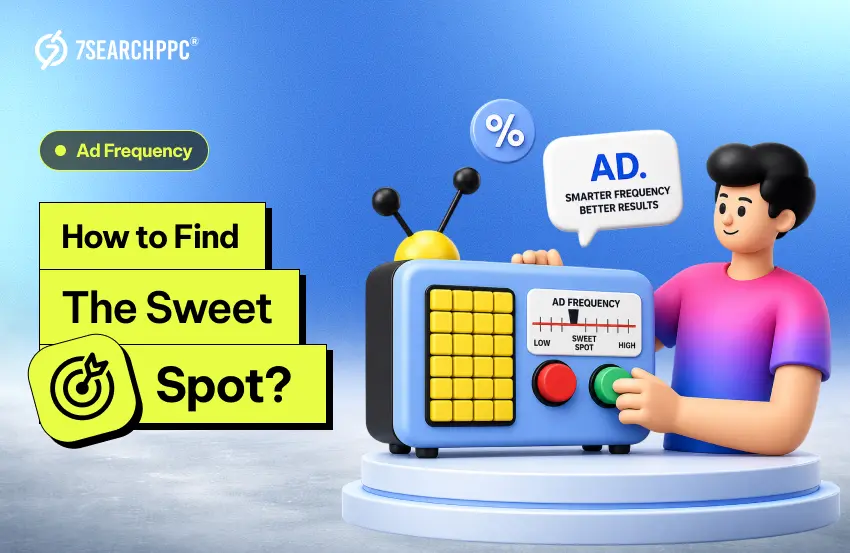
Neither too little nor too much. You have to find the sweet spot to balance ad repetition without annoying users.
When setting ad frequency benchmarks, consider your products, services, goals, audience, and advertising channels to strategically determine the ideal frequency for your online ad campaigns.
Ad Reach vs Ad Frequency: Which Is More Important in Advertising?
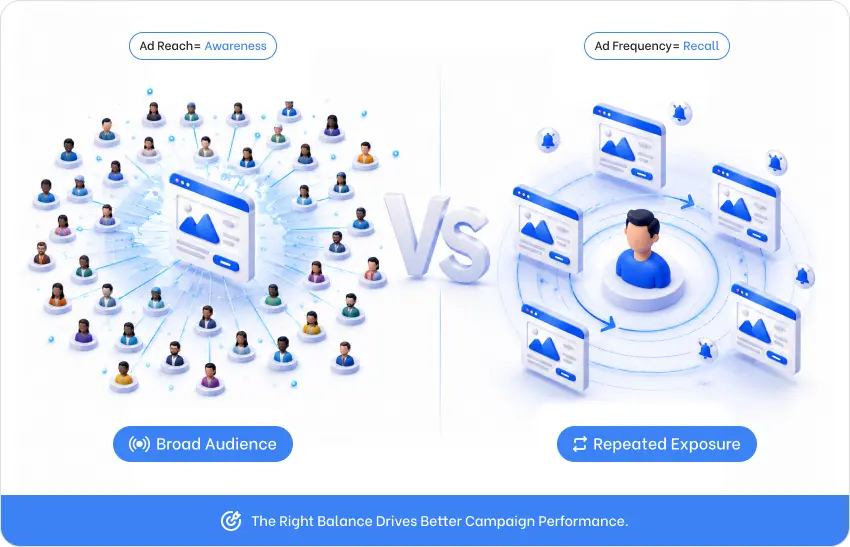
Reach and frequency are both important. The key is that their significance may vary depending on the campaign goal and user segment you’re targeting. Let’s use a comparison table to better understand the difference.
| Parameter | Ad Reach | Ad Frequency |
|---|---|---|
| Definition | Reach is the number of unique users exposed to your brand through an advertisement. | Frequency is the number of times a user sees the same ad over a period. |
| Primary Goal | Expand audience reach. | Reinforce the same ad message. |
| Best For | Awareness stage | Decision stage |
| Audience Size | Broad | Saturated |
| Advantage | Improves brand reach. | Increases brand recall. |
| Limitation | Prevents brand recall. | Creates ad fatigue. |
| Optimization Strategy | Focus on increasing unique ad impressions. | Set frequency capping based on your niche. |
Let’s use an example. During the awareness stage, you might want to create massive brand exposure among a diverse group of users. Your goal is to get more users to see your online advertisement, regardless of whether they see it once or twice. Here, reach automatically becomes more important than frequency.
Conversely, when creating retargeting ads for the decision stage, your audience is saturated, users are already familiar with your brand, and your primary aim is to show the same time-sensitive offer repeatedly to create product recall. In this case, you prioritize frequency over reach. Seeing the ad repeatedly can help you convert more users for your online business.
Ad Frequency Optimization Strategies to Increase ROAS
Some of the best ad frequency strategies to avoid ad fatigue and negative brand perception, and to maximize ROAS, are listed below.
- Set Optimal Frequency Count: Set a frequency benchmark based on your campaign goal, target audience, and products and services across the customer stage. As users approach the conversion stage, you can increase ad frequency, since they need to see the same ad multiple times before deciding to purchase.
- Measure KPIs: Track conversion and performance metrics to effectively evaluate campaign performance and determine whether the frequency is optimal. For instance, if the frequency count is increasing while CTR, ROI, ROAS, and other key metrics are dropping, then it means you need to adjust your ad frequency strategy.
- Set Frequency Capping: You can set frequency capping to limit how many times a single user sees the online ad during the campaign period. For instance, the ad can be shown to a single user only 8-10 times a month.
- Experiment With Different Creatives: Don’t push the same ad to the same users 100 times. It will only irritate them and cause ad avoidance. Instead, create multiple creatives with different headlines and visuals to promote the same message in distinct styles, maintaining user engagement and preventing ad fatigue. You can also combine AR ads with other digital ad formats to deliver your message in an innovative way. This approach allows you to run A/B tests and identify the ads that drive better campaign results.
- Create Serials of Ads: Create a series of advertisements rather than repeatedly showing the same ad to the same user. For instance,
- In ad 1, you can inform about the brand.
- In ad 2, you can inform about the products you’re selling.
- In ad 3, you can showcase customer testimonials to build trust.
- In ad 4, you can highlight the benefits and offers.
This approach allows you to reach the same user multiple times while keeping them engaged by giving each ad a unique angle, avoiding the impression of being a relentless brand, and increasing the likelihood of converting them into a customer.
- Choose Advertising Network Wisely: Select an advertising network that has a large number of active publishers, enables real-time tracking, offers multiple ad formats, and allows setting frequency capping to prevent ad overexposure.
You can choose to advertise with 7SearchPPC, since it connects you with publishers of all sizes and types through various advertising formats. |
- Understand Your Segmented Audience: Conduct thorough research to evaluate how your segmented audience reacts to ads, how frequently they want to see ads, how quickly they act, and at which stages they prefer to see ads. Go through research papers, statistics, and your in-house data to make more precise decisions.
- Target High-Converting Hours and Platforms: Increase online ad frequency during the most active hours of the day, week, or month on platforms where your target audience frequently spends time.
Optimize Ad Frequency to Maximize Impact!
The ideal frequency of an ad depends on your campaign goals, target audience, and the products or services you offer. So, it would be completely wrong to say that high frequency is always destructive, as in many cases it may be necessary to achieve results. Use ad impression frequency optimization best practices to strike the right balance between ad repetition and user annoyance.

Frequently Asked Questions (FAQs)
Q1. What do you mean by ad frequency?
Ans. Ad frequency measures the number of times a user sees an online advertisement over a specific period.
Q2. What happens if users see ads too often?
Ans. When users see the same online advertisement too frequently, it can cause banner blindness, ad fatigue, and create a negative brand perception.
Q3. How many times should a user see an ad?
Ans. There is no fixed number for displaying ads, but it’s better to set frequency capping based on your campaign goals and target audience.
Q4. How can I determine whether my ad frequency is too high?
Ans. If your CTR, CPC, and other conversion metrics, along with performance metrics, keep declining, while your ad frequency is constantly increasing, then you need to adjust your frequency capping to prevent ad fatigue and banner blindness.
Q5. How to avoid ad fatigue in campaigns?
Ans. Advertisers can prevent ad fatigue in several ways. Some of them are listed below.
- Use multiple ad creatives.
- Segment campaigns by customer funnel stage.
- Adjust frequency based on performance.
- Set frequency caps.
Q6. What is the impact of high ad frequency on brand perception?
Ans. High ad repetition or frequency can cause irritation, reduce trust, and negatively affect brand perception.