Key Takeaways!
- Advertising campaign management involves a series of steps from planning to optimization to effectively promote products and services across multiple touchpoints to reach the right audience.
- Lack of transparency about how AI is making decisions is one of the top concerns among marketers.
- 54% of marketers are concerned that over-reliance on AI might reduce creativity and human personalization.
- AI-driven campaign management tools can fine-tune raw data into robust online advertising strategies within seconds.
- Manual ad campaign management lets you create personalized ad creatives and copy to form an instant connection with your audience without sounding monotonous.
Managing advertising campaigns today isn’t what it used to be. Earlier, marketers would manually plan budgets, select audiences, and track performance step by step. Now, with AI stepping in, campaign management has become faster, more automated, and heavily data-driven. But does that mean manual campaign management is outdated? Not really. While AI can optimize ads in real time, human decision-making still plays a key role in strategy and creativity.
So, when it comes to advertising campaign management, which approach actually delivers a better experience and results? In this blog, we’ll compare AI and manual campaign management, explore their benefits, and help you determine which approach is right for you.
What is Advertising Campaign Management?
Advertising campaign management involves a sequence of steps advertisers follow to promote their products, services, and offers across single or several touchpoints to generate high-quality engagement and increase conversion and retention rates.
In simple terms, managing advertising campaigns involves everything from executing campaign goals to auditing and optimizing campaign performance for better results.
For example, marketers of a fitness website plan to target users who are interested in yoga, prefer healthy cooking, and seek positive lifestyle changes across various channels to promote their free trial classes and ultimately increase gym membership rates. They create multiple ad creatives, set targeting parameters, closely monitor performance, and refine their strategies to achieve the advertising goals.
In short, they’ll be:
- Developing Plans and Strategy
- Executing Advertising Campaigns
- Monitoring and Optimizing
- Analyzing and Scaling
Following all the ad campaign management steps necessary to achieve the digital advertising campaign goals.
AI-Powered vs Manual Campaign Management: Key Differences Explained
In 2026, let’s shed some light on the much-debated question: AI vs. manual advertising campaign management— which one is better for achieving higher ROI! But first, let’s understand the key differences and the benefits offered by both to better distinguish between them.
What is AI-Powered Ad Campaign Management?
In AI campaign management, you use AI-powered platforms like Meta Advantage+, AdScale, and similar tools to automate the entire campaign management process with minimal or no manual intervention. When integrated with a Customer Data Platform (CDP), these platforms can leverage unified customer data to improve audience targeting, personalize ad experiences, and optimize campaign performance across multiple channels.
Benefits:
- Identifies lookalike audiences.
- Easier to create and test ad variations.
- Forecasts the campaign outcome.
- 24/7 campaign optimization based on real-time data.
- AI processes large datasets to better understand and target the right audience.
What is Manual Ad Campaign Management?
In manual campaign management, all campaign operations are handled manually to have more control and space for customization and optimization, and to connect and engage with potential prospects on an emotional level.
Benefits:
- Marketers have full control over campaigns.
- Ideal for reaching a niche audience where compliance is mandatory.
- Forms emotional engagement through personalized ad assets.
- Spend the advertising budget precisely to avoid ad waste.
How AI Improves Ad Performance and ROI?
Suppose you’re managing an eCommerce site with multiple products and services. You want to attract and convert potential leads for your business through paid ad campaigns. Manually running and monitoring online ads for multiple products and services with personalized offers would be time-consuming and inefficient.
You will need to conduct thorough research, analyze data, and make smart guesses to better understand your audience’s interests, behavior, and intent. You’ll be performing lengthy, tedious, and repetitive tasks, all to make your campaigns more productive and results-oriented. This is where AI outperforms manual campaign management.
What AI does:
- AI derives strategy from data patterns, constraints, and goals you provide.
- Creates multiple ad assets to have more variations and conduct A/B testing.
- Buys high-converting ad inventories and adjusts bidding in real-time.
- Precisely targets devices, locations, and time.
- Places online ads where contextual relevance is high.
- 24/7 monitors and fine-tunes campaigns based on current data.
- Reallocate the budget to top-performing online ads.
- Pause and kill underperforming campaigns to prevent ad wastage.
- Scales campaigns when it is more likely to increase ROAS.
With minimal manual effort, AI eliminates the need to juggle complex datasets, enabling you to manage campaigns more efficiently while achieving better results.
AI tools learn and improve as data expands, filling every gap to enhance campaign performance, even while you’re sleeping. This is how AI gives you more time to focus on other critical areas of your business and improves ad campaign performance and ROI.
Can Manual Campaign Management Outperform AI?
AI automation streamlines advertising campaign management at scale, but several reasons show that manual campaign management can still outperform. Let’s have a closer look at the reasons.
How and where manual ad campaign management exceeds AI:
- More Compliance Control: Industries such as healthcare, iGaming, finance, and adult are highly regulated by government authorities. Here, high manual intervention is required to stay compliant, avoid fines and penalties, maintain human sensitivity, and provide a safe online experience.
- Data is Limited: AI-driven ad campaign management tools don’t show impressive results when you’re targeting a smaller group or don’t have enough datasets to train AI about your audience’s interests, behavior, and preferences. However, with manual campaign management, you can adapt quickly with judgment rather than relying on limited data.
- Goal is to Emotionally Connect: AI can generate multiple ad variations within seconds, which improves efficiency. Many marketers also use AI tools to craft social media posts alongside ad creatives to maintain consistency across campaigns. However, when it comes to connecting with human emotions or showcasing creativity, no one does it better than humans.
- Top-Funnel Difficulties: AI needs data to understand the audience, and during the beginner stages of the customer journey, businesses often lack sufficient data to train it. This makes it harder to educate, nurture, and convert potential leads from the top of the funnel. Whereas marketers can use a manual campaign creation process to access available data and craft meaningful campaign strategies to connect with users across the funnel.
- AI Increases CPC Competition: Programmatic buying of ad inventory increases cost-per-click (CPC) and cost-per-lead (CPL). AI tools compete to secure ad slots; as a result, you end up paying more for inventory that provides little to no value to your campaigns. On the other hand, manual campaign management allows advertisers to control sudden bid fluctuations and focus spending on high-quality, high-converting inventory.
- Monotonous and Repetitive: AI can deliver the same digital advertising strategies that often sound repetitive and lack creativity. If you choose to create ad campaigns manually, you can add unique insights and a personal touch to make your strategy stand out and outperform competitors.
In short, manual campaign management offers:
- Better brand positioning
- Stronger storytelling
- Improved compliance
- Reduced ad wastage
- Greater creativity
- More effective niche targeting
- Full strategic control
Let’s use a table to better understand the difference.
| Metrics | AI-Powered Advertising Campaign Management | Manual Advertising Campaign Management |
|---|---|---|
| Approach and Execution | Analyzes a large amount of data to create, optimize, and scale campaigns in real-time. | Manually research data to understand audience interest, behavior, and preferences to create and optimize online campaigns. |
| Speed and Efficiency | It takes seconds to create and optimize digital ads, but it can also lead to over-optimization and targeting the wrong audience. | It takes more time to evaluate and analyze data, but it helps to target the right audience with the right message. |
| Audience Targeting | Uses first-party data and previous campaign performance (datasets) to improve decision-making and target a lookalike audience. | Performs audience segmentation based on in-house data and assumptions to reach potential prospects. |
| Control | Black-box opacity: you don’t know how the decision is being made. | Full transparency and control. |
AI vs Manual Advertising Campaign Management: What to Choose?
Let’s take a closer look at the market and audience preferences to better understand what’s more effective, as both offer amazing benefits for managing ad campaigns.
- Advertising campaign managers face a 22% increase in CPC from Q1 to Q4 in 2025, with no meaningful improvement in CTR. The fact is, AI systems compete for ad placements, which often increases CPC and CPM costs. Unintentionally, this leads to higher spending for stagnant results across touchpoints.
- 54% of marketers agreed that over-reliance on AI can reduce creativity and personal experience in online ads.
- Not every user prefers AI-generated online ads. 39% of Gen Z views AI-generated content somewhat negatively, while 50% of millennials respond positively. Furthermore, 12% of the US audience is more likely to buy from a brand that uses AI to generate online ads.
- McDonald’s pulled its AI-generated Christmas ad amid online backlash, whereas Amazon is all set to provide AI-powered advertising solutions to SMBs.
The adoption of AI-generated online ads among businesses and audiences shows mixed signals. But on a broader level, you can’t rely too heavily on AI-powered ad campaign management solutions, as you can see the inputs and outputs, but don’t know how the decisions are being made.
AI is a machine; it can end up targeting the wrong users at the wrong time. For instance, a brand might be offering cosmetic products that suit Indian skin tones perfectly, but AI targets the US audience during the weekdays, which increases the CPC and CPM costs. Bids are being placed for irrelevant places, which broadens the gap between CPC and CPA.
AI-driven campaign management tools speed up and automate processes, but without manual intervention, even AI can fail to deliver positive results. AI and humans can’t compete with each other; instead, they should be combined to achieve results beyond expectations.
AI can increase speed and efficiency, while manual oversight can improve ad campaign performance through meaningful insights and expertise. Thus, adopting a hybrid advertising campaign management system is more ideal for advertisers of all sizes and types to succeed in the digital ecosystem.
Advice: Set a specific budget for AI-powered advertising tools to test and analyze their performance, and avoid overspending on tools that aren’t delivering results. This is the best approach for managing ad campaigns in 2026.
Top AI Tools for Managing Advertising Campaigns
Performance Max, Pixis, Smartly, Meta Advantage+, and AdScale are some of the top-performing AI tools for managing ad campaigns. Beyond campaign management itself, the ad visuals feeding these platforms increasingly start with something like nano banana prompts before a designer ever opens a design tool. Let’s explore them.
1. Performance Max
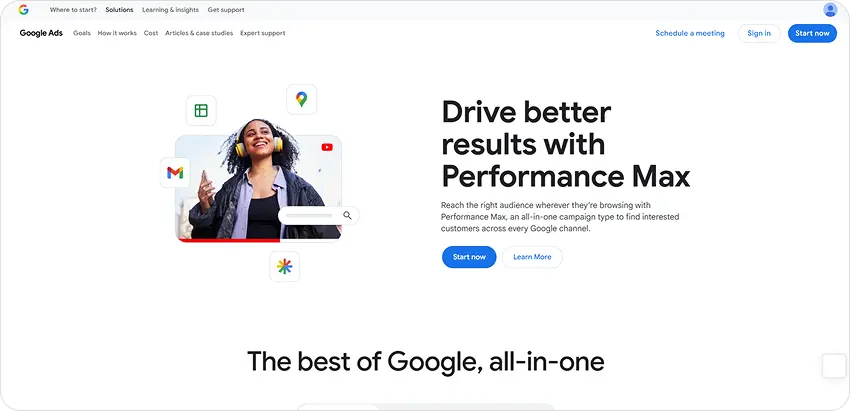
Performance Max is Google’s AI-driven automation solution for digital advertising, designed to reach lookalike and interested audiences across Google’s channels. Advertising campaign managers have to set their advertising goals, add the budget and creative, and Performance Max ensures the ads reach the right audience at the right time.
Benefits
- Performance Max uses your audience data to reach the prospects who are more likely to convert.
- Uses smart bidding to optimize campaign performance based on your ROAS target.
- It offers a user-friendly interface to manage ad campaigns.
2. Meta Advantage+
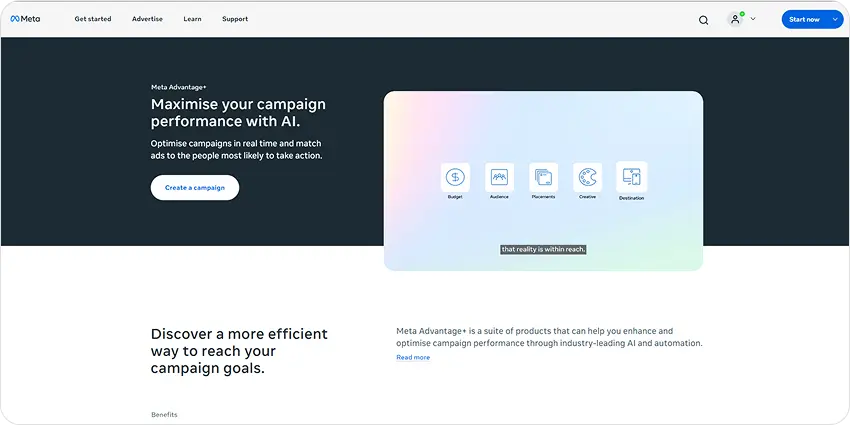
Meta Advantage+ is a suite of AI-powered tools within Meta’s Ad Manager that allows real-time campaign optimization and ensures your ads appear to users who are more likely to convert for your business. Advertising campaign managers can achieve their campaign goals by either using end-to-end or single-step AI ad management solutions.
Benefits
- Analyzes real-time data and auto-optimizes the campaign to maximize profitability.
- Engage with users on the top-performing social channels, having billions of active users.
- It reduces the cost per qualified lead (CPQL) to 10%.
3. Pixis
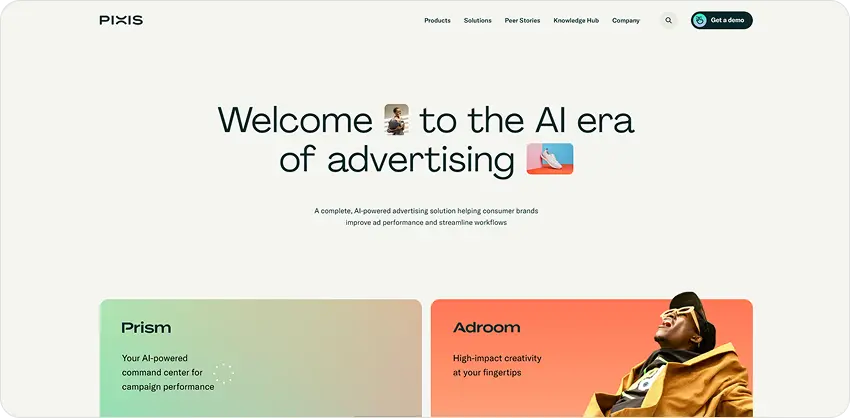
Pixis is one of the best platforms for managing advertising campaigns, as it automates everything from campaign creation to scaling, allowing advertisers to focus on their strategies to better reach their target audience and maximize profits.
It features two impressive AI-powered ad campaign tools, Adroom and Prism, that enable you to create, monitor, and optimize campaign performance through a user-friendly, real-time conversational interface. It’s ideal for consumer brands and agencies.
Benefits
- Transform your imagination into visuals within seconds.
- Intelligent optimizations prevent ad wastage.
- Converts raw data into a power-backed advertising strategy that’s ready to get launched and attract users.
- AI-powered smart budget allocation.
4. Smartly
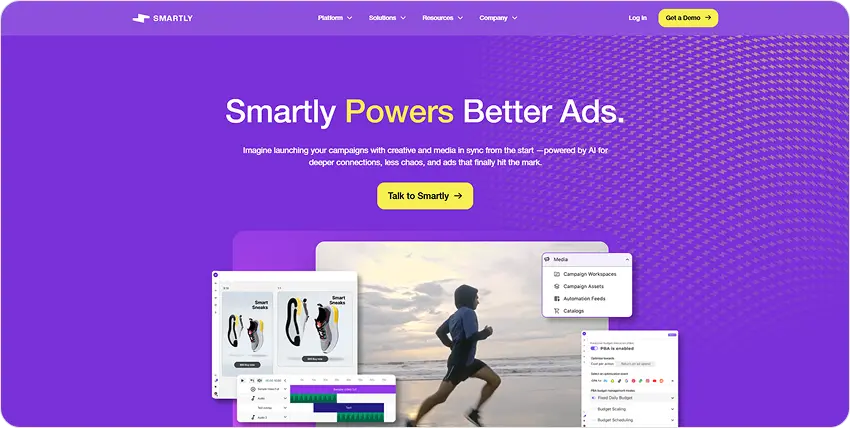
Smartly is an AI-powered advertising solution that streamlines workflows and improves ad performance to maximize ROAS. It transforms digital advertising campaign management, enabling advertisers to engage with their users more effectively.
Benefits
- Create, personalize, and scale creatives across platforms.
- AI pauses or scales the budget based on real-time insights.
- Monitor campaigns to keep track of how AI is optimizing and scaling.
- AI-powered features show you what’s actually working, eliminating guesswork.
5. AdScale
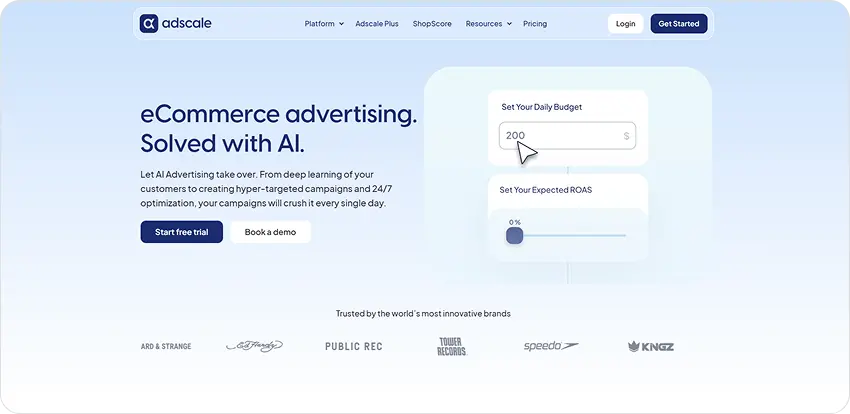
AdScale lets you create winning AI-powered ad campaigns from scratch through a beginner-friendly user interface. The platform analyzes your first-party data and the previous campaign’s performance to better understand and segment the audience. It develops a personalized digital advertising strategy based on the data to attract more potential customers and differentiate from the competition.
Benefits
- Understands your ideal users’ buying preferences to reach them at the peak moment.
- Set your expected ROAS and daily budget to avoid ad wastage.
- Create AI copy and creatives within seconds.
- Smarter budget allocation.
Hybrid Approach: Your Way to Manage Ad Campaigns Effectively!
For managing digital advertising campaigns, adopting a hybrid approach is a more optimal solution, as it allows you to target the right audience with the right message across channels. You can use AI to process large amounts of data, and your expertise to fine-tune the creation and execution.
Your next step is to practice tips that can help you manage online advertising campaigns. Some of them include:
- Keep a close eye on the places for which bids are being made.
- Pick a reliable AI tool for managing ad campaigns.
- Use a tracking tool to closely monitor campaign performance.
AI isn’t replacing manual oversight. You only need to learn how to integrate it into your online advertising strategy to maximize profits.
Get your message in front of the right users. Start advertising on our ad network today and drive measurable results at scale.
Frequently Asked Questions
Q1. Manual vs AI-powered ad campaign management: which one is better?
Ans. Choose a hybrid approach for managing ad campaigns, as it allows you to improve efficiency while providing full control to ensure accuracy across platforms.
Q2. Can businesses of all sizes use AI to automate campaign creation and execution?
Ans. Yes, businesses of all sizes can use AI to automate campaign creation and execution, but human oversight is vital in sensitive, highly regulated sectors like healthcare, where you can’t advertise products and services without considering the level of sensitivity involved.
Q3. When should advertising campaign managers focus more on manual oversight?
Ans. Advertising campaign managers should focus more on manual oversight when they:
- Want to target a niche-specific audience where advertising regulations are highly sensitive.
- Have to advertise on a tight budget.
- Don’t have enough data for AI to learn and grow.
- Want full control over their data and unique strategies.
Q4. What are the benefits of AI in digital advertising?
Ans. Some of the advantages of using AI in digital advertising are:
- Precision targeting
- Real-time bids reallocation
- Continuous campaign optimization
- Improves efficiency
Q5. Should small businesses use AI for launching online ads?
Ans. Yes, small businesses can also use AI-powered platforms to manage ad campaigns. But they need to have enough data to train the AI and a sufficient budget to support its learning and adaptation over time.