Core insights!
- AI search is making brand visibility more important than traditional search rankings.
- AI visibility tools are designed for different needs, from analytics to revenue tracking to SEO.
- Choose an AI visibility tool based on your goals, budget, and required AI platform coverage.
- Tracking AI mentions and citations is now essential for modern marketing success.
The way brands are discovered has completely changed because of AI search. Google searches now end without a click 68.01% of the time in the U.S., according to SparkToro’s Rand Fishkin, and as AI search gains traction, it’s eating into traffic; that figure has climbed from roughly 45% a decade ago, with the steepest acceleration in the last two years.
In the 2026 survey data, Semrush’s AI Visibility Index found that 45% of marketing leaders cannot accurately measure their brand visibility within AI-generated answers, and only 9% have the tools to track all relevant metrics across platforms, pushing brand tracking across different AI models into one of the top priorities for agency teams this year.
To save you time and effort, we’ve researched the five best AI visibility tools available today.
Quick Comparison of AI Visibility Tools
| Platform | AI Models Tracked | Key Feature | Pricing | Best For |
|---|---|---|---|---|
| AI Peekaboo | 5 (ChatGPT, Perplexity, Gemini, Google AI Overviews, Google AI Mode) | Multi-client dashboard + white-label + Looker Studio connector | From $50/mo | Agencies needing an affordable multi-client scale |
| Promptwatch | Multiple | Sentiment + competitor monitoring | From $99/mo | Data-driven marketers who want deep analytics |
| Mentions.so | 3–8 (tier-dependent) | Clean UI + industry ranking | From $49/mo | Small teams wanting intuitive tracking |
| Trakkr | 8 AI models | Revenue attribution via Google Analytics | From $79/mo | Brands connecting AI traffic to revenue |
| LLMrefs | 10+ AI engines | Keyword-centric + geo-targeting | From $79/mo | SEO professionals tracking at the keyword level |
Top 5 AI Visibility Tools in 2026
Here are five of the strongest AI visibility tools in 2026:
1. AI Peekaboo
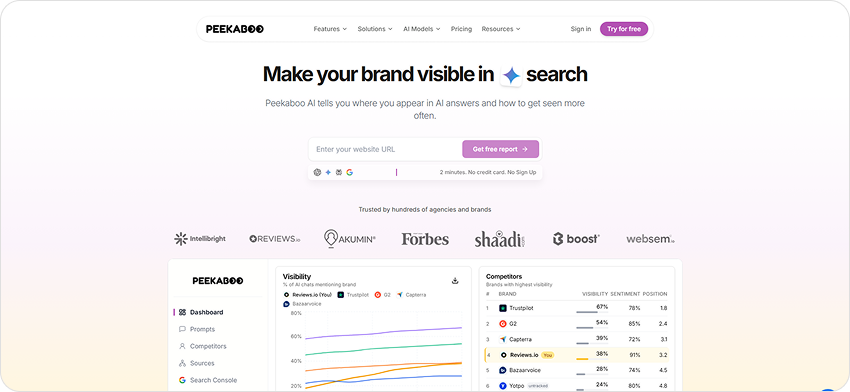
AI Peekaboo was built specifically for agencies and brands managing AI visibility across multiple clients. The platform tracks brand mentions and citations across five major AI engines, ChatGPT, Perplexity, Gemini, Google AI Overviews, and Google AI Mode, from a single multi-client dashboard. Unlike enterprise-focused competitors, AI Peekaboo launched with agency workflows at the core: unlimited team seats, white-label reporting, and per-client campaign management are available from the entry plan.
The platform features a dedicated ChatGPT tracker alongside its AI Overview tracker, giving agencies the ability to monitor these two rapidly growing AI discovery channels separately. Thanks to a Looker Studio connector, teams can feed visibility data straight into the client dashboards they’re already using,no manual exporting required. This bridges the gap between AI tracking and agencies’ existing reporting workflows. Looking ahead, the roadmap includes plans for automatic content creation and publishing, which would ultimately connect visibility tracking directly to content response, completing the loop from insight to action.
Key strengths:
- Multi-client dashboard for managing unlimited brands from one interface.
- White-label reporting with agency branding.
- Dedicated ChatGPT tracker for isolating ChatGPT citation performance.
- AI Overview tracker for monitoring Google AI Overviews visibility.
- Looker Studio connector for seamless integration with existing client reports.
- Tracks 5 AI engines, including Google AI Overviews and Google AI Mode.
- Unlimited team seats across all plans.
- Upcoming automatic content creation and publishing capabilities.
- Affordable entry point significantly below industry average.
Pricing: Starter $50/month; Grow $100/month; Scale $250/month. No contracts required.
Limitation: Keep in mind, AI Peekaboo isn’t built for traditional SEO or enterprise security needs. Teams that want keyword rank tracking alongside AI visibility will need to use it alongside a separate SEO tool.
Best for: Agencies needing white-label AI visibility tracking across multiple clients at competitive pricing.
2. Promptwatch
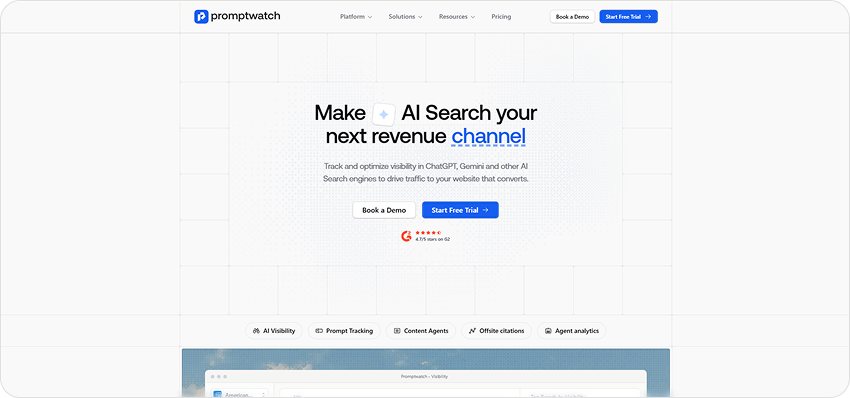
Promptwatch is a data-driven platform designed for marketers who need granular insight into how their brand performs across AI-generated responses. The platform combines brand mention tracking with sentiment analysis and competitor performance monitoring, producing structured recommendations rather than raw data exports.
What sets Promptwatch apart from lighter trackers is the analytics layer. Users can observe trends in share of voice over time, track how their brand performs against competitors in numerous AI models, and get prioritized advice to increase site traffic.
Key strengths:
- Robust analytics and reporting dashboard
- Brand mention tracking with sentiment scoring
- Competitor performance monitoring across AI models
- Actionable recommendations built into the workflow
- Multi-model tracking with trend analysis
Pricing: Essential $99/month; Professional $249/month; Business $579/month. Trial available for $1.
Trade-off: Since the analytics run deeper than what you’d find in simpler trackers, it takes a little getting used to. Most new users need some time to settle in before they’re really making the most of the reporting.
Best for: Data-driven marketers seeking deep analytics and actionable AI visibility insights.
3. Mentions.so
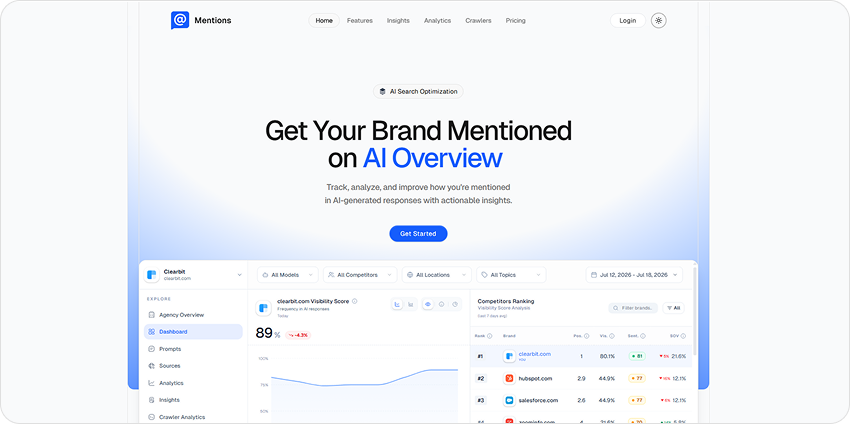
Mentions.so offers a clean, accessible entry point into AI visibility monitoring with a user interface designed for teams without dedicated analytics resources. The platform tracks brand mentions across ChatGPT, Gemini, and Claude on the starter tier, expanding to broader LLM coverage on higher plans.
Mentions.so offers industry-level tracking that helps brands understand where they fall compared to the competitors in their industry and category. This is especially helpful for companies that want to begin AI tracking and have no prior ranking for the field. There is also an agency-level plan at $399/month for companies handling several clients on one platform.
Key strengths:
- Clean, intuitive interface that’s easy to pick up, minimal onboarding needed
- Covers the big three at the entry level: ChatGPT, Gemini, and Claude
- Includes industry ranking alongside competitor tracking
- Sentiment analysis comes built in
- Also offers an agency tier for handling multiple clients at once
Pricing: Starter $49/month; Pro $99/month; Business $199/month; Agency $399/month.
Trade-off: With the starter plan capped at three LLMs, brand visibility numbers might not tell the whole story, especially for clients whose audiences use a broader range of AI tools. On top of that, the feature set isn’t quite as mature as some of the more established platforms out there.
Best for: Small teams and individuals wanting affordable, intuitive AI visibility tracking.
4. Trakkr
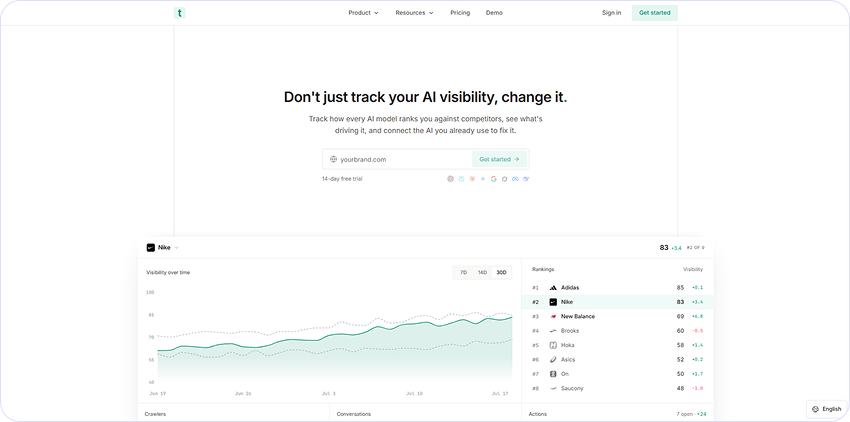
What sets Trakkr apart is its focus on revenue attribution. By integrating with Google Analytics, it connects AI citation traffic directly to actual conversions, something most AI visibility tools simply don’t measure. Beyond that, the platform tracks eight different AI models and offers citation tracking and perception analysis.
The reporting can also be white-labeled, and there’s a free entry-level option available for prospects to take the tool for a test drive before subscribing. Most notably, its revenue attribution module would be ideal for e-commerce marketers and performance-driven marketing teams.
Key strengths:
- AI-to-revenue attribution via Google Analytics integration
- Tracks 8 AI models, including major platforms
- Citation tracking and perception analysis
- Automatic site optimization suggestions
- White-label agency reporting
- Free plan available (1 brand, 5 queries)
Pricing: Free plan; Growth $79/month; Scale $399/month.
Trade-off: Some users have pointed out that the interface feels a bit cluttered compared to cleaner, more streamlined competitors. On top of that, the free tier only allows tracking one brand with five queries, not really enough room to properly test the platform before committing to a paid plan.
Best for: Brands and agencies connecting AI-driven traffic to measurable revenue outcomes.
5. LLMrefs
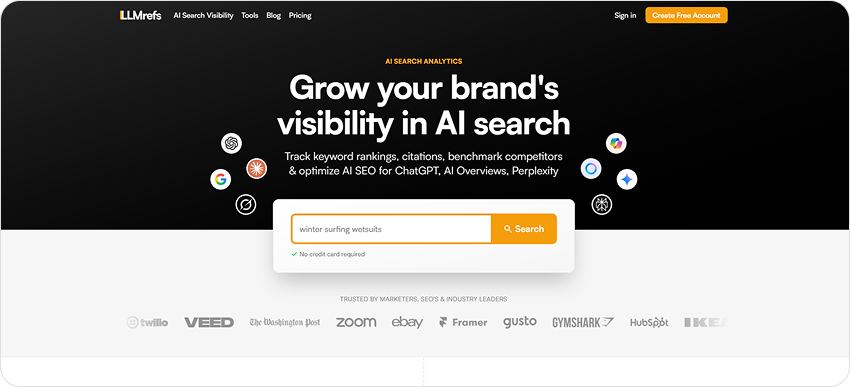
LLMrefs applies a keyword-centric tracking methodology rather than prompt-level analysis, making it the most natural fit for SEO teams already operating within keyword-based workflows. The platform monitors brand and keyword performance across more than ten AI engines, the broadest engine coverage in this comparison, and includes geo-targeting capabilities for brands with regional audience segments.
The straightforward interface minimizes the learning curve for teams migrating from traditional rank tracking tools. Pricing remains accessible relative to the engine breadth offered.
Key strengths:
- Tracks 10+ AI engines, the broadest coverage of any tool in this comparison
- Takes a keyword-centric approach that’ll feel familiar if you’re coming from an SEO background
- Geo-targeting is built in
- Pricing is easy to justify, given how much you’re getting feature-wise
- Interface is straightforward, so there’s not much of a learning curve
Pricing: Starter $79/month; Pro $159/month; Business $399/month.
Trade-off: Looking at things keyword-by-keyword doesn’t always show the full picture; sometimes, brand visibility really shows up in how an AI responds to a broader prompt or conversation. So if your team cares more about how AI models talk about your brand in open-ended questions, a prompt-level tracker will probably give you better insight.
Best for: SEO professionals tracking AI visibility at the keyword level across broad engine coverage.
Factors to Consider When Choosing the Best AI Visibility Tool
Price isn’t the only factor. If the tool priced at $500/month doesn’t have multi-client capacity for the agency to onboard all 10 of their clients, the tool at $50/month that covers 5 AI engines and white-label reports is still going to be better. Engine coverage needs to be tailored to who the users are and what they work on.
For brands whose users focus on Google’s ecosystem, it needs to cover Google AI overviews, as well as Google AI mode (not all have that).
Teams targeting an international audience may need to factor in geo-targeting. Agency infrastructure: the major distinction here is between tools built for a team and multiple clients versus those built for individuals.
If it doesn’t have white-label reports, the ability to support a multi-client dashboard, and has one seat per client, it likely won’t scale. Attribution depths differ immensely. Most platforms focus on simply tracking what’s visible, what’s mentioned, or the number of citations-none of which tie back to how it influences traffic or revenue.
Brands that do both brand awareness and performance will want a tool with some analytical or traffic integration capability.
Reporting frequency is another important consideration. A tool that updates data daily rather than weekly enables teams to identify changes as they happen, which is particularly valuable during product launches and other fast-moving campaigns.
Conclusion
Now that you have explored the best 5 AI visibility tools through this blog. However, the right fit depends on what you’re trying to solve. If you’re an agency managing several clients, you should look for white-label reporting and multi-client dashboards. If revenue matters most, prioritize tools with analytics integrations. Smaller teams might prefer something simple to start with, while SEO-focused teams may want broader keyword and engine coverage. Match the tool to your goals, not the other way around.
Frequently Asked Questions (FAQs)
Q1. What is an AI visibility tool?
An AI visibility tool helps you see how often your brand is mentioned, recommended, or cited in AI platforms like ChatGPT, Gemini, Perplexity, and Google AI Overviews.
Q2. Why is AI visibility important for brands?
More people are using AI tools to find information instead of clicking on search results. If your brand appears in AI answers, you have a better chance of reaching and converting potential customers.
Q3. How is AI visibility different from SEO?
SEO focuses on improving your website’s ranking in search engines. AI visibility focuses on how often AI tools mention or recommend your brand in their responses.
Q4. Are there budget-friendly AI visibility tools for small teams?
Mentions.so and AI Peekaboo offer affordable entry points, starting at $49–$50 monthly, ideal for smaller teams beginning AI tracking.
Q5. Who should use an AI visibility tool?
Marketing agencies, businesses, SEO professionals, content marketers, and brands that want to improve their online presence can all benefit from AI visibility tools.