Core Insights
- US teams often learn about a competitor’s move only after it costs them a deal. Competitor monitoring closes that gap.
- Readiness is low: teams rate themselves 6.3 out of 10, even though seven in ten say at least half their opportunities are competitive.
- Speed matters: teams that share intelligence weekly or faster report revenue impact at 79%, versus 41% for monthly-or-slower teams.
- Monitoring tracks signals, while competitive intelligence turns them into strategy. Teams need both.
- Choose tools that deliver relevant alerts, integrate with your CRM and sales tools, and synthesize signals into action.
Most US sales teams don’t lose deals because their product is worse. They lose because they didn’t see the competitor coming until the prospect brought them up.
This disconnect between what the market is doing and what the team knows is where competitor monitoring is supposed to fit in. This article covers what competitor monitoring detects, why it matters to US businesses, and what to look for in a tool.
What Competitor Monitoring Actually Is
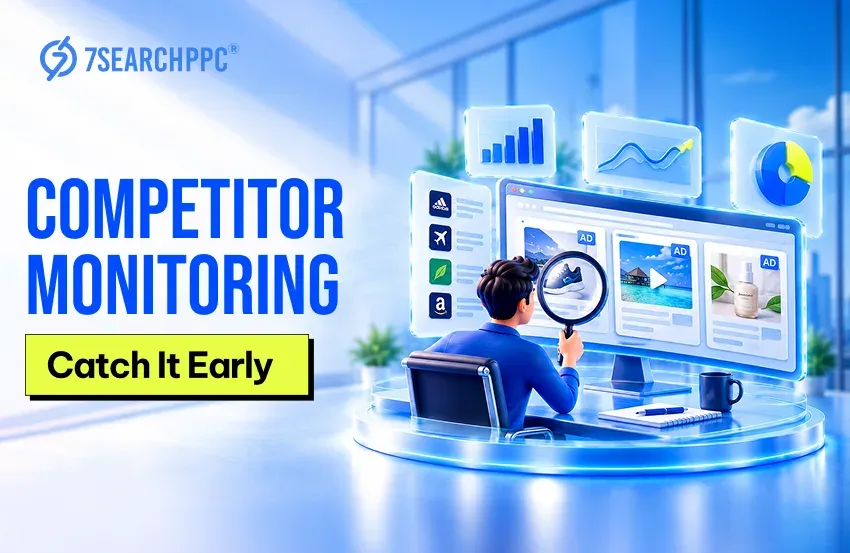
Competitor monitoring is the continuous process of tracking a competitor’s online ads, pricing, product launches, messaging, hiring, and public activity, so your team hears about changes from your monitoring system rather than from a prospect or a headline. It is often called competitor tracking, and the two terms are used interchangeably here.
The scope of the issue is larger than most US teams assume. Crayon’s 2026 research, based largely on North American B2B teams, found that seven in ten teams say at least half of their sales opportunities are now competitive, yet the average team rates its readiness for those deals just 6.3 out of 10.
That readiness gap is exactly what competitive enablement exists to close. It is a real gap, not a rounding error, given how much of the pipeline is now competitive.
Four Real Things Competitor Monitoring Catches
Good competitive monitoring catches signals relevant to the business long before they turn into a crisis. Here are four things competitor monitoring helps you spot.
- Pricing changes: A competitor cuts prices, and a salesperson learns about it only after losing the deal. An alert would have given them time to prepare.
- Feature launches: A competitor ships a feature you don’t have, and marketing keeps promoting claims that are no longer true. Monitoring flags the launch so messaging can be corrected quickly.
- Hiring patterns: A burst of job postings in a new area, such as AI engineers or enterprise sales, often signals a product shift weeks before any press release.
- Website and messaging changes: Edits to a competitor’s homepage, positioning, or pricing page often reveal a change in strategy before it is announced.
How Competitor Monitoring Helps Advertisers
Sales teams aren’t the only ones who feel the cost of missing a competitor’s move. Advertisers and marketing teams feel it too, and often sooner, because ad campaigns react to the market in real time.
Competitor monitoring gives advertisers visibility into what rivals are doing in paid advertising channels or traffic sources:
- Messaging and offers: Seeing which claims, discounts, and calls to action a competitor is running helps you avoid repeating them and find angles they aren’t using.
- Creative and landing pages: When a competitor changes their ad creative or the page it leads to, it often signals what they’re testing or what is working for them.
- Channel and budget shifts: A sudden push into a new platform, or a pullback from one, can show where a competitor sees opportunity, and where the competition for attention is getting tougher or easier.
- Timing: Competitor promotions, seasonal pushes, and launch campaigns are easier to respond to when you see them early, rather than after your own cost per click has already climbed.
The same principle from earlier applies here: a signal only helps if it reaches the right person in time. An ad team that learns about a competitor’s price cut after their campaign has gone live is already behind. One that sees it as it happens can adjust the offer, update the copy, or shift budget before performance slips.
Competitor monitoring also keeps ad claims honest. If a competitor ships a feature or changes pricing, your ads may be promoting a comparison that is no longer true. Catching that quickly protects both your credibility and your ad spend.
Why Manual Tracking Isn’t Enough Anymore
If you’re trying to track all this information manually, it’s no longer feasible. That’s why competitor monitoring tools were created.
Crayon’s 2026 research also found that internal intelligence is now cited more frequently than competitor websites: 54% cited internal intelligence compared to 48% citing competitor websites.
Despite the stakes, most US companies are still moving too slowly. Only about 56% of teams share competitive intelligence with sales weekly or faster, according to Crayon’s 2026 research — and teams that do share weekly or faster achieve revenue impact at 79%, versus 41% for teams on a monthly-or-slower cadence
That’s the exact gap competitor monitoring solutions are built to close, turning scattered signals into something a US sales team can act on inside the tools they already use.
Competitor Monitoring vs. Competitive Intelligence
Competitor monitoring and competitive intelligence are often confused, but they are two stages of the same process.
Competitor monitoring is the tracking stage. It collects signals over time, such as pricing, product changes, hiring activity, and messaging.
Competitive intelligence is the next stage. It analyzes those signals and turns them into strategic recommendations a team can act on, rather than leaving them as a list of raw alerts.
The distinction matters because many teams stop at monitoring. According to Valona Intelligence’s 2026 benchmarking, 63% of competitive intelligence teams are at an intermediate maturity stage: they have monitoring processes in place but have not yet influenced company strategy. The teams that move past that stage pair consistent monitoring with analysis that turns signals into decisions.
What to Look for in Competitor Monitoring Tools
Not all competitor monitoring tools solve the same problem, and choosing the wrong one usually means more alerts that nobody reads.
- Breadth of sources: Competitor signals now come from more than their website, so look for tools that track a wide range of sources.
- Relevance over volume: A tool that flags every minor change creates noise that teams learn to ignore; this is a major reason many competitive intelligence (CI) programs stall at intermediate maturity instead of driving real adoption.
- CRM and sales integration: Insights that live outside a rep’s daily workflow rarely get used in time; integrating with CRM and sales tools puts them where reps already work.
- Synthesis: To go beyond simple tracking, a tool must turn raw signals into clear points the team can act on.
Final Words
Competitor monitoring works best as an ongoing habit, not a one-time project. The teams that benefit most share insights quickly, keep alerts relevant, and turn raw signals into clear recommendations. Start by auditing what your team already knows about competitors, then choose a tool that fits into the systems your sales team uses every day. Review one competitor’s pricing, messaging, and hiring this week, and you will likely find something worth acting on.